Suman Tiwari, 27 October. In September 2022, a foundation stone was laid for a natural zoo at Ramwan in Birgunj. The following year, the Ministry of Forests and Environment formally designated 50 hectares of Sabaiya Collaborative Forest for the project. For a city better known for customs, commerce and cross-border trade, the proposed zoo offered an opportunity to develop a different side of its economy.
Four years after the foundation stone was laid, the pace of implementation deserves scrutiny. By June 2024, more than half of the boundary fencing had reportedly been completed, while encroachment was already complicating the work. Later reporting referred to preparation of a Detailed Project Report (DPR), although an approved DPR has not been independently verified. More recent physical progress is difficult to establish from publicly available information. An updated implementation timetable, alongside the status of the DPR and expenditure, would help clarify how the project is moving from announcement and site preparation towards construction.
The opportunity is considerable. With thoughtful planning, Birgunj could develop a destination combining family recreation, regional tourism, wildlife conservation and scientific education. The challenge is to turn an existing public commitment into an institution that remains valuable long after construction ends.
A new reason to visit Birgunj
Birgunj’s location offers an advantage that few other Nepalese cities share. Across the border lies Raxaul, connected to Bihar’s wider road and railway networks. Trade and cross-border movement have shaped the city’s economy for generations, but tourism has not developed on the same scale.
Families from Raxaul and other parts of Bihar could find a well-designed zoological park attractive for outings, school excursions and holidays.
The wider effort to promote tourism in Madhesh is already underway. Nepal Tourism Board’s Madhesh Tourism Meet in 2025 involved tourism representatives from several Indian cities, while its Madhesh Travel Mart in June 2026 promoted opportunities across Birgunj, Jitpursimara and Janakpurdham.
Yet proximity alone will not produce tourists. Affordable family tickets, school packages, Bihar-focused promotion and convenient access from Raxaul would matter. Travellers entering through Raxaul before continuing elsewhere in Nepal could provide another possible market, although its size should not be assumed.
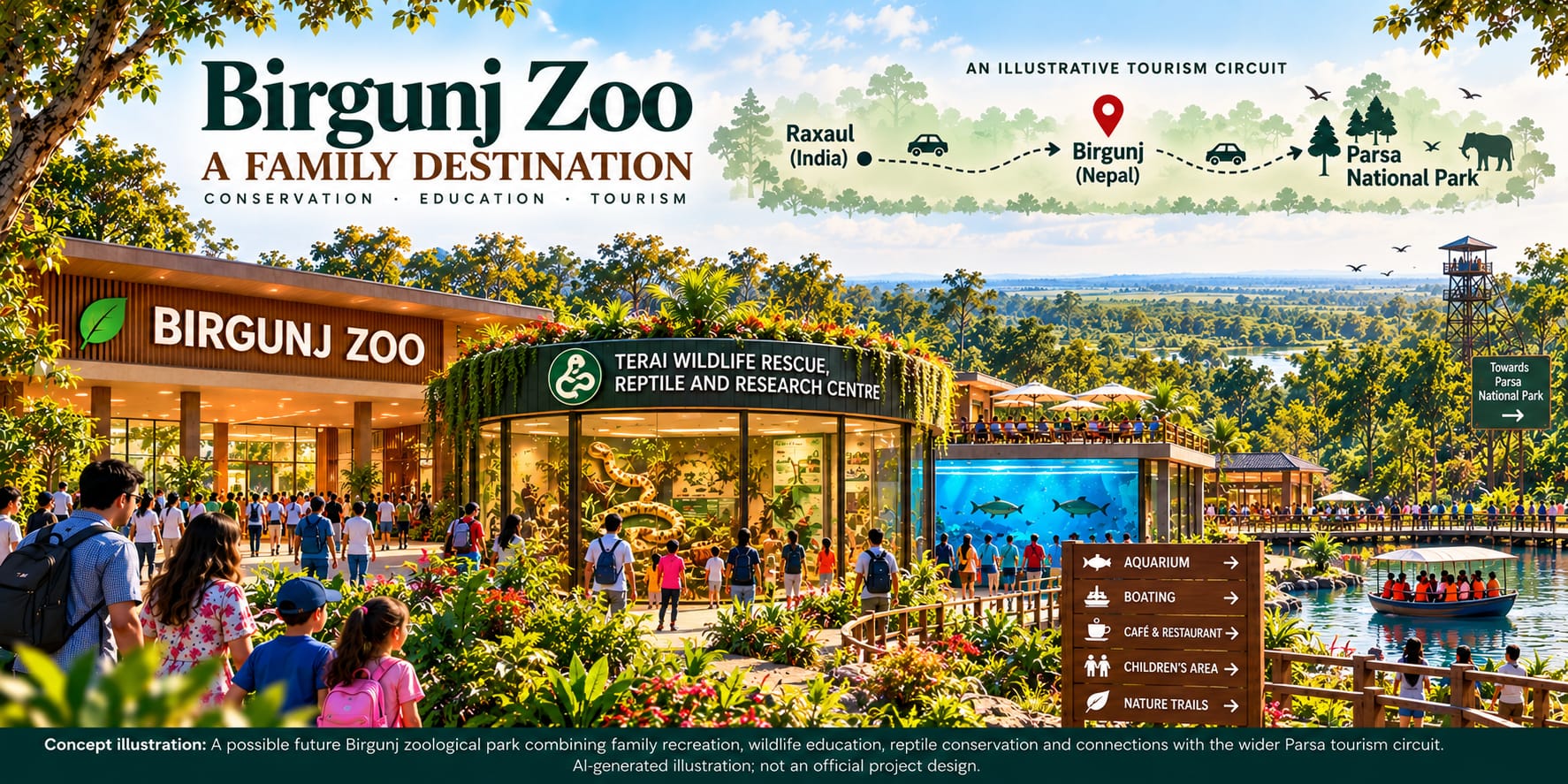
Tour operators could develop short itineraries connecting the zoo with Parsa National Park and other Madhesh attractions. The zoo could introduce families to Terai wildlife, while Parsa National Park offers the experience of wildlife in a natural setting. Longer stays could benefit hotels, restaurants, guides and transport providers, while the zoo itself could create opportunities for animal-care staff, vendors, retailers and local suppliers.
The broader aim should be to give visitors a reason to experience Birgunj rather than simply pass through it.
A destination for the whole family
The visitor experience will determine whether families return.
Shaded paths, children’s play areas, clean toilets, drinking water, accessible facilities and safe parking would make the zoo more comfortable for families. Restaurants, cafés and food kiosks could offer places to rest, while souvenir shops could sell wildlife-themed merchandise, educational materials and locally produced handicrafts.
An aquarium would add an educational attraction, introducing visitors to freshwater biodiversity and Nepal’s river ecosystems. Proper water treatment, specialist staff and suitable animal-care standards would be essential.
Boating could provide another recreational experience. Nepal’s Central Zoo at Jawalakhel already offers an aquarium and boating, demonstrating how these facilities can complement wildlife exhibits.
For Birgunj, however, boating would require a site-specific feasibility assessment. Water availability, environmental effects and long-term maintenance costs must be examined before any artificial water body is developed. Existing forest and wildlife habitat should not be sacrificed to accommodate it.
Evening activities offer a further opportunity to attract repeat visitors and earn additional income.
Dublin Zoo, for example, runs Wild Lights as a separately ticketed seasonal night-time experience alongside its regular daytime visits. Birgunj could explore illuminated walking trails, festive displays, cultural programmes and special family evenings.
Such events could bring in additional ticket and visitor-service income while creating opportunities for food vendors and seasonal workers. Lighting, noise and visitor movement would need careful management in designated areas away from sensitive animal habitats.
Schools could also become regular partners through guided visits, wildlife education and practical learning programmes. Together, these attractions would give families reasons to return throughout the year rather than visit only once.
A conservation identity rooted in the Terai
Recreation should be matched by a serious conservation purpose.
The original proposal included a wildlife hospital, placing veterinary care within the project’s plans from the beginning. A specialist Terai Wildlife Rescue, Reptile and Research Centre could build on that idea, giving Birgunj a conservation role closely connected to its surroundings.
Snakes are part of the Terai’s natural environment, but encounters with venomous species can have serious consequences. A population-based study published in The Lancet Global Health in 2022, involving more than 63,000 people across the Terai, highlighted the substantial burden of snakebite.
A dedicated centre could help visitors learn about common native reptiles, understand their ecological roles, avoid dangerous encounters and recognise the importance of prompt medical treatment after snakebite.
It could also support authorised wildlife rescue, rehabilitation, quarantine and veterinary care in cooperation with Parsa National Park and other conservation authorities.
Partnerships with universities and specialist institutions could support research into reptile ecology, habitats and, where scientifically justified, venom. Such work would require qualified personnel, regulatory permission and dedicated funding.
The centre should not be presented as a hospital treating human snakebite patients or an antivenom manufacturing facility. Its immediate contribution would be conservation, education, professional wildlife care and carefully governed scientific work.
This specialist focus could give Birgunj Zoo a distinctive identity among regional attractions.
Lessons from other zoos
The proposed 50-hectare site is substantial. Across the border, the Shaheed Ashfaq Ullah Khan Zoological Park in Gorakhpur occupies approximately 49 hectares, offering a useful comparison of scale.
Similar land areas do not mean identical development possibilities. Encroachment has been reported on part of Birgunj’s proposed site. Clear demarcation and long-term protection of the designated land should therefore precede major construction. The latest survey and environmental assessment should guide the layout, protecting existing vegetation, drainage and wildlife habitat. The 50-hectare site provides substantial room, but the master plan should also preserve ecological buffers and, where feasible, options for future expansion rather than filling every available space.
Nepal’s Central Zoo offers another lesson. Managed by the National Trust for Nature Conservation (NTNC), it attracts more than one million visitors annually and combines wildlife exhibits with recreation and education.
That demonstrates the appeal of an established zoo, although Birgunj should not assume comparable attendance. Kathmandu and Birgunj have different populations, transport connections and visitor patterns.
NTNC’s management experience is relevant, but any involvement in Birgunj would require a separate agreement. The responsibilities of Parsa National Park, Birgunj Metropolitan City and other authorities should be clearly established before the zoo opens.
Who will pay for it?
The project’s financial history makes this question particularly important.
When the foundation stone was laid in 2022, a Department of National Parks and Wildlife Conservation official estimated the project at around NPR 1.1 billion. More recent official information on the project’s expected cost and financing is difficult to establish publicly, strengthening the case for an updated estimate and financing plan.
Government funding will remain important for core infrastructure and conservation responsibilities. Local and provincial authorities could support access roads, utilities and tourism promotion, subject to their respective mandates and budgets.
Restaurants, cafés, souvenir shops and other visitor services could operate through transparent private-sector concessions. Ticket sales, memberships, sponsorships and seasonal events could provide additional income.
Partnerships with NGOs, INGOs, conservation foundations, universities and research institutions could also be explored for defined programmes such as wildlife rescue, habitat restoration, conservation education and research. None should be treated as a guaranteed source of funding.
Development could proceed in stages. Wildlife facilities, veterinary care, visitor access and basic amenities could come first. An aquarium, boating and other specialised attractions could follow if feasibility studies, financing and visitor demand justify them.
Most importantly, the zoo must have a dependable operating budget after construction. Animal welfare, veterinary care, trained staff and habitat maintenance require continuing expenditure, regardless of ticket sales. Animal welfare and visitor safety must remain non-negotiable. Enclosures, barriers, access controls and emergency arrangements should protect both visitors and animals, while boating, aquarium and evening activities would require appropriate safety measures of their own.
The operating arrangement is equally important. The authority responsible for construction may not be the institution best equipped to manage animal care, commercial concessions and research partnerships. A clear agreement should establish who operates the zoo, who funds recurring costs and who is accountable for its performance.
The public also deserves updated information on the DPR, environmental approvals, expenditure, construction progress and financing commitments. Greater transparency would make it easier to judge how far the project has advanced and whether it has a viable path towards completion and operation.
A zoo worth having
Land has already been designated and preliminary work has begun towards a natural zoo in Birgunj. The task now is to turn that commitment into an institution that people will value and authorities can sustain.
A well-planned destination could attract families from Madhesh and Bihar, offer an aquarium, boating and evening attractions, support local businesses and create employment. A specialist reptile and wildlife centre could give the project a conservation purpose closely connected to the Terai.
Those ambitions will succeed only with realistic financing, sound environmental planning, professional management and sustained attention to animal welfare.
Birgunj does not need a zoo merely because one was announced. It needs an institution worthy of the land, public investment and expectations attached to that decision.
The real question is not simply when Birgunj will get its zoo, but whether it will get one worth having.
About the author
Suman Tiwari is a cybersecurity professional and writer based in Ireland. His articles explore technology, public policy, digital governance and issues affecting Nepal and its wider region.