Basu’s corpse would be turning in his grave with Mamata unleashing tandav in West Bengal.
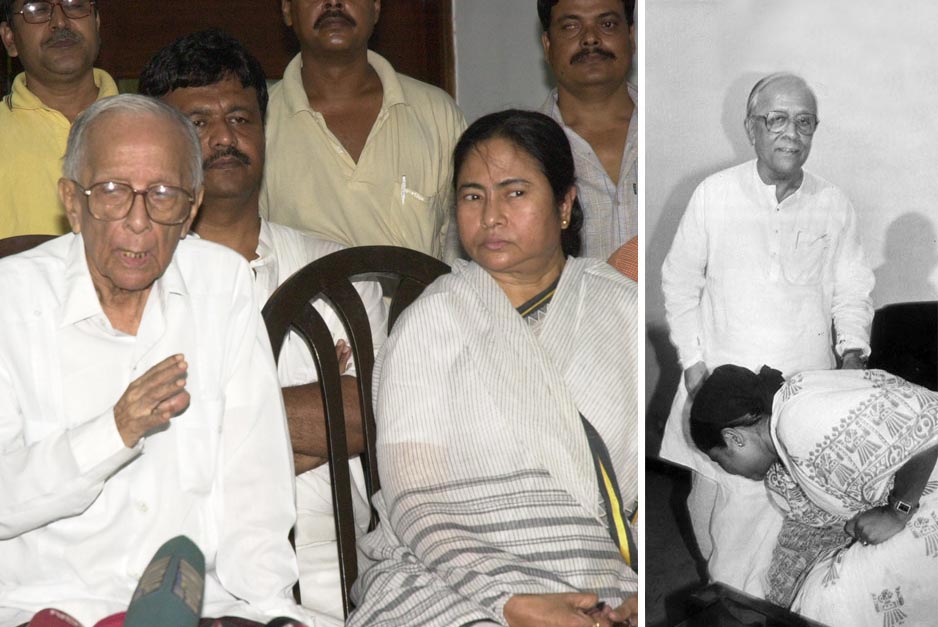
Vivekanand jha, Ranchi. With the scenario in West Bengal deteriorating to such an extent that the demand for the President’s rule is so vociferously sought to be imposed by the BJP. Will BJP hand over a walkover to Mamata by imposing the president’s rule just before the impending state election of West Bengal?
Mamata Banerjee, perhaps never looked as chastened as she looks today–the lioness of West Bengal who had little qualms in dancing on the bonnet of the car, in the wake of the demise of great Jayprakash Narayan to please her boss Indira Gandhi—today appears subdued, far withdrawn from her own flamboyance, recoiled in her shell, obediently complying with the instructions of her aid Prashant Kishor—Prashant, in his interview with Karan Thapar, had made his choice clear that he would prefer to be designated as an ‘aide’. But the bigger question her attitude conveys is this: Why would Mamata, an intrepid leader, who hardly gave two hoots anyone, suddenly metamorphosed into a pussy cat- politician who thinks someone understands politics better than her? Especially when Mamata would scoff at the remotest of insinuation that anyone understood the pulse of Bengalese better than her; when,
far from recognising anyone at par with her own persona, she had so
condescendingly ignored the advice tendered to her by close aids to pay a visit to the corpse of Jyoti Basu, would so amicable settle for following someone’s advice, especially when Prashant, her troubleshooter, hardly is known to have the grassroot experience of West Bengal politics, defies all logic and self- belief. But then the prospect of defeat in the upcoming Assembly election and losing power, carries the ghost of letting the pigeons among the cats, which resulted in Mamata’s mellowing or purportedly her changed attitude in public. But then isn’t it too late for Mamata’s so- called transformation of her behaviour when the grounds appear to be slipping fast from beneath her feet? Has not Mamata, in her power intoxication, forgotten to learn the lessons from Jyoti Basu’s inglorious political career that towered over West Bengal for decades, yet got quickly erased soon after his leaving the public life?
Jyoti Babu, as he was publicly addressed, was, unequivocally, a
phenomenon in West Bengal politics for decades. Unequivocally, the
prestige that Jyoti Babu had enjoyed in Bengal politics, remains
unmatched in provincial politics across India. In fact, Jyoti Basu’s
clout in the party apparatus rose significantly after the demise of
Pramod Dasgupta, the state chief of CPIM. Pramod Dasgupta, an upright party organiser had been ideologically scrupulous inasmuch as he had never visited Writer’s Building during his life- time, remaining confined within the walls of the Alimuddin street of Communist headquarter of the state. In the wake of demise of Pramod Dasgupta, his protegis like Buddhadev, Anil Biswas and Biman Bose rose in prominence. However the death of Pramod
Dasgupta had provided Basu with the licence of towering over the
polity both as an administrator of the state as well as the man whose
influence over the party organisation too was unquestionable.
Significantly, Basu’s numero uno status in the state resulted in his
initiating several reforms–the first and foremost being that of land
reforms where the equitable distribution of land to a substantial
proportion entrenched the Communist in the state for decades. While
Basu’s rule ushered in the rural reforms, his devastating role in the
education sector that eventually witnessed the large scale penetration
of Communist cadres in the schools, colleges and universities,
invariably contributed to the emasculation of the education sector in
the state. Worse still, the Jyoti Basu regime presided over the
funeral of the industrialisation in the state. ‘Lal Jhada’, ‘Kalo
Haath bhengay dao, were the slogans that ruled the state. No wonder
the state that was the paradise of the industries during Bidhan
Chandra Roy’s tenure was so unabashedly reduced to its graveyard.
Regrettably, Calcutta, the bastion of intellectuals, was so systematically reduced to be a spectacle of colourful processions: in fact, no day would go blank when the denizens of the great city would not watch the people with Lal Jhanda stalking the roads with sloganeerings:’ Duniyar majdoor aek ho'( let the labour from the world be united), ‘Inquilab zindabad'(Hail the revolution). For a
child like us then, it would offer us a great source of entertainment.
But then Communists had insulted the Bengali psyche in no ambiguous term–the long standing belief of the Communist that Netajee was a ‘burjua’–I am yet to know the actual significance of the term, apart from inferring that he was perceived by the communist as the agent of capitalist and fascist forces–was atoned by Basu’s famous observation of seeking mass pardon for insulting Netajee’s memory by calling him burjua. The complete strangulation of industrialisation in the state had resulted in the flight of Bengali talent; the deluge of talented people making a beeline for the metropolises like Mumbai and Delhi became the new norm. Moreover, Basu’s biggest hypocrisy was for all to see: While the sons and daughters of the Communsit leaders would send their children to the English medium schools and colleges, the mass was left to fend for themselves–to study in Bengali medium where English was taught
from 7th standard Ironically, while Basu’s prescription for the
masses was to follow Gurdev Tagore–He had instructed that elementary education should be based on mother tongue–Basu’s son Chandan Basu studied in St. Xaviours school and college. Interestingly, while Basu did nothing tangibly good for the state other than infiltrating the state with the ideology of Communist party, yet he remained extremely popular till he presided over the affairs of the state for the reason best known to the people. Yet, one discernible trend that was visible to me in Calcutta during those days was the dominance of Bhadralok and Bhadra Mahila in multiple aspects of life, if not in all dimensions.
Buddhadev Bhattacharjee, the most visible face to succeed Basu, had a fallout with his party, hastening his unceremonious departure from the government, prompting his daughter to say, ‘ Amar Baba oe chorer dale kono din phirbay na( My father will never return to the gang of thieves) But then one fine morning Buddhadev, eating his own words returned to party for taking over the reign from Basu. The Party too had its own compulsions: Buddhadev was the perfect mascot to succeed the sophisticated Basu. Incidentally, Buddha’s elevation as the Chief Minister of the state had a price tag attached to him: He was no Jyoti Basu and consequently had no free hand to deal with the affairs of the state–the constant power struggle with Alimuddin street from his comrades Anil Biswas and Biman Bose was the limitation within which he tried to manoeuvre. Anil Biswas, in those days, was the most powerful leader with whom Buddhadev had to constantly lock horns, yet he convinced them for some urgent policy changes. No wonder Buddhadev introduced a remarkable change in education policy by advancing English from class 3rd onwards. This apart, Buddhadev, unlike his predecessor, sincerely strived for re- industrialising the state; however, his valiant effort to bring Tata to Singur and Nandigram, simply backfired, with Mamata Banaerjee taking advantage of her Biplabi( revolutionary) image undid all the good Buddhadev was seeking to do, albeit at the eleventh hour with all his desperation. Thus ended the long innings of Communist rule of almost three decades in West Bengal, and brought Mamata Banerjee as the new messiah in West Bengal politics.
The dawn of a new era of Mamata Banerjee was a perpetration of a bigger fraud upon the people of West Bengal. The glory of Bhadralok and Bhadra Mahila took the immediate back seat, with hooliganism of humongous magnitude replacing the goondaism of the communist party. The size and magnitude of corruption almost rose ten times with the nature of flags changing hands—Many of the communist cadres switched sides in no time, while those remaining with the party faced the hardest time in their lives: The letting loose of the bloodhounds by Mamata, striking wherever communists had their symbolic presence, burning their offices and slapping random cases at them, were the most savagious nature of retribution unleashed at the opponents the degree of which were hitherto unseen in the country. Mamata’s visceral hatred for Communists manifested itself in all its dimensions, causing a dread in the heart of her opponents, so much so that she began to perceive as the supremacist leader of West Bengal at whose beck and call the entire state was. Such was the degree of terror instilled in the hearts of the opponents that none could dare raise a voice of protest against her various omissions and commissions. Interestingly, with the banishment of Communists from the public gaze, Mamata, in all her wisdom, systematically sought to cement her Muslim vote bank as a tactical ploy to keep hold on to power, went for an immediate makeover: From Mamata Banerjee she metamorphosed into a Mamata begum. Here too, Mamata had made a strategic calculation: With Hindu votes–both Bengali and Non- Benglai seldom voting for a particular party–Mamata, seemingly enamoured of cornering votes of Muslims to her kitty, went gaga over playing the minority appeasement policy. The policy that paid Congress rich dividends for decades, became Mamata’s milch cow. Also, the monolithic Muslim vote bank, comprising of more than 30 percent of votes, was the immediate lure for her to portray her image as Mamata Begum. Moreover, emboldened by her success, and drawing inspiration from neighbouring Laloo, while putting to shreds the last vestiges of the Bengali pride and wisdom, designated her own nephew, Abhishek Banerjee as her successor, driving out Mukul Roy, the number two in her party, who finally took refuge in BJP. No wonder the exponential rise of BJP in the 2019 general election was the vindication of Mamata losing plot in West Bengal, and BJP, enriched by the gain of strategist Mukul Roy, was going great guns in the state. Small wonder then, the 2021 Assembly election was the eye opener for Mamata Banerjee where even protecting her own turf from eventual BJP’s invasion, is a daunting challenge in view of BJP’s going gung ho with its confidence level at an all time high.
But then Mamata committed a Himalyan blunder, a blunder that triggered the eclipse of Congress Party in the past, and the messianic rise of BJP–insulting Shri Ram, the soul of Bharat Varsha. Rajiv Gandhi’s historic blunder to open the locks of Babri mosque in 1987 to play Hindus against Muslims, had caused Congress so dearly that it is presently locked in the comatose state, propelling the resurgence of BJP, a party of two MP’s then. Mamata’s visceral distaste for Ram, if not antagonism for Him, which came in the public domain a few months ago, when giving two hoots to her chief ministerial dignity, she chased and had sworn expletives at the youths who had sought the slogan of Jai Shri Ram. Like a bloodhound, Mamata, in full public view, as if being severely censured, made a big public spectacle of herself. No wonder the fact became obvious to one and all: Mamata is being paranoid at BJP’s coining of ‘Jai Shri Ram’ and, therefore, was going berserk in a show of her maddening frenzy. Unmindful of her own political vulnerability, Mamata invited BJP to cash in on her vexation for Shri Ram, which BJP shrewdly realised would deliver it the long term political dividend in the upcoming Assembly election of 2021.
The latest episode of Mamata’s formidable gaffe wherein she had revoked her own order of lockdown on Saturday, on account of Bakrid, a Muslim festival, especially after she had officially declared Saturay and Sunday as the official days of lockdown, when she had seldom cared for any Hindu festival like Hindu new year on 14th April or any other day, while it definitively owns her the Muslims’ delight, she, unequivocally has ended up offending the majority of Hindus. Worse still, her unwise, paranoid declaration of 5th of August, the day the grand Bhoomie pujan will be organised at Ayodhya, at the Sanctum Sanctorum of Ram Lala, is rubbing salt to the wound of Hindu sentiment. ‘Are we living in Pakistan’, Bengali Hindu chorused at this paranoid decision of Mamata Banerjee government. Surely but definitively, Mamata in her paranoia, has only helped to bolster the BJP’s stand: Mamata is pro Muslim while being against Hindu sentiments. Unfortunately, where Mamata ought to have shown her political sagacity, she ended up trapped in the net of BJP. Willy nilly, Mamata has provided further ammunition for BJP to fire at her. Small wonder what BJP wanted, Mamata has provided it on a platter. Has she written her own political obituary, only time will say, but one thing is certain: she has ended up alienating scores of Hindus–both Bengali and non- Bengali –by her antics. Regrettably, Mamata has forgotten that Shri Ram is the soul force of the nation and this fact was articulated by none other than Swami Vivekananda.
Significantly, Mamata’s own elephantine ego is boomeranging on her. In the wake of Jyoti Basu’s demise, when all her aides advised her to visit the patriarch’s corpse, she bluntly stood her ground. Also, she failed to take lessons from the decades old government of Basu that, so long as he remained on to power, Basu was the darling of the masses, especially the favourites of Bhadralok and Bhadramahila; however the moment he is gone, Basu is a forgotten figure today, rarely does someone discuss about him, for he failed to leave any legacy for the posterity, except for the fact that he left only Nandan, the theatre hall and his son Chandan. Mamata too, once she exits from power, she will be remembered only for her paranoia for Jai Shri Ram, for being Mamata Begum and for imposing a dynasty on the most literate people of the state. After all, Basu at least had no audacity to designate his son Chandan Basu as his successor, Mamata going a step further, had so blatantly designated her own nephew Abhishek Banerjee as her successor. Furthermore, Mamata had lost the sight of Congress being sent into a comatose state for insulting Shri Ram, she too, had committed the blasphemy by insulting Shri Ram, the soul force of this great nation. How the Hindus will react to his blasphemy is to be seen in the year 2021 to this insulty of the soul of Bharat Varsha ?