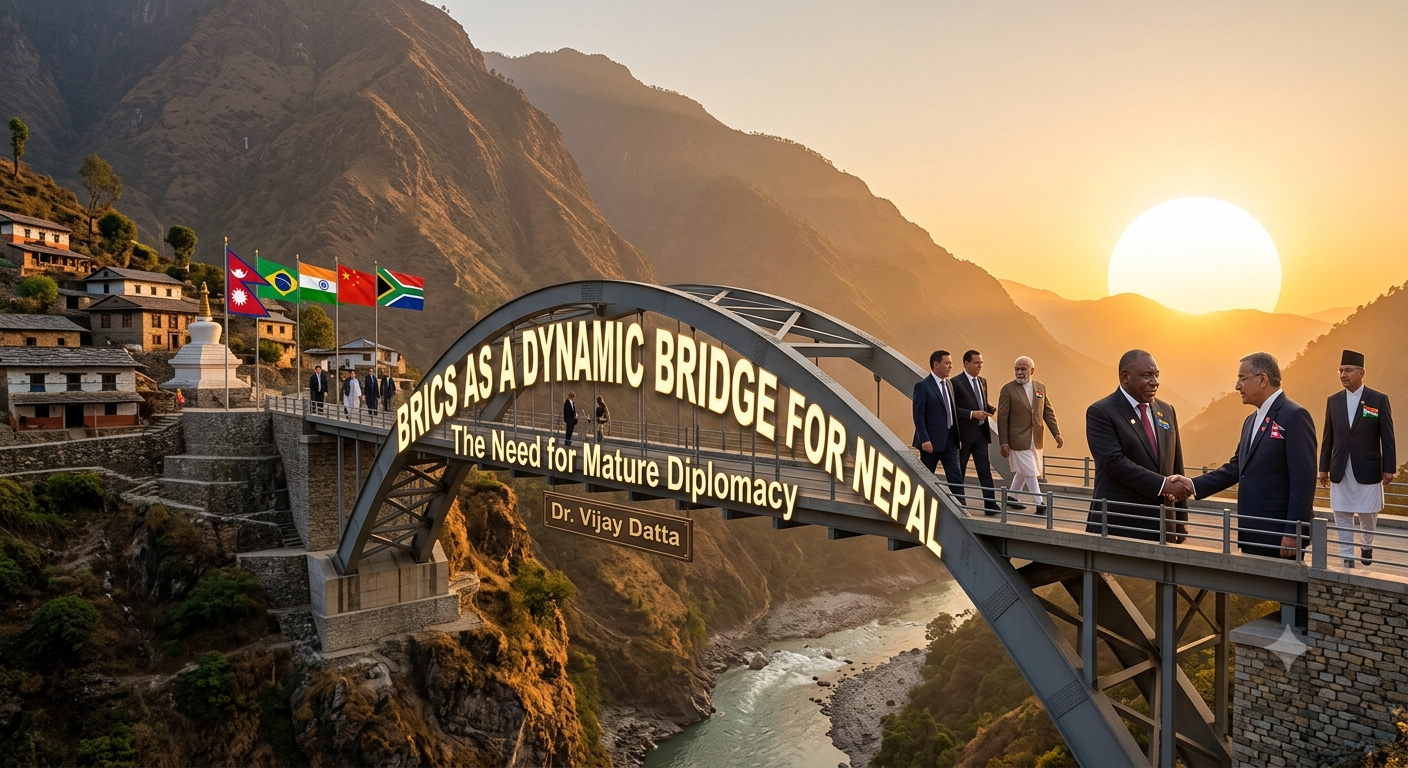
Dr. Vijay Datta, 13th September. The recently concluded 18th BRICS Plus Summit in New Delhi, India,along with the unanimously adopted 140-point “New Delhi Declaration”,has charted a far-reaching direction for global politics and the economy. On the sidelines of the summit, bilateral talks between the Chinese President and the Indian Prime Minister featured terms like “long-term development” and “strategic perspective,” signaling the dawn of a new era of competitive cooperation between the two neighboring powers.
For a least developed nation like Nepal, emerging from a prolonged transition and political instability, this new regional dynamics is not a time to falter in hesitation. Instead, it presents a decisive opportunity to secure maximum national benefit through mature diplomacy.
1. *Key Dimensions of the BRICS New Delhi Declaration*
Spanning 45 pages and 140 points, the New Delhi Declaration prioritizes the interests of the Global South, a multipolar world order, and sustainable economic recovery:
Local Currency Trade & Financial Systems: An agreement to reduce reliance on the US dollar by promoting trade in local currencies and developing cross-border payment systems among member states.
Multilateral Institutional Reforms: Calls to enhance the role of nations like India and Brazil in the UN Security Council (UNSC) and revive the World Trade Organization’s (WTO) dispute settlement mechanism.
Energy Security & Green Transition: Joint investment and partnerships in renewable energy, technology transfer, and sustainable energy transformation.
Technology, AI, and Digital Infrastructure: Capacity building for developing countries through Artificial Intelligence (AI) and Digital Public Infrastructure (DPI).
Opposition to Unilateral Tariffs & Protectionism: Strong opposition to unilateral tariffs and economic sanctions that disrupt global trade.
2. *What Does the New BRICS Paradigm Offer Nepal ?*
Nepal stands to gain significantly, both directly and indirectly, from the expanded BRICS+ framework and its policy directions:
Access to Investment via the New Development Bank (NDB): Through membership or partnership with the NDB, Nepal can secure concessional loans and grants for mega-projects in hydropower, road networks, and urban infrastructure.
Regional Connectivity & Trilateral Trade: As India and China streamline cross-border trade and transit, Nepal has the opportunity to evolve into a vital trade node connecting both nations through a Trans-Himalayan network.
Financial and Digital Tech Transfer: The BRICS emphasis on cross-border payment systems and the expansion of technologies like UPI will directly ease Nepal’s tourism, commerce, and foreign trade.
Climate Finance & Green Energy Partnerships: With BRICS prioritizing global climate funds and green tech, Nepal can more easily adopt clean energy technologies and access climate adaptation funds.
3. *Diplomatic Finesse*: Navigating the Alliance or Rivalry of Two Giants
A traditional Nepali proverb warns: “Whether two elephants fight or make peace, it is the grass underneath that suffers.” In the past, domestic leaders exploited the trust deficit between our two neighbors for short-term political gains, trapping the country in a vicious cycle of underdevelopment and dependency.
Nepal must now rise above the paranoia that a Sino-Indian accord will sideline us, or that their rivalry will crush us. As both neighbors align strategically, doors open for Nepal to expand cross-border trade, energy commerce, and trilateral cooperation.
4. *From a ‘Dynamic Bridge’ to a ‘Prosperous Nation’*
The new generation and current leadership must recognize a fundamental reality: true national dignity on the global stage is impossible without high, sustainable economic prosperity and astute soft power. To achieve this, the following steps must be taken immediately:
Prioritize Economic Diplomacy: Integrate Nepal’s infrastructure, tourism, and hydropower potential with the economic momentum of our neighbors.
Abandon the Transitional Mindset: Modernize our non-aligned foreign policy into a doctrine of ‘Active Equilibrium’ and pragmatic diplomacy anchored strictly in national interest.
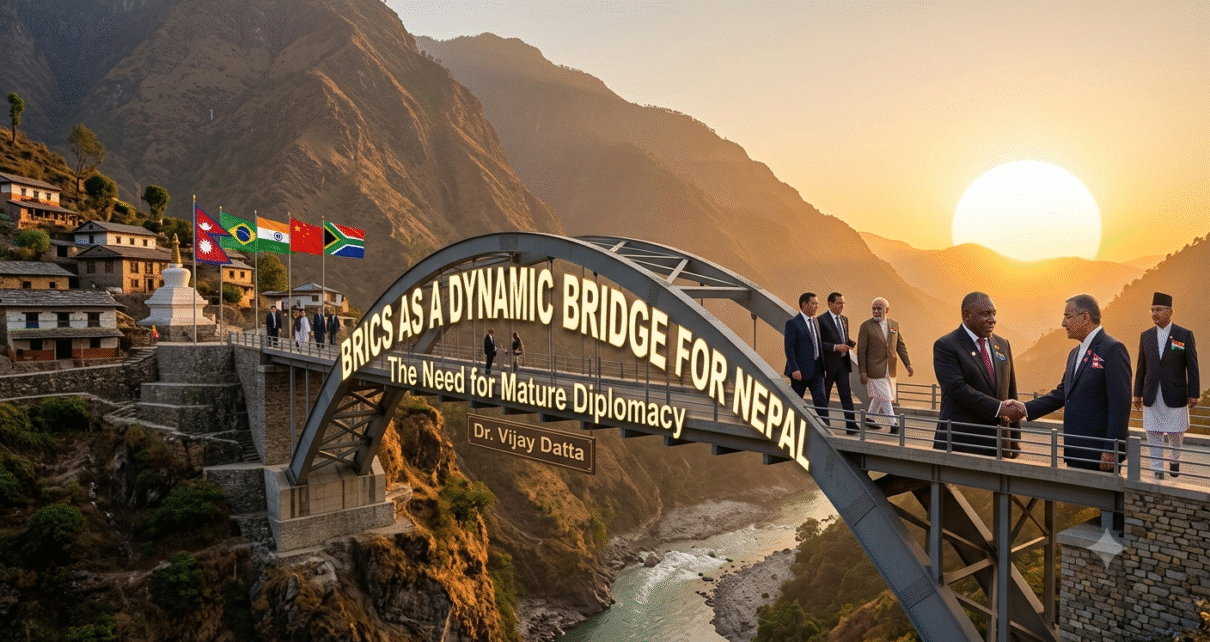
Realize the ‘Dynamic Bridge’ Concept: Transform Nepal into a secure, trans-Himalayan transit corridor that links China’s Belt and Road Initiative (BRI) with India’s regional infrastructure networks.
Establish Identity as a Safe, Neutral Haven: Instill absolute confidence in both neighbors that Nepal is a entirely reliable, neutral, and peaceful buffer zone regarding their security interests.
The dialogue and strategic understanding between our two massive neighbors have opened a wide window of opportunity that Nepal must harness as an engine for its own prosperity. This juncture demands vision, prudence, and bold diplomatic initiatives. Through mature diplomacy, Nepal must seize this golden opportunity.
Nepal be never trick as *परोक्षे कार्य हन्तारं,प्रत्यक्षे प्रियवादिनी च ।*
The recently concluded 18th BRICS Plus Summit in New Delhi, India,along with the unanimously adopted 140-point “New Delhi Declaration”,has charted a far-reaching direction for global politics and the economy. On the sidelines of the summit, bilateral talks between the Chinese President and the Indian Prime Minister featured terms like “long-term development” and “strategic perspective,” signaling the dawn of a new era of competitive cooperation between the two neighboring powers.
For a least developed nation like Nepal, emerging from a prolonged transition and political instability, this new regional dynamics is not a time to falter in hesitation. Instead, it presents a decisive opportunity to secure maximum national benefit through mature diplomacy.
1. *Key Dimensions of the BRICS New Delhi Declaration*
Spanning 45 pages and 140 points, the New Delhi Declaration prioritizes the interests of the Global South, a multipolar world order, and sustainable economic recovery:
Local Currency Trade & Financial Systems: An agreement to reduce reliance on the US dollar by promoting trade in local currencies and developing cross-border payment systems among member states.
Multilateral Institutional Reforms: Calls to enhance the role of nations like India and Brazil in the UN Security Council (UNSC) and revive the World Trade Organization’s (WTO) dispute settlement mechanism.
Energy Security & Green Transition: Joint investment and partnerships in renewable energy, technology transfer, and sustainable energy transformation.
Technology, AI, and Digital Infrastructure: Capacity building for developing countries through Artificial Intelligence (AI) and Digital Public Infrastructure (DPI).
Opposition to Unilateral Tariffs & Protectionism: Strong opposition to unilateral tariffs and economic sanctions that disrupt global trade.
2. *What Does the New BRICS Paradigm Offer Nepal ?*
Nepal stands to gain significantly, both directly and indirectly, from the expanded BRICS+ framework and its policy directions:
Access to Investment via the New Development Bank (NDB): Through membership or partnership with the NDB, Nepal can secure concessional loans and grants for mega-projects in hydropower, road networks, and urban infrastructure.
Regional Connectivity & Trilateral Trade: As India and China streamline cross-border trade and transit, Nepal has the opportunity to evolve into a vital trade node connecting both nations through a Trans-Himalayan network.
Financial and Digital Tech Transfer: The BRICS emphasis on cross-border payment systems and the expansion of technologies like UPI will directly ease Nepal’s tourism, commerce, and foreign trade.
Climate Finance & Green Energy Partnerships: With BRICS prioritizing global climate funds and green tech, Nepal can more easily adopt clean energy technologies and access climate adaptation funds.
3. *Diplomatic Finesse*: Navigating the Alliance or Rivalry of Two Giants
A traditional Nepali proverb warns: “Whether two elephants fight or make peace, it is the grass underneath that suffers.” In the past, domestic leaders exploited the trust deficit between our two neighbors for short-term political gains, trapping the country in a vicious cycle of underdevelopment and dependency.
Nepal must now rise above the paranoia that a Sino-Indian accord will sideline us, or that their rivalry will crush us. As both neighbors align strategically, doors open for Nepal to expand cross-border trade, energy commerce, and trilateral cooperation.
4. *From a ‘Dynamic Bridge’ to a ‘Prosperous Nation’*
The new generation and current leadership must recognize a fundamental reality: true national dignity on the global stage is impossible without high, sustainable economic prosperity and astute soft power. To achieve this, the following steps must be taken immediately:
Prioritize Economic Diplomacy: Integrate Nepal’s infrastructure, tourism, and hydropower potential with the economic momentum of our neighbors.
Abandon the Transitional Mindset: Modernize our non-aligned foreign policy into a doctrine of ‘Active Equilibrium’ and pragmatic diplomacy anchored strictly in national interest.
Realize the ‘Dynamic Bridge’ Concept: Transform Nepal into a secure, trans-Himalayan transit corridor that links China’s Belt and Road Initiative (BRI) with India’s regional infrastructure networks.
Establish Identity as a Safe, Neutral Haven: Instill absolute confidence in both neighbors that Nepal is a entirely reliable, neutral, and peaceful buffer zone regarding their security interests.
The dialogue and strategic understanding between our two massive neighbors have opened a wide window of opportunity that Nepal must harness as an engine for its own prosperity. This juncture demands vision, prudence, and bold diplomatic initiatives. Through mature diplomacy, Nepal must seize this golden opportunity.
Nepal be never trick as *परोक्षे कार्य हन्तारं,प्रत्यक्षे प्रियवादिनी च ।*