

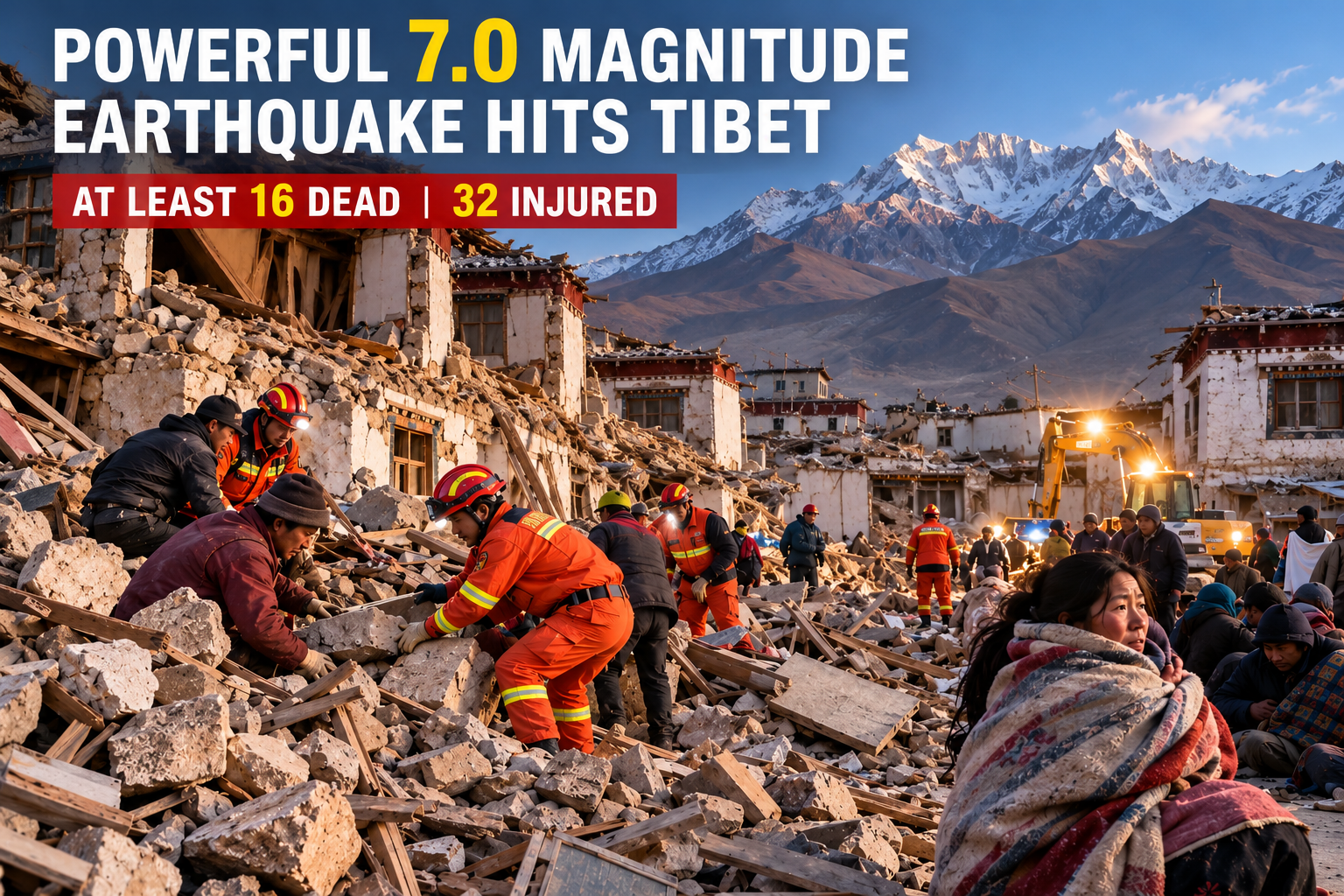
Hundreds of homes collapse as rescue teams race against time in the high-altitude region
TIBET, October 23, 2026 — A powerful magnitude 7.0 earthquake struck China’s Tibet Autonomous Region late Thursday night, killing at least 16 people and injuring dozens, according to initial reports from Chinese state media. The earthquake caused widespread destruction in the northern city of Nagqu, where hundreds of homes and livestock shelters collapsed.
The death toll and number of injured may change as rescue operations continue and authorities assess the full extent of the damage. Reuters initially reported 32 injured, while a subsequent Associated Press report put the number at 46. <Cite refs={[“turn928559news12″,”turn928559search4”]}/>
Shallow Earthquake Shakes Northern Tibet
The earthquake struck at approximately 10:33 p.m. local time on October 22. According to China’s earthquake monitoring authorities, its epicentre was in Baqing County, within the Nagqu region of northern Tibet.
The China Earthquake Networks Center initially placed the earthquake’s depth at approximately 10 kilometres, while the United States Geological Survey (USGS) estimated it at around 18 kilometres. The epicentre was located in a sparsely populated, high-altitude area, roughly 400 kilometres from Lhasa, the Tibetan capital. <Cite refs={[“turn928559news12″,”turn928559search3”]}/>
The powerful tremor sent residents rushing out of their homes in fear. Videos broadcast by Chinese state media showed people gathering outdoors and seeking safety in vehicles as buildings shook.
Hundreds of Buildings Destroyed
The earthquake caused extensive damage to residential buildings and other structures. Local authorities reported that at least 339 homes and 20 livestock sheds had collapsed.
The destruction has raised concerns about the safety of residents in remote mountain communities, where access to emergency services can be difficult. Families whose homes have been destroyed face an urgent need for temporary shelter, food, warm clothing and medical assistance.
More Than 1,600 Personnel Deployed for Rescue Operations
Emergency response teams have been mobilised across the affected region. According to reports from Chinese state media, more than 1,600 local personnel have been deployed to assist with search-and-rescue operations and provide emergency support.
Authorities have also arranged relief supplies, including approximately 1,000 prefabricated housing units and 3,000 tents, along with beds, flashlights and winter clothing.
Rescue workers are continuing to assess damaged buildings, assist injured residents and help displaced families move to safer locations. The difficult terrain and cold weather could complicate relief efforts in the coming days. <Cite refs={[“turn928559news13″,”turn928559search4”]}/>
Roads and Transport Services Disrupted
The earthquake also affected transport and communication infrastructure. Rockfalls forced authorities to close a section of National Highway 317, allowing access primarily to emergency and rescue vehicles while debris was being cleared.
Local railway authorities also took emergency measures to halt trains passing through the affected area. Communication services in some locations were reported to be disrupted, adding to the challenges facing rescue teams and residents.
Weather forecasts indicating intermittent snowfall over the next three days could further complicate rescue operations and the delivery of relief supplies. <Cite refs={[“turn928559news13″,”turn928559search4”]}/>
Aftershocks Raise Further Concerns
Several aftershocks measuring between magnitude 3 and 4 were reported following the main earthquake. Such tremors are common after major seismic events and may pose additional risks to buildings already weakened by the initial shock.
Residents have been urged to remain cautious around damaged structures. Authorities will need to assess the stability of affected buildings before people can safely return to their homes.
A Reminder of the Himalayan Region’s Seismic Risk
The earthquake has renewed attention to seismic hazards across the Himalayan region, which includes Tibet and neighbouring Nepal. The region is geologically active because of the continuing interaction between the Indian and Eurasian tectonic plates.
Although the earthquake has highlighted the vulnerability of mountain communities, it does not mean that another major earthquake is imminent in Nepal. Scientists cannot reliably predict the exact timing and location of a future earthquake based on a single event.
Experts have repeatedly emphasised the importance of earthquake-resistant construction, emergency preparedness, public awareness and effective disaster-response systems to reduce casualties and damage during major seismic events.
Rescue Efforts Continue
Authorities are continuing search-and-rescue operations, assessing structural damage and providing assistance to affected residents. The final casualty figures and the overall economic impact remain subject to further official updates.
The disaster underscores the importance of rapid emergency response and adequate preparedness in remote mountainous areas, where difficult terrain and harsh weather can make rescue operations particularly challenging.
Source: Reuters, Associated Press, Xinhua and official earthquake monitoring authorities.
— Himalini Online