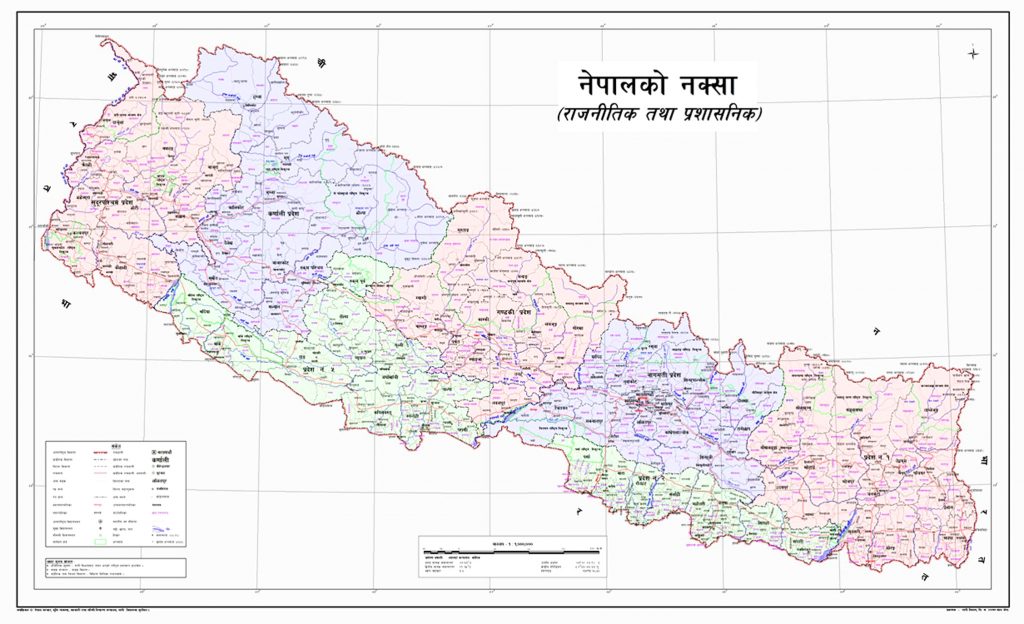
Dr. Geeta Kochhar Jaiswal /Murlimanohar Tiwary. On June 13, many Nepalese rejoiced the passing of a new map of Nepal in the lower house of the Parliament with almost full consensus, with few members not present and a strong objection from MP Sarita Giri. Many termed it as ‘history being made’. There remains few formalities of passing in the National Assembly (meeting due on June 18th) where Nepal Communist Party (NCP) has the majority and then the final approval of the President. There is now little doubt the process will be stalled in any manner on the pretext of a dialogue with India. However, there are serious and critical issues that need to be unravelled to comprehend what led to this complexity in India-Nepal relations. The issue is also whether this is a real success for Nepali citizens or it only caters to few vested interest groups? What is the role of other actors in the region, i.e. China and Pakistan?
There is a vociferous narrative floated in Nepal for citizens consumption that the territories Kalapani, Lipu Lekh, and Limpiyadura belong to Nepal since the 1816 Sugauli treaty, the reason cited for the current political action. However, there is no progress on delineating this boundary through technical mechanisms in place, though for decades India and Nepal enjoyed closer ties far above rigid diplomatic procedures. One wonders the urgency behind and the need to ignore the consequent impact on the lives of people of both countries. Apart from the media pushing the issue to enforce this outcome, there were nationalist forces that led to this wider friction between India and Nepal. It is imperative to decode the intentions and objectives of this move.
Recent article in Hindustan Times revealed India had offered talks, but Nepal ignored. Quoting Foreign Ministry sources, the article states “India had made a clear-cut offer of a foreign secretary-level phone call; to be followed by a video conference between the two foreign secretaries and then, a visit of Nepal’s Foreign Secretary to India to discuss the boundary issue.” Even if one does not buy this argument as some Nepalese profess, yet Nepal’s Foreign Minister in a video interview on India Today recently stated, “Modi and Oli had personal good relations”. The issue then is why Oli never used the option of calling PM Modi or his Foreign Minister/Foreign Secretary took initiative to make a phone call and diffuse tensions prior to holding a special session of the parliament on a holiday to pass the amendment bill? Clearly the motives are deeper than visible to the eyes.
Oli’s Urgency: A Leader’s Aspirations and Dilemma
Nepali politicians have long used “China card” against India to reap electoral successes. NCP also came as a strong force riding the tiger of anti-India narrative and promising economic development. The success of Oli as the PM was based on being a Marxist, who will continue to bargain greater fiscal and infrastructure projects with the northern neighbour – China, as other small and medium powers in the region cash the opportunities of China’s economic accomplishments. The unity of Maoist and United Marxist-Leninist (UML) before elections was a signal towards this direction.
However, this unity started to show signs of fraction due to the inner-party political tussle of power between Oli and Prachanda. Alongside were challenges of the global Covid-19 pandemics that stalled the internal economic policies designed for future prosperity of Nepal, pulling it down to much lower levels than speculated with pressures of migrants demanding return to Nepal. Hence, a tense situation was build internally and externally for Oli to sustain. The current actions of Nepal and Oli have evolved in this backdrop, yet few key issues need due consideration.
One, an ailing Oli has aspiration to put a mark in history proving himself as a strong nationalist leader. Since the signing of the Mahakali treaty with India in 1996, UML party had divisions, though Oli was a supporter. However, when the treaty was finally signed under the Nepali Congress (NC) then leader Sher Bhadur Deuba, UML party made a big political issue of unresolved border, especially on the origin of Kali river and objections over the provisions of the treaty, resulting in gaining the credit of nationalist party. Since then, UML has been ferocious in attacks towards the NC; though Oli was the coordinator of the treaty. Hence, this time Oli saw an opportunity to regain recognition as a leader of par excellence, even if that means distancing from India.
Two, in terms of linking with China, Oli has been facing greater challenges. His proximity is not matched to that of Prachanda. Chinese President Xi Jinping during his visit to Nepal in October 2019 had praised Prahanda over Oli, calling him as “good and old friend”. The Memorandum of Understanding on Belt and Road Initiative (BRI) was signed by Maoist leader Prachanda in May 2017 in the final months of his tenure as PM; though the negotiations between Nepal and China were initiated in 2014 during the rule of the Congress leader Sushil Koirala. The Joint Communique signed after the second BRI Forum in 2019 only mentions Nepal-China Trans-Himalayan Multidimentional Connectivity Network that incorporates Trans-border Railway, but does not list other specific projects. Kamal Dev Bhattaria in his article “Nepal’s Delicate Dance With China on BRI” states that according to former Nepali Ambassador Mahesh Maskey, Nepal had earlier identified 35 projects; while China only accepted nine due to funding issues, as China prefers loans and Nepal expects aid or grants. Hence, Oli is in a spree to prove his proximity with Xi and his global ambitions, thus supporting not only BRI and Hong Kong issue, but even agreeing to terms relating to Tibetans and accepting to train NCP cadres on Xi’s ideological new formulation “Socialism with Chinese Characteristics in the New Era”.
Three, the land itself has strategic value for Nepal, as the BRI route can support Nepal’s development and connections. According to Sudhir Sharma, Editor-in-Chief, Kantipur Daily, in a article written some 21 years ago, almost 30 kms. from Lipu Bhanjyang is China’s Xinjiang-Tibet old Silk route and If Dharchula is connected to this route via road, then Nepal will be connected to port of Karachi in Pakistan without touching Indian soil. He further adds that the Karakoram Pass can be reached within 1100 km from Darchula (Lipu Bhanjyang), which is closer to the northern border of Pakistan than the road from Darchula to Calcutta or Dhaka. Hence, he opines, as the same route can be connected to Kabul and to Caspian sea via Turkmenistan, Nepal can get a trade gateway to Europe via land route, if China supports Nepal with money and infrastructure development. As Nepal is negotiating projects with China under BRI, and also as India-China do not have a clearly demarcated land boundary in this area, Nepal sees an opportunity, especially at a time when India and China are having frictions on boundary issues. Whether China will support these projects or not in the current pandemic and post-pandemic scenario is another issue of debate.
Four, the nationalist narrative with which Oli came to power, started to haunt him, with opposition forces putting pressure on him to act; while there was internal dissent on his unilateral decision making actions. Oli is pushed to take decisions on Nepal without showing closeness to India. He had to divert the attention of internal dissent and attacks on his rule with Patriotic fervour and stand to prove his rhetoric of “Samriddha Nepal, Sukhi Nepali”, at a time when this will become a dream due to the global economic slowdown. He also needs to stand to his policy proposition of “equi-proximity” with both neighbours.
Why Larger Political Consensus?
There is some element of surprise that Nepali politicians manifested this unity over the amendment of the constitution to incorporate a new map. However, there is little to be actually surprised if one considers the overall development and vested interests of various leading political parties in Nepal, apart from the pressure of nationalist sentiments. There are two significant factors.
One, the Madhesi parties have a huge burden to prove that they are not supporters of India, but hard core Nepalese. Although, many in Nepal have praised the comments of Rajendra Mahato, RAJPA’s Madhesi leader, for stealing the nationalist card, there were imperatives for Madhesi leaders to remain in the centre stage of Nepali politics. According to Shree Govind Shah inches article “Peacful Resolution of Ethnopolitical Movement in Nepal”, till 1940, Madhesi people were required an entry paper to visit Kathmandu and their leaders feared expulsion from party, though the key players of NC and UML gained foothold from Terai.
Besides, after the failure of the third wave of Madhesh movement in 2015, where Nepalese blame Modi government for imposing a blockade and many Madhesi leaders feel lack of Indian support, Madhesi leaders are walking a cautious line to remain pro-Nepal to not get the wrath of Khas dominated communities and leaders. On the issue of sovereignty, even if their MP Sarita Giri had serious objections, most Madhesi leaders wanted to prove their loyalty to the people and reinforce their rights of self-determination in a federal system of governance in the larger region from Mechi in the east to Mahakali in the west. There was an explicit mention of Madhesis defending the borders by Mahato.
Alongside, Upendra Yadav, another Madhesi leader from Samajwadi Party, questioned the silence of ruling politicians from 1816 to the signing of Mahakali treaty in 1996. He even questioned the need for a newly formed nine-member committee to collect evidences on claims over territories. Yet, Madhesi leaders, who hold merely 34 seats in the parliament have no greater say except to flow with the nationalist wave of Nepal and remain the patriotic Nepalese. They even wanted to keep distance from C K Raut older narrative of ‘Separatist Madhesh’.
Second, in November 2019, the issue was pulled out by the NC to strike on Oli’s nationalism over the new political map of India after bifurcation of J&K, along with pressing demand for acceptance of Eminent Persons Group (EPG) report. The Kalapani issue was a card to question the nationalism of Oli and NCP. However, Oli decided to draft a new map. NC, the main opposition party, was probably unprepared for Oli playing the new map game and demanding all parties to support the Constitutional amendment, which left the NC in Catch 22 situation as it already lacks strong unified leadership to regain power. NC had no way to step back without being labelled anti-Nepal; while its leaders carry the tag for signing the Mahakali treaty with India without considering national interest.
Hence, a movement that was incited by media reports and propagated through social media has already turned into a larger issue of hitting nationalist sentiments, whereby people are calling out to expose the duality of politicians and demand rooting out of corruption. It is evident in Nepal that the people, especially the youth, are dejected as they see the generations that struggled through mass revolution stood to create a state free of corruption and advocating socialist values, which is where Oli’s team had been brought to majority power. Oli, therefore, used the same trump card to used the tool of nationalism to get mass support; while all the other party leaders now tow his line. Whether these sentiments will actually bring benefit to the citizens suffering from Covid-19 pandemics or not; whether people dying in foreign land will be able to return to their motherland and get reasonable employment to sustain living or not; whether the economy will be able to continue some growth momentum in the post-Covid scenario or not; and whether the lives of ordinary workers moving in-and-out of Nepal to India on a regular basis will get affected or not, are all issues that get lesser importance over the greater value of a piece of land, which may or may not provide actual benefits to ordinary citizens. Yet, Oli becomes the bagpiper of New map, a leader rewriting Nepal’s history.