Vivekananda Jha, Ranchi.The relationship between the BJP and the forward Castes is that of the ‘Bhakt’ and ‘Bhagwan’. With Bhagwan, increasingly in search of new Bhakts, the old Bhakts lose their overall importance in the eyes of their god. Ostensibly, the oldest Bhakts in the Bhagwan camp have been so comprehensively subsumed by the Bhagwan that they have losttheir own identity so much so, that these Bhakts remain the cheerleaders being fully aware of the fact that Prasad will ultimately go to the new Bhakts from the purported Backward Castes, yet they have nowhere to go apart from cheerleading their Bhagwan.
The millennia old inconsistencies and incompatibilities among the
Hindus, have been both the reasons for their strength as well as their
monumental shortcomings. The caste division which, unequivocally
though, fostered discrimination within the Hindu community, continues
to reman its most conspicuous bane despite the passage of the time
immemorial, vindicates the inherent contradiction which resulted in
subsequent conversion of millions of Hindu into Mulsims and ChrIstians.
Paradoxically, even one of the exponents of Hinduism, in the recent
history, who dared to set a new trajectory for the heathen religion as
Hinduism had come to be looked upon worldwide, Swami Vivekananda, on
his return from his world famous Chicago address, was questioned by
the Brahmin class, those considered to be at the top of the social
pyramid, as to how, being from a Backward Class, he had the
credentials to champion Hinduism in the World Parliament of Religions.
Swamijee, albeit in his own inimitable style, had replied, ‘ I trace
my descent to that almighty lord at whose feet thousands of Brahmns
offer their flowers’. Significantly, the murmur of protests that had
started taking a tangible shape, on his return from the USA,
apparently dIed down. Yet, the caste discrimination which has come to
acqure the pivot around which Hinduism revolves, over time, continues
to keep the Hindus hostage to its charm and consequently its’ ptfalls.
Bhagvad Gita, the eternal scripture of Hindus, too has thrown a light
on the Varnasharam, a traditional concept that defines the social
moorings. Unequivocally, what Bhagvad Gita says, is the division of
the social system based on the nature of work done by the people. For
instance, those who are educated and trained in scriptures, were
classified as Brahmins; those who were trained in warfare, were
classified as Kschatriyas; who were involved in trading
businesses were referred to as Baniyas; while those who were serving
all these three castes in their own myriad ways, were bracketed as
Shudras. Significantly, Brahmins remained at the peak of the social
pyramid, followed by Kschatrays, Vaishyas followed Kshatriyas and,
finally, it was Shudras that remained at the bottom of the social
pyramid. Unfortunately the division of labour, which was
systematically classified in Bhagvad Gita, took a regressive turn for
the worse: The social classification which ought to have been
determined on the basis of one’s work, diabolically took the uglier
form of such a criterion of determining one’s status being
institutionalised from birth. Consequently, the age- old caste
friction began taking a tangible shape since the time immemorial. The
upper caste, which subsequently was classified as ‘Forward Castes’
comprised of, the Brahmins, Kschatriyas and Vaishyas, came to be
associated with unleashing tyranny over the lower castes, Shudras,
which over time, had several classifications.
.
Hence, this age- old conflict was so stark that compelled Mahatma
Gandhi to call the most deserted of all, those languishing on the periphery of
the social hierarchy for millennia as ‘Harijans’. In the wake of Muslim
invasions, especially Mughals, many Hindus of different castes were
forcibly converted into Muslims. Later, those who continued to
remain as Hindus, yet at the bottom of social pyramid, continued to
face the atrocities of worst types from the higher castes. In his
famous essay in the Young India, Mahatma Gandhi had famously said, ‘
If I were to be reborn, I would like to be born as a Harijan so that I
could share their pains and misery’.
However, in the wake of independence, when the expectations rose that
the caste barriers should be given a decent burial once and for all,
it assumed its monstrous proportion in one form or the other.
Balasaheb Ambedkar, the father of Indian constitution, who hailed from
a lower strata; finally, unable to cope with the social prejudices,
embraced Buddhism–a casteless religion, along with his followers.
Fortunately, when the caste discrimination was gradually plumetting
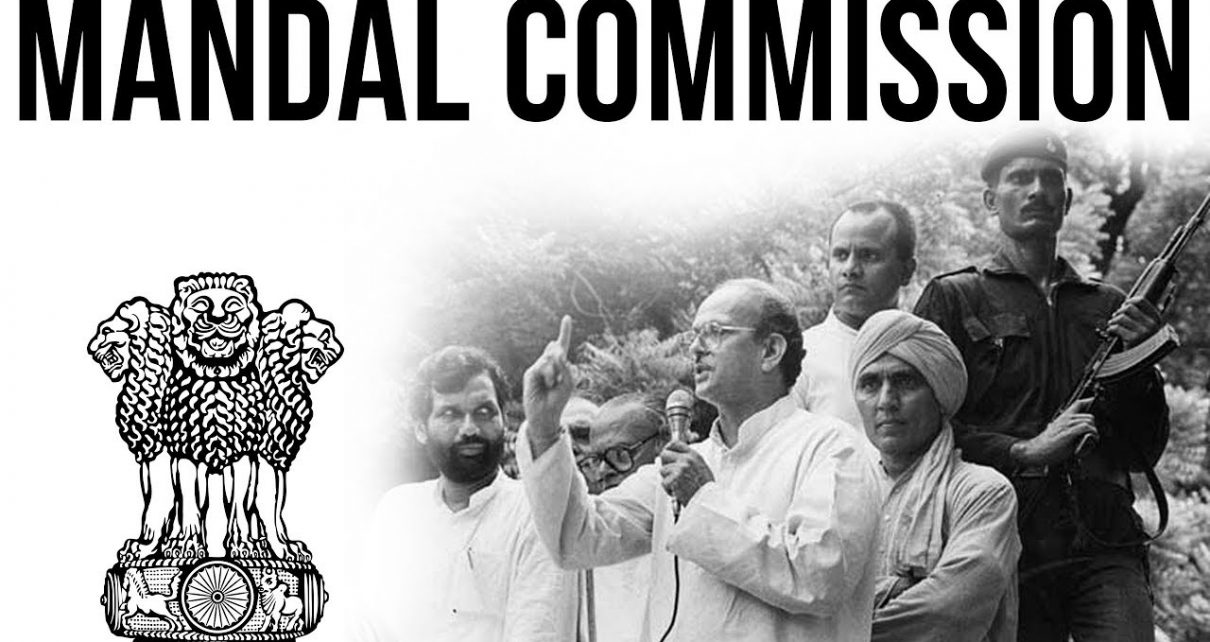
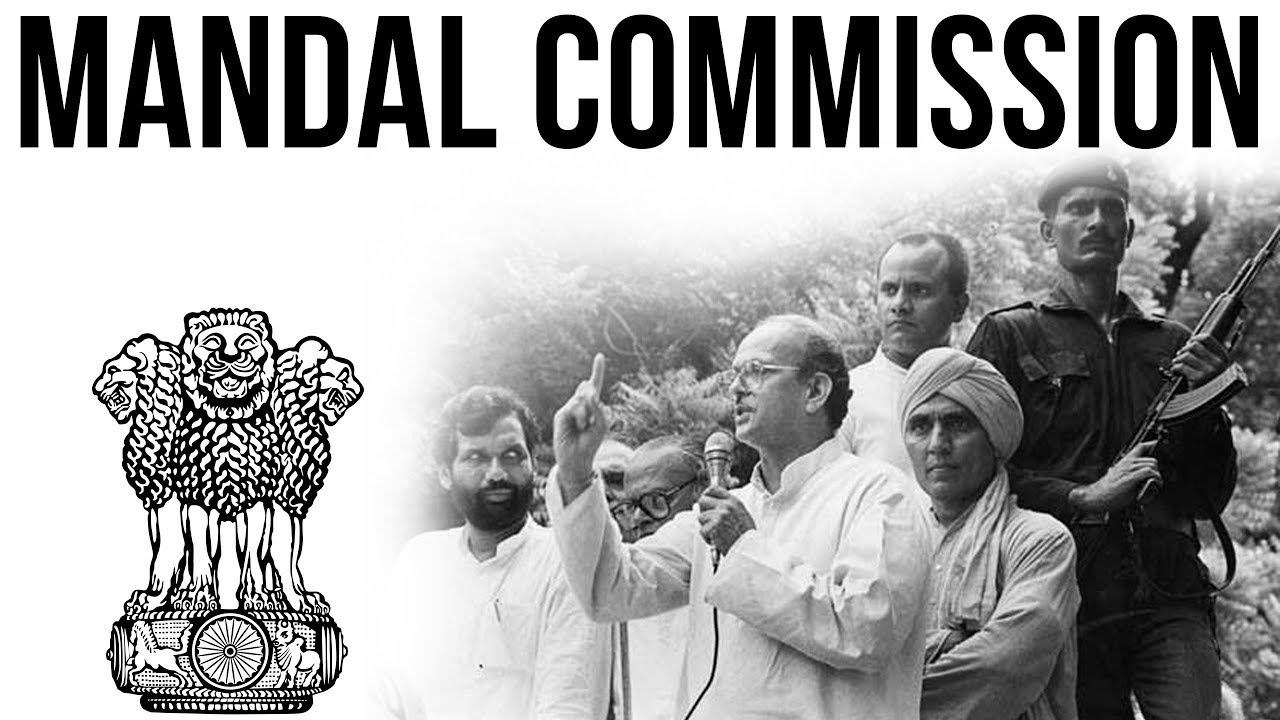
from the society, Vihwananth Pratap Singh, the Prime Minister of India, from
Janata Dal, had dropped the bombshell: Implementaton of Mandal
Commission’s Recommendation to reserve the government jobs for the
Backward Castes. This was the beginning of the end of the upper caste
domination in the society. Had that recommendation envisaged the
reservation of jobs for the lower castes who were economically
backward too, possibly it was a welcome step for one and all.
Paradoxically, the legislation left some inevitable cleavages that
became apparent to one and all: While the creamy layer walked out with
the booty, those at the bottom of the social pyramid, economically
retarded, continued to struggle as usual. Further, it triggered
the hitherto unseen social engineering of monumental magnitude: The
Backward Caste began asserting their domination in the polity; the
democracy which till then, remained as the ‘caged parrot’ of the
Forward Castes, opened a pandora box for the Backward Caste to sense
their own numerical strength in the polity. The phenomenal consequence
of Mandal Commission, more than any other state, was palpably felt in
Bihar and Uttarpradesh: The concurrent rise of two powerful Yadav
Leaders, Laloo Prasad Yadav in Bihar, and Mulayam Singh Yadav in Uttar
Pradesh, from the Backward Cates, whereas it also triggered the sunset
of the forward caste leaders like Dr Jagannath Mishra, Bahuguna and
others, was the vindication of the fact that, hitherto those at the
bottom of the social pyramid, will
eventually call shots in the polity. No wonder Bihar, in the post-Mandal
phase, had not witnessed any Forward Caste chief minister,
although Uttar Pradesh too, after decades, had witnessed Yogi
Adityanath as the chief minister from the Forward Castes. In fact, the
chief ministership in Uttar Pradesh rotated between Mayavati and Muayam
Singh Yadav, both from the Backward Castes.
Indira Gandhi, in her own ingenious innovation of working out a winning
formulae, had sequestered Brahmin from the forward caste to make her
own winning permutation and combination. Her famous slogan of ‘Garibi
Hatao’ had caused a frenzy among the masses to vote for her. Her
famous step of nationalisation of Banks, reaffirmation of her
father’s socialistic mindset, endeared her to the masses, much like
what Narendra Modi’s infamous de- monitisaton had evoked—although it
was a disaster for the economy, the vast section of poor people
inadvertently believed that such a step was against the rich, for
arresting the black money–earned Modi plaudits from the poor and
even the middle class. Interestingly, Mandal Commision was the major
blow to social
compatibility inasmuch as, it heralded a new change in the social
order: Laloo Yadav, a master in real politicking, fully capitalised on
this opportunity: He craftily devised a slogan: Tilak, Tarazoo aur
Talwar, inko maro jutay char( equating Tilk with Brahmin, Tarazoo with
Vaishyas and Talwar with Kschatriyas).Consequently, the social
temperature went soaring, with the friction between the Forward and
the Backward Castes, too reaching its zenith. Interestingly as the social
re-engineering process was going on, the Forward Castes reworked its
own permutation and combination: Its decades old loyalty towards
Congress had begun to shrink, it eventually kick- started the quest for a new
political party which could advance its strategic interest in the
polity, which had already begun ebbing fast.,
Lal Krishna Advani’s famous Rath Yatra was the new awakening for the
masses, especially the Forward Castes which, in the wake of the
implementation of the Mandal Commission, had begun to lose its
influence, ostensibly had pinned a new hope of survival for the Forward Castes.
Mandal versus Kamandal, or Ram versus Babur, was the new emerging
clarion call from a new BJP which endeared the Forward Castes which
quickly lapped up the latter, rising on the horizon as the new hope
that beckoned the Forward Castes in particular, and the collective
Hindus in general. Nonetheless, BJP, having showcased all its topmost
leaders from the
Forward Castes, especially Brahmins, from Shyamaprasad Mookerjee to
Atal Bihari Vajpayee, were from Brahmin class, gave a formidable hope
to the Forward Caste that their interest was much safe with BJP than
with Congress or any regional parties like RJD, JDU Samajwadi Party,
BSP. Significantly, the outbreak of tensions, in the immediate
implementation of Mandal Commission Report that provided 50 percent job
reservation for the Backward Castes( its new nomenclature being that
of Scheduled Castes) , had already galvanised the caste
temperature across the Northern and Eastern India, especially in
Bihar. No wonder even though BJP, hitherto being the party propped up by
Brahmins and Baniya, could seldom reverse the Mandal Commission Report.
In fact, the social tensions in those days had become so abominably
prejudicial that the upper caste women were the most vulnerable in
the fragile social environment where the Scheduled Castes had come to
look upon the Forward Castes as their sworn enemies. Surprisingly,
there was an unexpected nexus between the Scheduled Castes and the
Muslims, in view of their perceiving Forward Castes, especially
Brahmins, as their sworn enemies they enormously despised–the age
old tyranny of the Brahmins and Thakurs upon the lower castes came to
play its role reversal.
Incidentally, such was the high temperature of distrusts between the
Forward Castes on the one hand, and Backward Castes and Muslims
together on the other, that there was a significant misgivings whether
Atal Bihari Vajpayee would be allowed to become the Prime Minister of
India, since he was from the Brahmin community. Finally, Ataljee, even
though became the Prime Minister, yet the diabolical roots of Reservation
had been deeply entrenched in the polity in such venomous ways
that none could dare to destabilise the newly institutionalised social
re-engineering. Yet the Forward Castes had the requisite satisfaction that
the BJP was the party that would keep their strategic interest in mind.
They knew that they stood marginalised in the social matrix, yet they
looked upon BJP as their saviour. But all their robust hope and optimism
went for a big toss with the advent of Naendra Modi in Delhi Durbar
who, in the guise of upending this caste ridden structure and
promoting the meritocratic society, created an unfathomable divide
where, although it appears that Muslims were being discriminated
against, yet in reality it is the Forward Castes which stand as the
minority. In the name of Hindu Consolidation, it is the Forward Castes
which is paying the immense price for being the voiceless in this
social churning out.
The relationship between the Forward Castes and the BJP, was that of
the old and loyal Bhakt to its Bhagwan. With Narendra Modi’s
Developmental Politics so expediently blended with the expansion of
BJP across all sections of societies excluding Muslims, that it hardly
cares today of the age-old loyalty of the Forward Castes. In fact, it would be
hardly an exaggeration to suggest that the Forward Castes as the old
and loyal Bhakt stands completely subsumed by their Bhagwan BJP, with the
former’s urges and aspiration being relegated to the backburner..
In the current scheme of things of the BJP, Forward Castes hardly
matters, for the Bhagwan believes that the Bhakts have completely
surrendered themselves to it and, therefore, it was the time for
Bhagwan to hunt for the new Bhakts. Or else, why BJP failed to
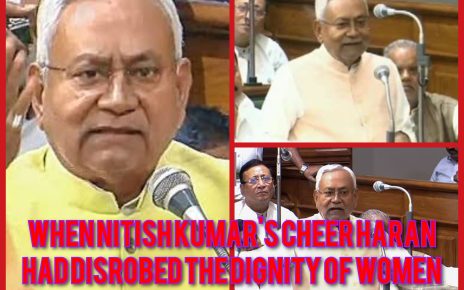
identify anyone from the Forward Castes as one of the Deputy Chief
Ministers in the present dispensation of Nitish Kumar where it
unabashedly appointed two from the Backward Castes to the position of
Deputy Chief Ministers? Forward Castes matters little in the new scheme of BJP.
Ironically, the government being enormously sensitive to the Backward
castes have created several Commissions to cater to their needs and
demands: Rashtriya Anusuchit Jaati Aayog, Rashtriya Anushit Janjati
Aayog, Rashtriya Pichda Varg Aayog and for Muslims, Christains and
Jains, Rashtriya Alp Sankhak Aayog. Where is any commission created
thus far for the backwards among the Forward Castes? Unequivocally, it
is the Forward Castes who too have almost the same proportion of
economically underprivileged people, but where is any mechanism for
the redressal of their grievances? Far from constitution of any
commission for the Forward Castes, the government has begun sincerely
ignoring the urges and aspirations of the Forward Castes. Today, the
BJP hierarchy is filled up with the Backward Caste people as the
party’s overwhelming interest is to expand its footprints across the
section of the society. Its formidable goal is to find more and more
new Bhakts, where then does it have any time for the old and loyal
Forward Caste Bhakts who have already surrendered themselves at the
altar of their Bhagwan BJP. They have been cheerleading their Bhagwan
when Narendra Modi talks about Hindu nationalism; when his
coherts take the potshots at the Mulsims, the Forward Caste Bhakts
cheer them, presuming that Muslim bashing help in the Hindu
consolidation. Never could they have been more off track than they are
now: It is not Muslims who are the minority in India, it is the
Forward Castes who are the real minorities in India. Owaisi’s claron
call of ‘Jai Bhim’ to unite the lower castes around this slogan,
irrevocably establishes this fact that the real minority in India is the
Forward Castes who, if they do not think about their own strategic
interest at this crucial hour, they will be the ones at the receiving
end. It is, therefore, the real time for the Forward Castes to reflect
themselves in the mirror and think about inventing a new Bhagwan. In
other words, exploring the options beyond BJP for their survival,
becomes absolutely imperative for their own survival now.
Vivekanand Jha is an author of Yes, I am Bihari and The Living Legends
of Mithila. He is an author and a public Intellectual.: