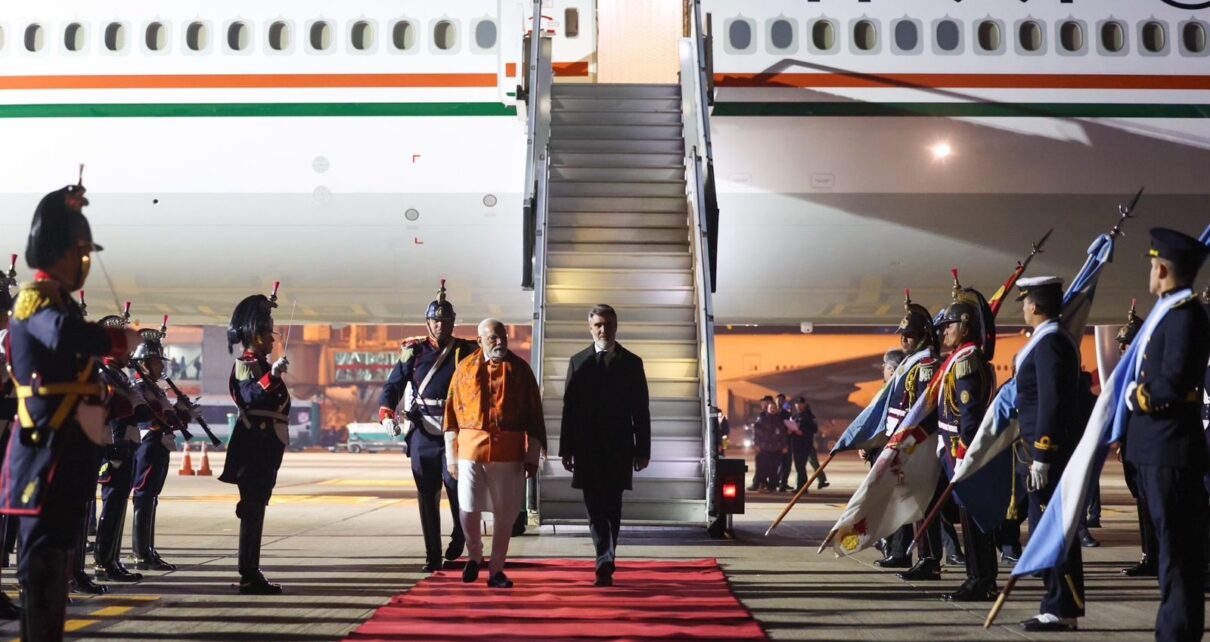

Indian Prime Minister Narendra Modi arrived in Buenos Aires on Friday evening for a two-day landmark bilateral visit to Argentina, marking the first visit by an Indian Prime Minister to the South American nation in 57 years. The high-profile diplomatic stopover is part of a broader five-nation tour that underscores India’s increasing engagement with the Global South and efforts to diversify its strategic and economic partnerships beyond Asia and the West.
Modi’s arrival at the Ezeiza International Airport was met with full ceremonial honours, a red-carpet reception, and a warm embrace from Argentina’s President Javier Milei’s representatives. The Indian diaspora, though small in Argentina, greeted Modi with resounding chants of “Modi, Modi!” and “Bharat Mata ki Jai!” as he reached his hotel, further energizing the moment with a spirited cultural dance performance.
“This is not just a visit — it is a rekindling of an old but undernourished friendship,” an MEA official traveling with Modi told reporters. “The potential for India-Argentina cooperation is vast, and yet it has remained largely untapped.”
Indeed, Prime Minister Modi’s visit is only the second by an Indian premier to Argentina — the first being that of Prime Minister Indira Gandhi in 1968. Modi had visited Buenos Aires earlier in 2018, but only as part of the G20 summit. This time, the tone is different: it’s bilateral, focused, and strategic.
Modi’s statement on X (formerly Twitter) emphasized this significance:
“Landed in Buenos Aires for a bilateral visit which will focus on augmenting relations with Argentina. I’m eager to be meeting President Javier Milei and holding detailed talks with him.”
On Saturday, Modi is scheduled to meet President Milei at the Casa Rosada (Pink House), where the two leaders will hold extensive discussions covering a wide range of sectors. This includes defence cooperation, agricultural innovation, mining of critical minerals, oil and gas exploration, renewable energy, space technology, pharmaceuticals, and bilateral trade.
“Argentina is a key economic partner in Latin America and a close collaborator in the G20,” Modi said in his departure statement from Port of Spain, Trinidad and Tobago. “We will focus on advancing our mutually beneficial cooperation, including in agriculture, critical minerals, energy, trade, tourism, technology, and investment.”
President Milei, a libertarian economist who came to power on a platform of deregulation, dollarization, and institutional overhaul, is reportedly eager to align more closely with countries like India that combine democratic governance with rapid economic development. Sources suggest he sees India as a long-term counterweight to China’s deepening footprint in Latin America.
From a geopolitical standpoint, both countries are looking to strengthen their voices on the world stage. Argentina, a G20 member, has shown aspirations for closer cooperation with BRICS countries, while India continues its outreach to Latin America as part of its South-South cooperation agenda.
India’s interest in Latin America is part of its broader effort to secure access to critical resources and new markets. With its rich reserves of lithium — a key component in electric vehicle (EV) batteries — Argentina has become central to India’s raw material strategy. The Indian government has shown growing interest in investing in Argentina’s lithium triangle, which it shares with Bolivia and Chile.
“India sees Latin America not just as a market but as a strategic reservoir of resources and a partner in balancing global multipolarity,” said Dr. Seema Desai, a Latin America analyst with the Observer Research Foundation in New Delhi.
The two leaders are expected to sign multiple Memoranda of Understanding (MoUs) in sectors:
Critical Minerals: India’s Ministry of Mines has already engaged in talks with Argentina’s Secretariat of Mining to jointly develop lithium reserves. ONGC Videsh and other public-private partnerships may explore joint ventures.
Defence Cooperation: India’s growing stature as a defence exporter is also part of the discussion. Argentina has expressed interest in Indian-made Tejas fighter jets, BrahMos missiles, and coastal radar systems. Discussions may lead to Letters of Intent or feasibility studies.
Agriculture and Food Security: Argentina, known for its soybeans and wheat, could benefit from Indian irrigation technology and agri-drones, while India looks to secure stable food imports amid global volatility.
Pharmaceuticals and Health: India, the ‘pharmacy of the world’, may look to expand its generic drug exports to Latin America through regulatory harmonization.
Space and Technology: With ISRO’s growing reputation, there is potential for cooperation in satellite launches and space-based applications such as weather forecasting and crop monitoring.
India’s ambitions to become a global EV hub require a stable supply of lithium, cobalt, and rare earth elements. Argentina’s northwestern provinces are home to some of the largest untapped lithium reserves in the world. So far, China dominates investment in Argentina’s lithium sector — with nearly 60% of current projects having Chinese stakes.
India, playing catch-up, hopes to secure a foothold via state-run companies and joint ventures. A delegation from Khanij Bidesh India Ltd. (KABIL), the joint venture between NALCO, HCL, and MECL, is already in Argentina exploring opportunities.
“India doesn’t want to trade one dependency — oil — for another — lithium,” said Aditya Bose, an EV policy expert based in Mumbai. “This visit is about securing future supply chains.”
Though the Indian community in Argentina is relatively small — estimated at 3,000 to 5,000 people — they turned out in vibrant numbers to welcome Modi. Dressed in traditional attire and waving Indian flags, they sang, danced, and chanted slogans as the prime minister interacted briefly with them.
Modi’s meetings often include a diaspora outreach component, which he considers a vital aspect of India’s soft power. In Buenos Aires, this was no different. A community reception is being planned, where Modi is expected to emphasize the cultural ties and the role of the Indian diaspora as “ambassadors of India’s heritage.”
Despite strong political goodwill, trade between India and Argentina remains modest by global standards. In 2023–24, bilateral trade stood at approximately $7 billion, with India exporting automobiles, pharmaceuticals, and machinery, while importing vegetable oils, minerals, and wine.
The visit may help energize plans to negotiate a trade facilitation agreement or create special investment corridors. Argentina is not a member of the India-MERCOSUR Preferential Trade Agreement (PTA), but recent meetings have hinted at expansion talks.
“We’re looking at targeted agreements that reduce tariff and non-tariff barriers for specific goods,” said a senior Indian commerce ministry official. “Especially in pharmaceuticals and agricultural machinery, where Indian firms have competitive pricing.”
India’s engagement with Latin America has long been characterized by sporadic visits, limited embassies, and reactive diplomacy. Modi’s visit could mark the beginning of a new proactive model — built on sustained economic outreach, resource diplomacy, and ideological convergence with market democracies.
“Argentina offers India a non-threatening, open, democratic partner that is looking for new global relationships beyond the traditional powers,” noted Ambassador Sujan R. Chinoy, former Indian envoy to Mexico and now DG at MP-IDSA. “Modi’s visit sends a strong message that India is serious about its presence in Latin America.