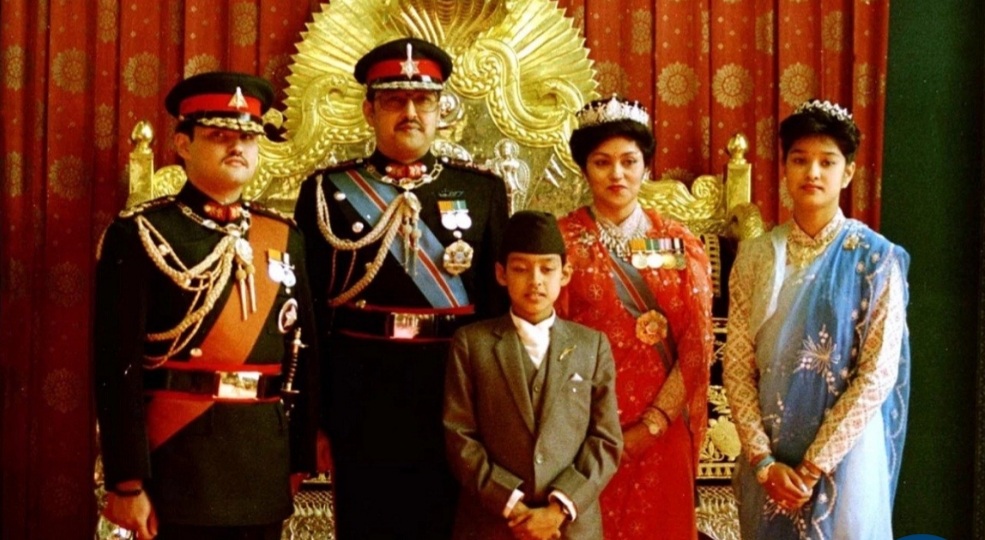
It is shocking, indeed shocking. It is a nightmare, so macabre, so horrible. Something never heard in the history of the world has happened in the country. The entire nation is weeping. No word has ever been invented in the dictionary of mankind that can express the host of emotions seeping out. The king is dead. Not the king alone, the Queen is dead as well together with other members of the royal family. They were all killed in a shootout inside the Narayanhiti royal palace at the regular Friday dinner. This is something unbelievable even while configuring to write a fiction. But this is the reality that Nepalese people are forced to grope with in the face of this most difficult period in our country
Monarchy in Nepal has taken different forms over three hundred thirty three years of history after Prithvi Narayan Shah, the Great King, unified the kingdom of Nepal on September 25, 1768. His Majesty King Birendra became the eleventh in line of succession when, at the age of twenty-seven, he ascended the throne after the death of his father king Mahendra in January 1972. He ruled actively till 1990 and decided to remain as constitutional monarch when confronted by People’s Movement for the restoration of democracy. He was so gracefully reconciled to donning the new role, proving to be an exemplary king. All those who met him invariably have carried a very good impression of his refined and gentlemanly behavior. But this king is no more.
During King Birendra’s rule as an active monarch, people’s rights were limited. However, he was able to provide security, stability and build up infrastructure and institutional capabilities for development of Nepal. He was perhaps the only one who had travelled almost to every nook and corner of the country in his efforts to understand and feel the ground realities, and gear up his development efforts. He had practised Nepal’s foreign policy in a very prudent way and had even gathered the support of one hundred and eighteen countries to his proposal of declaring Nepal as a Zone of Peace. The new democratic dispensation scrapped that noble initiative and hard won support for absolutely no rhyme or reason whatsoever except making an example of foolhardiness. The euphoric psyche of our new leaders meant that anything that of earlier regime was to be discarded even if that was good. In this process, they could not hold good things and instead continued with bad things excelling in acquisition
The Raj Parishad has already proclaimed Crown Prince Dipendra as the new king, and since he is in a critical condition in army hospital with the gunshot wound, Prince Gyanendra is appointed as Regent. But the immediate days are so crucial for us to stabilize the surge of emotions and also to see that no untoward events occur, that will make us weak. We all carry so much of pain inside us. It is painful that our monarch has been killed, a sensibility is dead. Amidst this pain, we have to be resolute, as a nation.
He was a beloved king who always maintained his calm and sensibility. His serene behavior as a practitioner of constitutional monarchy for the last eleven years had exalted him in the minds of the people. This is well reflected in the spontaneous outpour of grief pervading all across the country and also among hundreds of thousands of people who lined the streets from hospital to cremation ghat at Pashupati for hours. Neither the delay in funeral procession nor the rain detered them. People were weeping and the collective emotion forming was bleeding inside. After we lose something, then we realize its importance more, and the frightening void thus created. At this point, how the King had remained as our unifying force has come to the fore for all of us feel and be aware of. Those who hurled their filth, in one pretext or another, and went on to shift their failures onto monarchy, as an institution, should realize now their size in terms of holding the country together, be it in a party in majority or in a party in popularity.
Never before was this country as vulnerable as it is today. The identity of the nation is in crisis. We have to succeed for we, as a nation, have to live. What this calls for is the magnanimity on the part of our political leadership to encompass all of us, first as the Nepalese, then only as the members of any political party. Those outside the political boundary have as much responsibility as those competing inside. This is a time of integration not of differentiation where the intra and inter party relationships should be focused to cope with the fluid situation. Therefore, neither the Lauda debate nor anything else could divide our strength. National debates are meant to churn out ideas for the betterment of the nation.
At this point in time, the nation is to be held together. From this point of view, the decision of the main opposition party CPM (UML) to withdraw all its street programs to press for the resignation of the prime minister, shows both wisdom and maturity. Who resigns and who comes in is simply not important at this time. What is more important is the need to cope with the crisis. The deep stream drives a nation similar to a river than what flows fast at the surface. Ours is a united identity. Monarchy, as an institution, is what that binds us together. And, there only the democracy that we have can continue unfractured. It is the test of time. No. It is our test. Here are the few lines of the poem entitled ‘When Lilacs Last in the Dooryard Bloom’d ‘, written by Walt Whitman in memory of the sixteenth American President Abraham Lincoln after he was shot dead inside a theatre on April 14, 1865.
O powerful western fallen star!
O shades of night—O moody, tearful night!
O great star disappear’d—O the black murk that hides the star!
Another few lines from another poem of Walt Whitman called ‘O Captain! My Captain!’
But O heart! heart! heart!
O the bleeding drops of red
Where on the deck my Captain lies,
Fallen cold and dead
This is my tearful goodbye to the King, who for the last eleven years, remained the true custodian of democracy, surpassing all those who fought for its restoration.
TKP/June 5, 2001 ( Jestha 23, 2058)
debate nor anything else could divide our strength. National debates are meant to churn out ideas for the betterment of the nation.
At this point in time, the nation is to be held together. From this point of view, the decision of the main opposition party CPM (UML) to withdraw all its street programs to press for the resignation of the prime minister, shows both wisdom and maturity. Who resigns and who comes in is simply not important at this time. What is more important is the need to cope with the crisis. The deep stream drives a nation similar to a river than what flows fast at the surface. Ours is a united identity. Monarchy, as an institution, is what that binds us together. And, there only the democracy that we have can continue unfractured. It is the test of time. No. It is our test. Here are the few lines of the poem entitled ‘When Lilacs Last in the Dooryard Bloom’d ‘, written by Walt Whitman in memory of the sixteenth American President Abraham Lincoln after he was shot dead inside a theatre on April 14, 1865.
O powerful western fallen star!
O shades of night—O moody, tearful night!
O great star disappear’d—O the black murk that hides the star!
Another few lines from another poem of Walt Whitman called ‘O Captain! My Captain!’
But O heart! heart! heart!
O the bleeding drops of red
Where on the deck my Captain lies,
Fallen cold and dead
This is my tearful goodbye to the King, who for the last eleven years, remained the true custodian of democracy, surpassing all those who fought for its restoration.
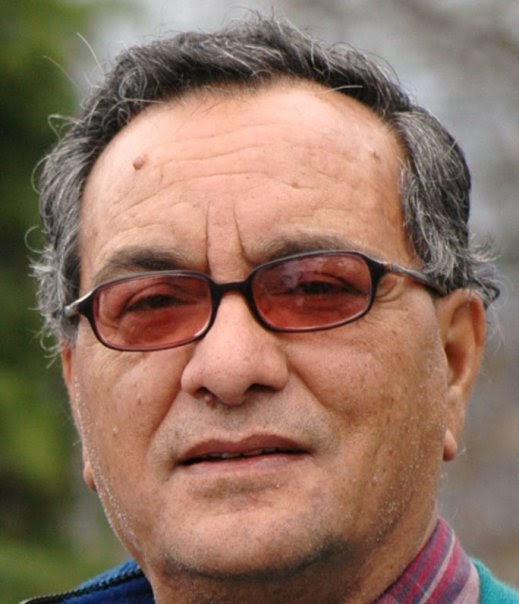
Basant Lohani
( Courtesy: The Kathmandu Post of June 5, 2001)
Pls. Click