
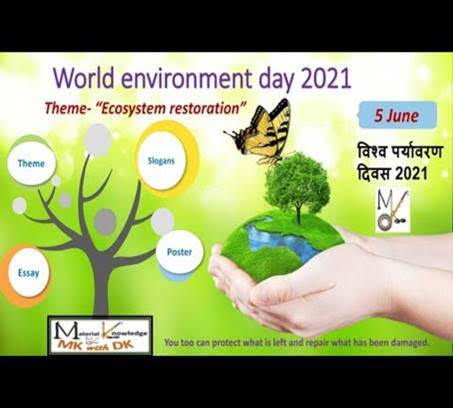
Govind Shah, PhD, We have been celebrating World Environment Day globally on 5 June each year for the last 47 years to raise awareness about environmental issues such as air and water pollution, forest and land degradation, over exploitation of natural resources, global warming and others as well as to advocate ways for reducing environmental degradation. We have not been able to solve many issues, but we have had great successes.
The first celebration in 1974 had the slogan “Only One Earth” and each year the slogan changes which reflect the serious environmental issues. The theme for 2021 World Environment Day is ‘Ecosystem Restoration and on this day ‘UN Decade on Ecosystem Restoration’ will be officially launched. Pakistan is the global host of World Environment Day 2021.
The terrestrial and aquatic ecosystems across the world support life on our planet. However, unwise use, misuse and over exploitation of natural resources, extensive conversion of land and water bodies, and climate change have visible impact on ecosystems leading to biodiversity loss. ‘Degradation is affecting about 40% of world population and every year loss of ecosystem services worth more than 10% of our global economic output’. Land degradation has been very high, and the ‘Nature’ is being destroyed. We need to save nature now.
There has been decreasing quantity and quality of ‘Ecosystem Services’ such as food, water, fodder, timber, fibre, medicines etc from forests, croplands, grasslands, rivers, marines and other water bodies. This decrease in ecosystem services has adversely affected men, animals, and other life forms; these impacts are direct or indirect, small or large, short-term or long-term, and site specific or zonal or national or regional. This will invariably restrict achievements of Sustainable Development Goals. Without ecosystem services, life on earth would not exist.
Nepal is facing environmental and ecological challenges – loss of terrestrial habitat and biodiversity, degradation of watersheds, lowering productivity of ecosystems, desertification in Trans-Himalayan regions, over exploitation and shrinkage of mountain ecosystems, forest disappearance, cropland degradation and loss, water-induced disaster and crisis, forest fire and droughts in Tarai plains.
Ecosystem restoration implies “assisting in the recovery of ecosystems that have been degraded or destroyed”, and conservation of the ecosystems that are fragile or still intact but in the verge of further destruction. Urban and rural landscapes have different ways to adapt and restore ecosystems. The most important is eliminate pressures on the environment. It has been observed that conservation efforts alone are insufficient to prevent large-scale ecosystem collapse and biodiversity loss.
Un System is developing principles and guidelines for ‘ecosystems restoration’ and ‘good practices’; expected to be finally done by the end of this year. The ecosystem can be restored in many ways. Planting trees is one of the easiest and best ways of caring for the environment. Agroforestry is better alternative in degraded farmlands and forests near to settlements.
In Nepal, ecosystems requiring urgent restoration include about 2 million ha of degraded forests more so in fragile Siwaliks and Tarai plains, degrading farmlands, grasslands and Tras-Himalayan steppe, wetlands in Tarai and mid-hills, riverine areas in valleys and Tarai plains, and all urban areas.
Ecosystem restoration would require a sound planning at national and provincial level identifying ecosystems that require restoration and developing strategies and mechanism for plan implementation at various levels.
Stakeholders government agencies, NGOs/CBOs, communities, financial agencies and others must be involved in restoration works
Awareness and consciousness among various agencies, communities and individuals are vital in restoration activities. Capacity build-up of various agencies and communities are required.
Government must develop ‘framework for ecosystem restoration monitoring’ which would enable both country and its communities to measure the progress of restoration projects or actions.
Success and failures of ecosystem restoration work will depend on the above three factors. In developing countries, all these aspects are less cared or practically ignored.
There is no alternative but to create and maintain healthy ecosystems which can enhance people’s health and livelihoods, reduce climate change effects, and stop the collapse of biodiversity. Ecosystems restoration can generate employment. It will restore relationship between people and nature.
Let us take care of Environment today which will promise us a better tomorrow for our next generation. If you like this message, please share with your friends. Let us work together.
Shree Govind Shah, PhD
Ecologist, Environment Planning and Policy Analyst
Bangalore, India