Suman Tiwari, 31 October. In October 2005, the Nepali Times carried an advertisement for a Halloween Night party at Rox Bar in Kathmandu. Entry was priced at Rs 600. More than twenty years later, Kathmandu has Halloween-themed events alongside a horror film festival taking place over the same weekend. Similar activities have appeared in Birgunj too.
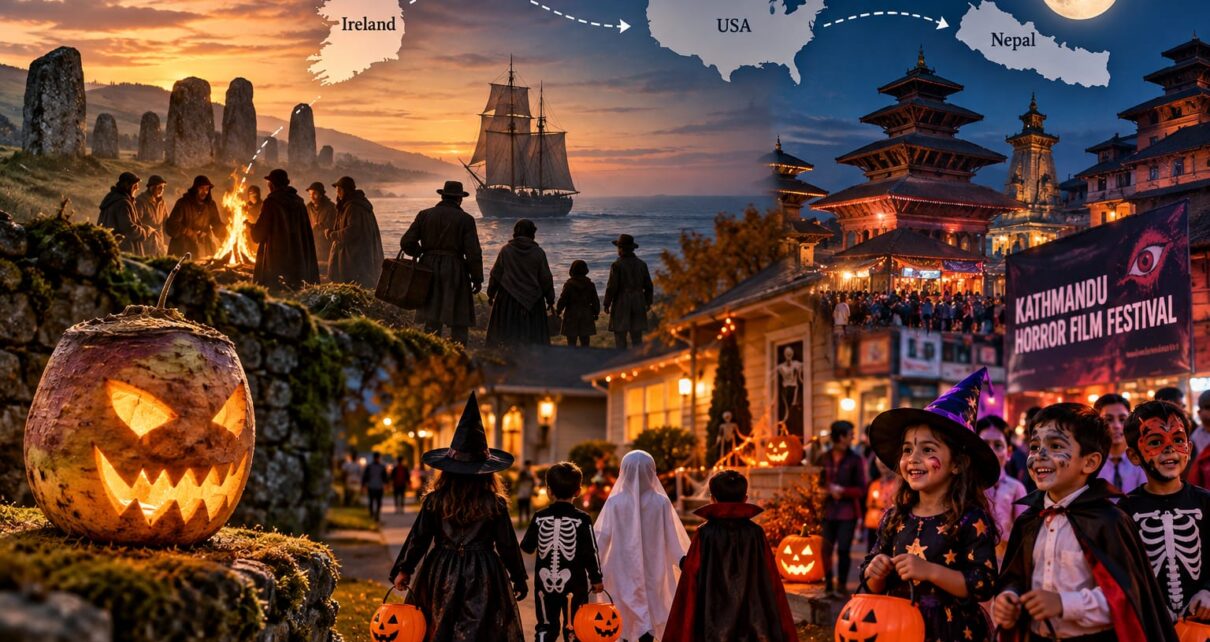
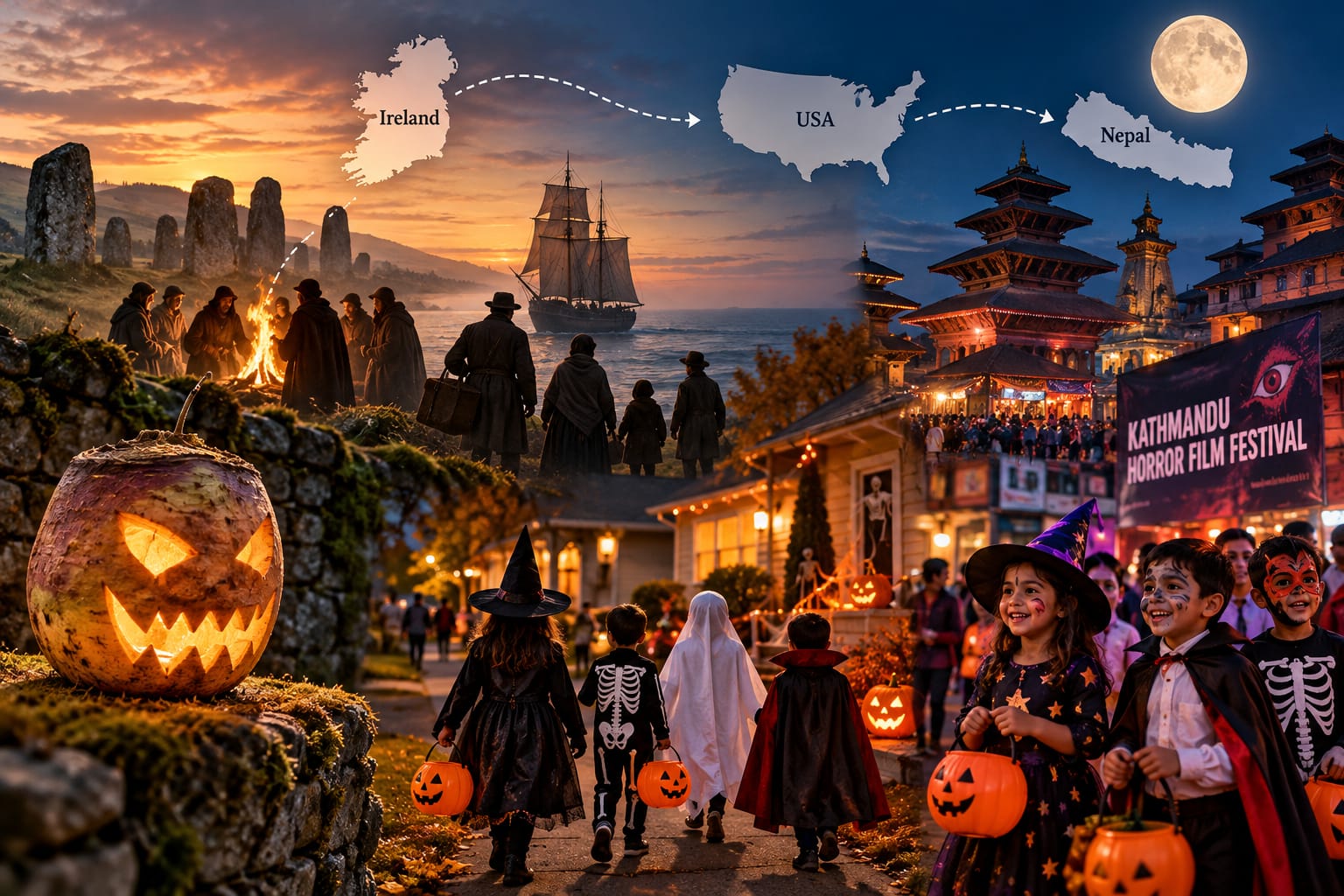
The pumpkins, costumes and trick-or-treating associated with Halloween are familiar from American films. Yet some of its older customs travelled to North America from Ireland and Scotland before the American version spread around the world. The story of Halloween is not simply about where it began, but about what happened to it along the way.
In Ireland, Halloween remains a familiar part of autumn. Shops fill with pumpkins and costumes, while children prepare for trick-or-treating. Much of the modern celebration looks distinctly American, although older Irish customs could look quite different.
Part of Halloween’s history is linked to Samhain, a Gaelic festival marking the end of summer and the beginning of winter. Popular accounts describe it as the ancient Celtic New Year, when the boundary between the living and the dead was believed to become thinner. Historian Ronald Hutton has cautioned that some of these familiar claims are difficult to establish from early evidence. Medieval Irish stories do connect Samhain with gatherings and supernatural events, but they do not tell us everything later tradition has attributed to the festival.
Christian traditions also played a part. Halloween takes its name from All Hallows’ Eve, the evening before All Saints’ Day. The idea that the Church simply replaced Samhain with Halloween makes for a neat story, but the historical relationship is more complicated.
Irish Halloween traditions also included games, ghost stories and fortune-telling. Some young women peeled apples and threw the skins over their shoulders, hoping the shape would reveal the initials of a future husband. Barmbrack, a traditional Irish fruit bread eaten around Halloween, sometimes contained a ring said to predict marriage for whoever found it.
Even the lantern was different. Before pumpkins became Halloween’s best-known decoration, people in Ireland carved frightening faces into turnips. The National Museum of Ireland records a turnip-lantern tradition near Fintown in County Donegal around 1900. The museum received one of these turnip lanterns in 1943, and an artist later made a plaster-cast model of it.
During the nineteenth century, particularly during and after the Great Famine, many Irish people migrated to North America. Scottish migrants also brought related traditions across the Atlantic. Families carried their stories, games and seasonal customs with them, but traditions change when they travel.
In North America, pumpkins became a popular material for lanterns. Costumes and parties took new forms. The familiar practice of trick-or-treating, in which children in costume knock on doors asking for sweets, developed over time. Some historians connect it with older customs such as souling and guising, when people visited homes seeking food or gifts, sometimes offering prayers or performances. The modern American version became widespread much later, particularly during the twentieth century.
Films and television helped make the American version of Halloween recognisable far beyond North America. The first journey had largely followed migrants across the Atlantic. The next travelled through screens and popular culture.
America did not merely preserve Halloween. It helped transform it. Ireland helped export traditions. America helped export the image.
That helps explain why a celebration with historical connections to the Gaelic world is now so strongly associated with the United States.
In County Meath, Ireland, modern Halloween is now being reconnected with some of its older roots. This year, the Púca Festival runs from 29 October to 1 November in Trim and Athboy, with storytelling, music, folklore and events drawing on Samhain traditions.
Halloween has a longer history in Kathmandu than might be expected. In 2009, an American living in Kathmandu wrote about celebrating Halloween with an international group of friends while Nepali festivals, including Tihar, were part of life around her.
A Nepali Times events listing from 2011 advertised another Halloween celebration, Voodoo Ghar, at The Tantra in Thamel. These records show that Halloween was present in parts of Kathmandu’s social scene long before this year’s costume events.
This year, Eveedge Events has advertised a Halloween celebration at Mellow Pomelo in Swoyambhu for 31 October, with costumes, trick-or-treating, games and music. The advertised entry fee is NPR 500.
This October, the second Kathmandu Horror Film Festival runs from 30 October to 1 November at Russian House. Its newly announced lineup includes 28 films: six competition features, 18 competition shorts and four non-competition films. The festival is primarily about cinema, not traditional Halloween customs, but its timing and focus on horror and folklore show how such themes have found an audience in Nepal.
Halloween-related activities are not confined to Kathmandu. In 2023, Ninos, a preschool in Birgunj, shared a Halloween Day celebration featuring children in costumes and character makeup. Halloween has appeared in school activities elsewhere in Birgunj too. Gyanda Academy, another school in Birgunj, also listed Halloween as a pre-primary activity for 31 October.
These examples show Halloween-related activities appearing in different settings in Kathmandu and Birgunj. They do not establish that Halloween has become a major festival across Nepal.
Nepalis are familiar with carrying their own celebrations overseas. In Ireland and Northern Ireland, Nepali community organisations help families gather, maintain cultural connections and continue traditions from home.
Halloween and Nepali festivals have different histories and meanings. The similarity lies in what happens when people move. They take celebrations with them, introduce them to new surroundings and sometimes change how those occasions are observed.
When Halloween is marked in Nepal this October, costumes and pumpkins may be its most visible symbols. Behind them lies a longer story of migration, adaptation and cultural memory.
 About the author
Suman Tiwari is an Ireland-based writer and cybersecurity professional with an interest in technology, public policy and cross-border issues.