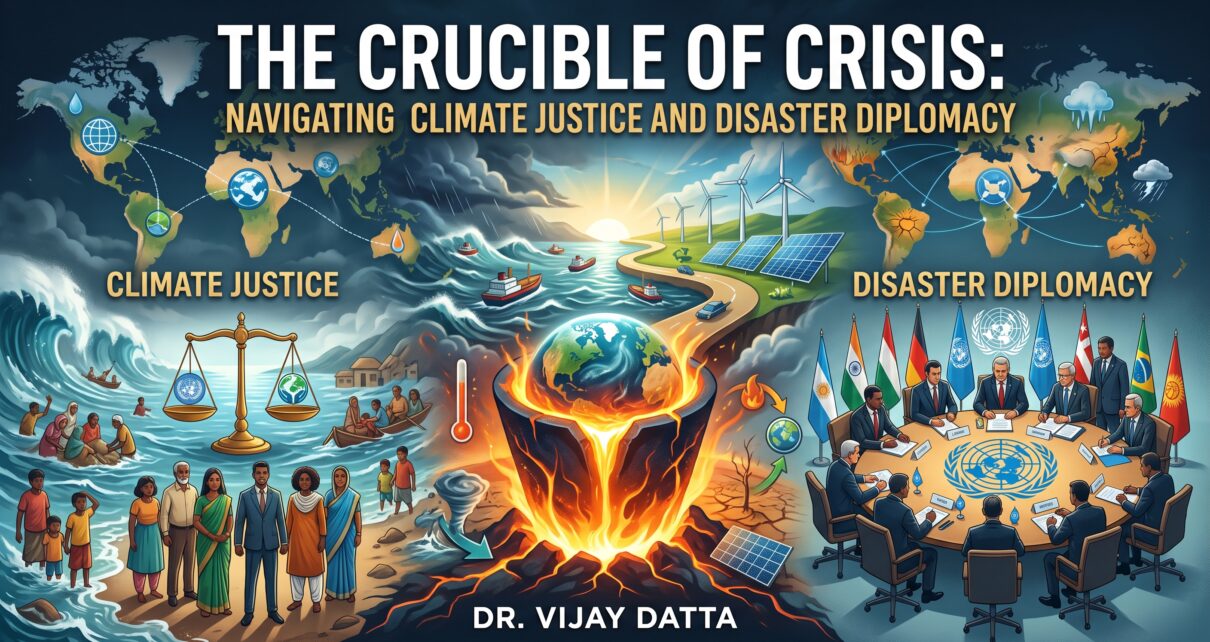
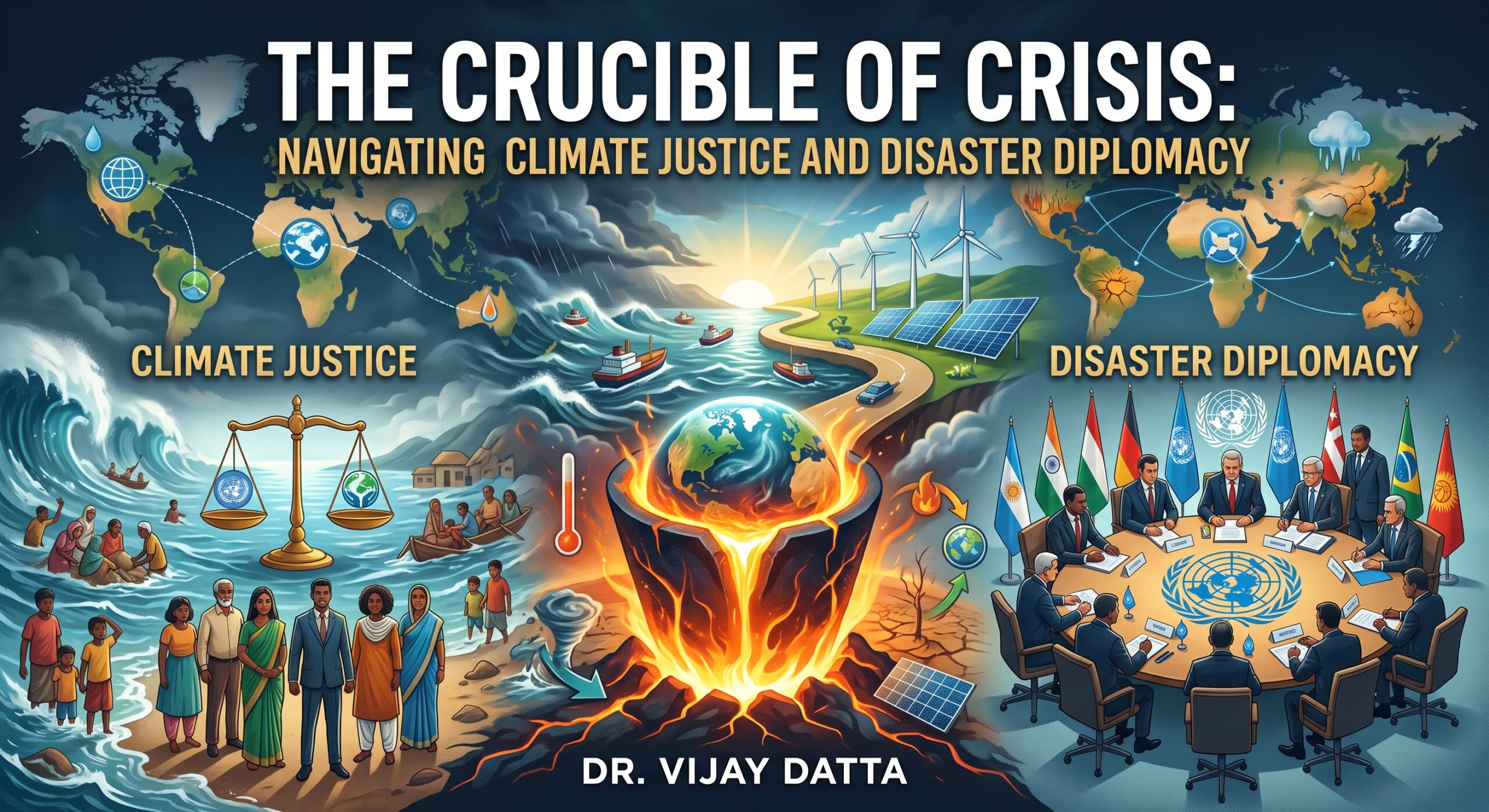
Dr.Vijay Datta,Kathmandu, 17 Sept. In the shadow of the Himalayas, Nepal stands at a harrowing intersection. It is a nation besieged by the dual forces of an accelerating climate emergency and an internal political landscape defined by constant volatility,a phenomenon increasingly described as a perpetual “political earthquake.” As Nepal seeks to assert its voice on the global stage, the synthesis of **climate justice** and **disaster diplomacy** has become not merely an academic exercise, but a vital imperative for national survival.
*The Moral Imperative: Climate Justice*
Climate justice demands that we look beyond the metrics of carbon emissions and atmospheric change to the ethical landscape beneath. Nepal, a country that contributes negligibly to global greenhouse gas emissions, finds itself on the front lines of glacial retreat, erratic monsoons, and devastating floods.
For Kathmandu, the pursuit of climate justice is an assertion of moral clarity. It rejects the narrative that places the burden of adaptation solely on the vulnerable. Instead, it posits that the Global North and industrialized powers bear an inescapable debt. However, the challenge for Nepali statecraft lies in transforming this rightful indignation into tangible policy. Advocacy must evolve from a rhetoric of grievance into a strategy of bargaining, positioning Nepal not just as a victim, but as a crucial provider of ecosystem services,a “climate-resilient hub” whose preservation is essential for regional stability.
*The Strategic Pivot: Disaster Diplomacy*
Disasters, whether triggered by seismic activity or climate-induced environmental collapse, serve as both catalysts and conduits for international relations. This is the realm of disaster diplomacy. In a geopolitical environment defined by the tug-of-war between major powers like the United States, China, and India, Nepal’s vulnerability can paradoxically become a strategic asset.
By framing its disaster preparedness as a priority for regional security, Nepal can invite international collaboration that transcends traditional power rivalries. If managed with precision, relief efforts and humanitarian aid can act as “windows of opportunity,” allowing Nepal to solidify its sovereignty while fostering technical and financial partnerships. The risk, however, is that disaster diplomacy often masks the pursuit of “soft power” by donor nations. A matured diplomatic approach requires Nepal to navigate these humanitarian corridors without compromising its agency or falling into the trap of becoming a geopolitical pawn.
*Bridging the Domestic-Global Gap*
The effectiveness of Nepal’s foreign policy is inextricably linked to its internal stability. The current “greyzone” of governance,marked by public disillusionment, the rise of populist figures, and the frequent collapse of coalition governments-undermines the nation’s credibility abroad. When domestic policy is perceived as chaotic, external calls for global accountability can be dismissed as mere deflection.
For Nepal to project strength, it must reconcile its internal political volatility with its international commitments. A cohesive domestic consensus on climate and disaster policy would provide the Prime Minister with the legitimacy required to speak firmly at forums like the United Nations General Assembly.
*A Path Toward Matured Statecraft*
Nepal’s path forward requires a sophisticated, three-pronged strategy:
1. **From Blaming to Bargaining:** Move from reactive protest to a proactive demand for equitable climate finance, framing Nepal’s adaptation as an investment in global environmental health.
2. **Strategic Vulnerability:** Utilize disaster diplomacy to position Nepal as a neutral, collaborative arena for regional climate research and humanitarian coordination, turning crises into opportunities for diplomatic engagement.
3. **Internal Consolidation:** Stabilize the domestic “greyzone” through governance that addresses the electorate’s hunger for systemic change. Without a stable foundation at home, the reach of any diplomatic strategy will be limited.
*In conclusion*, the intersection of climate justice and disaster diplomacy is the crucible in which Nepal’s future will be forged. By balancing the moral weight of its grievances with the pragmatic realities of its geopolitical neighborhood, Nepal has the potential to move beyond the shadow of its the alliances necessary to survive and thrive within it.