
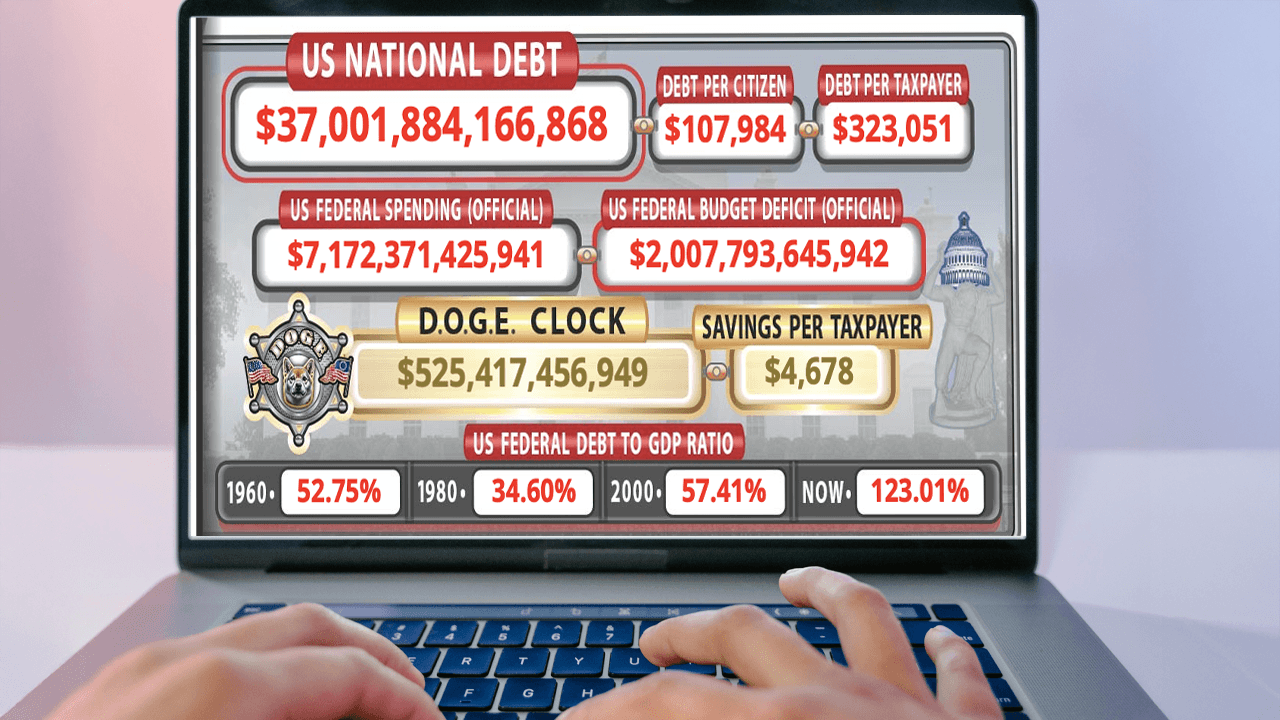
July 6, 2025 , Washington D.C. The United States’ total national debt has now reached a staggering $37 trillion, raising serious concerns about long-term sustainability and global financial stability. The recently passed budget bill, dubbed the “Big Beautiful Budget Bill” by former President Donald Trump, is expected to add at least $3 trillion more to the already massive debt pile.
This has reignited global doubts about how long the world can keep lending money to “Uncle Sam” without consequences. The situation has been worsened by a weaker U.S. dollar and higher interest rates, which are making it more expensive for the U.S. to borrow money.
Growing Alarm: Weak Dollar, High Interest, Massive Deficit
Since the start of 2025, the dollar has declined 10% against the British pound and 15% against the euro, despite the U.S. normally having stronger currency due to higher interest rates. However, with the Federal Reserve now gradually lowering rates — unlike the European Central Bank or the Bank of England — the usual appeal of the dollar has waned.
Furthermore, investors are demanding higher returns to lend to the U.S., indicating growing doubts over America’s debt sustainability. While short-term borrowing costs remain manageable, the gap between short-term and long-term interest rates is widening — a warning sign for financial markets.
Critics and Warnings
Even Elon Musk, a former ally of Trump, has blasted the budget bill as “disgusting and disgraceful.” And Ray Dalio, the founder of the world’s largest hedge fund, believes the U.S. is approaching a critical inflection point.
Dalio warns that if current trends continue, the U.S. government will soon be spending $10 trillion annually just on debt servicing and interest payments.
“If we don’t act now, debt will spiral out of control and a major financial crisis will become unavoidable,” says Dalio.
What Could the Crisis Look Like?
Deep Spending Cuts or Major Tax Hikes
To stabilize the debt, experts suggest reducing the budget deficit from the current 6% to around 3%. That could require drastic spending cuts or large-scale tax increases — or both. However, the Trump-backed bill reduces taxes even further, while offering only minimal spending cuts, moving in the opposite direction of fiscal prudence.
More Money Printing
The U.S. Federal Reserve could return to quantitative easing, printing more money to buy government bonds, much like during the 2008 financial crisis. But this move risks fueling inflation and widening inequality, as wealth tends to concentrate among asset holders, not wage earners.
A Full-Blown Default
The worst-case scenario is that the U.S. defaults on its debt, essentially declaring “we can’t or won’t pay.” Since U.S. Treasury bonds are seen as the backbone of the global financial system, such a default could make the 2008 crisis look like a picnic by comparison.
As the world watches closely, the U.S. now faces a financial crossroads. Decisions made in the coming months could determine whether the country returns to fiscal responsibility — or steers into a debt-driven disaster with global repercussions.