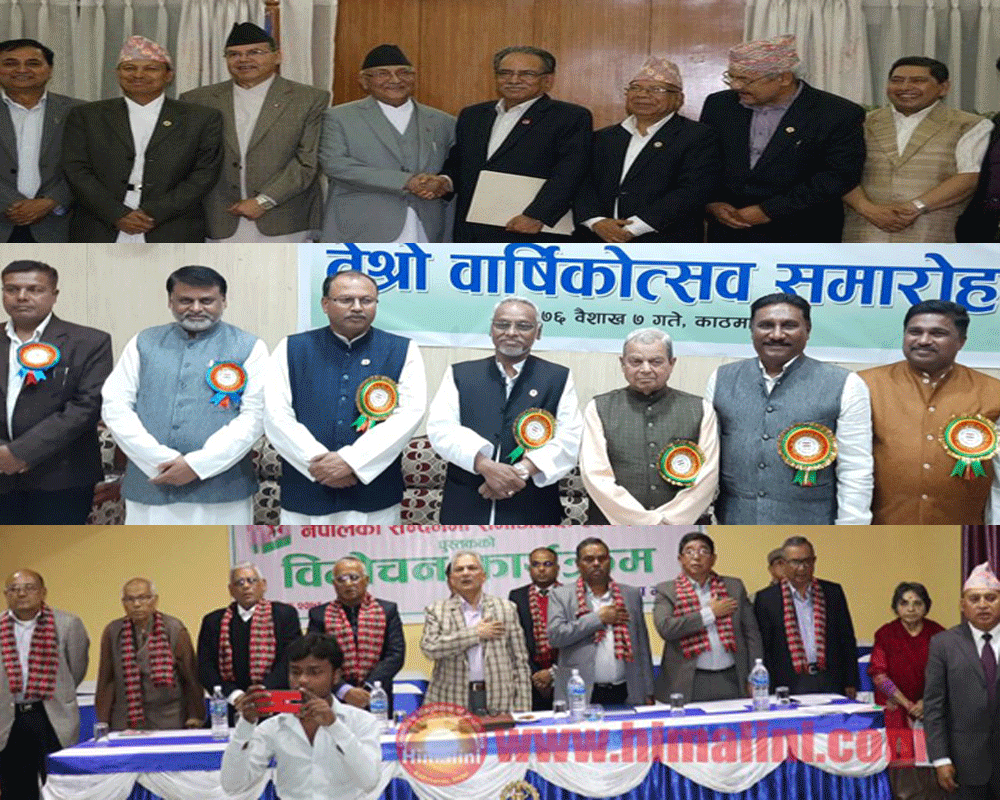
Dr. Geeta Kochhar Jaiswal & Sipu Tiwari. Nepal is again on a political turmoil with agitated politicians and unhappy people. The turmoil this time seems to be created and promoted by the ruling majority party Nepal Communist Party (NCP) under the leadership of Prime Minister Kadga Prasad Oli. April 22, 2020 became a whole night drama whereby each actor was speculating the direction in which the wind will blow. On the one hand, there was unilateral decisions of PM Oli to pass the ordinances (though now stand withdrawn) with the full support of the President Bidhya Devi Bhandari that created rift within the NCP; and on the other hand, there were attempts to split the Terai based political parties by the NCP to gain larger support and control of the region. This chaos had sent jitters not only in India, but also in China with the Chinese President and Ambassador making proactive actions to engage with the ruling leaders under the larger umbrella of support for the Covid-19 pandemic. In one sense it proves that neither India nor China wants to see an unstable next door neighbour – Nepal, yet the game of money and power reigns high in Nepal’s political stability.
The unexpected outcome of the night long chaos is the long pending unification of Terai based Samajwadi Party (SP) and Rashtriya Janta Party Nepal (RJPN) with those lured for breaking the party returning to join the united coalition; while the demands for the resignation of PM Oli got consolidated with the NCP Secretariat holding emergency meetings in between the ongoing Covid-19 outbreak challenges. It is quite clear that NCP that came to power boasting ‘corruption free Nepal’ is not only using all corrupt practices to continue to rule, but has greater divisions in terms of power and position even though it fought elections as a united party.
However, more of the discussion in Nepal is around the sustenance of the newly united based People’s Socialist Party (Janta Samajwadi Party, PSP/JSP). The issues that need greater debate in Nepal considering the changing geo-political scenario in the world are: whether the future economic challenges due to the Covid-19 crisis create greater instability within Nepal? Will an ailing PM Oli continue to rule or replace his close protege Bam Dev Gautam (who is regarded as the main man behind the NCP unity) as the future PM under his control? What will be the future direction of JSP and its role in the larger Nepali politics? Will the Nepali Congress Party, the main opposition party having serious decline of leadership re-emerge as a political game changer? Or will the diffusion of Oli’s power in NCP lead to a decline of NCP unity, thereby repositioning of power centers within the House of Representatives?
NCP and the Power Struggle
Since the formation of NCP (UML and Maoist) in May 2018, there has been a constant tussle of power division and cadre composition. The unity formed to win the elections resulted in gaining the two-third majority in the House of Representatives, but the ideological differences and the membership of party cadres remained a greater challenge with unclear organizational structure. However, gradually Oli from UML group who was placed at the PM position consolidated his control over the party and the co-Chairman Prachanda from the Maoist group was sidelined in many ways. To the extend that in May 2019, Prachanda had openly claimed that Oli and Prachanda had a secret deal for unity to head the government and the party on alternating basis, creating an open debate in Nepal. However, Oli by August 2019, came out to claim that he will lead as the PM for full five year term and warned opposition forces not to “day dream of toppling the government”. Thereafter, Prachanda was made the Executive Chairman of the Party, destroying the hopes of many former Maoist cadres of NCP to see Prachanda as the future PM.
Oli heading NCP ran the ultra nationalist discourse to gain the support of the masses and control within the Party. His call of “Samridhh Nepal, Sukhi Nepali” forcing on development of the state and rooting out poverty without excessive reliance on foreign powers, including both India and China, was a welcome beginning for many Nepalese. There was proposition that the newly formed party has adopted a ‘zero tolerance’ policy against corruption and seeks to uphold social justice. Oli’s style of running the government has been a constant subject of debate with intense objections from the opposition party – Nepali Congress, with some calling it as an ‘autocratic’ style of governance. However, the crucial issues that have shaken the trust of the masses are the innumerable cases of corruption including the Gokul Baskota corruption charges, or the embezzlement in importing of medical equipments from OMNI tech group during covid-19 crisis to cite a few.
Recent charges that is creating furore among the Terai people are the actions of the NCP to use power and money to divide Madhes based parties. With Renu Yadav and few other members moving to register an independent party soon after Oli got President’s approval of two ordinances (Political Parties Act and Constitutional Council) without consultation in the NCP or broader cabinet. The most crucial of the two ordinances was that of amending the Political Parties Act (PPA) that earlier required 40 per cent support from both the party central committee and the parliamentary party in order to split was changed into getting support from either or. The Constitutional Council ordinance would have allowed to convene a meeting of the Constitutional Council that makes constitutional appointments even without the participation of the main opposition party leader.
Even though many felt that the PPA ordinance was passed as Oli feared lack of support for himself in both the Party Central Committee and the Parliamentary Party, there was another clear objective of dividing the Madhes based Samajwadi Party and the Rashtriya Janta Party Nepal. In December last year, Samajwadi Party had quit the government and Oli was successful in coaxing the RJPN to form alliance for the National Assembly elections. The split between Madhesi parties can help Oli to stand the ‘no confidence’ test at the House of the Representative in case Prachanda plans to quit the NCP and join the opposition National Congress, as the Madhes based two parties hold 34 seats in total in the 275 member House of Representatives including one seat of Resham Chaudhary that is suspended as he currently serves jail term; while Congress holds 63 seats. It is crucial to know that the ruling NCP that currently holds 174 seats has 121 former UML members and 53 from the former Maoist faction, though recently within the NCP the affiliations and supports among members and high-level cadres have been oscillating.
People’s Socialist Party – A New Unity of hope for Madhes
With the possibility of split of the Samajwadi Party visible as seven MPs and members (Renu Yadav, Surendra Yadav, Mohammad Ishtiyak Rai, Pradeep Yadav, Umashankar Argariya, Kaludevi Biswakarma, Renuka Gurung) were working to break the party and form an independent party with the support of the NCP, a new united Party was formed named People’s Socialist Party (Janata Samajwadi Party, JSP). The united party of RJPN and SP agreement was signed by RJPN leaders Mahantha Thakur, Rajendra Mahato, Mahendra Raya Yadav and Saratsingh Bhandari along with Samajwadi Party leaders Dr. Baburam Bhattarai, Upendra Yadav, Ashok Rai and Rajendra Shrestha. The party decided to have Mahantha Thakur as their head for the time being.
The twist in events leading to unity happened when Surendra Yadav disclosed that he was kidnapped and taken to Marriott hotel on the behest of NCP to lure him to quit the Party and join to form an independent party under the name National Socialist Party (Rashtriya Samajwadi Party, RSP). It is understood that Renu Yadav was assured Deputy Chairman position in the new Party; while few others were assured Ministerial positions or positions in some high level Committees. However, as the news spread among Party leaders, there was swift action among party heads and decision was reached to expedite the formation of unified party, which until fourth quarter of last year was speculated by some media reports as ‘impossible’.
Although the new party is already formed, many experts and political commentators view it as a decision in haste that is bound to fragment. There are many running commentaries stating that the Madhes based parties are fraught with tussle over positions, which has a long history of breaking parties into multiple divisions or sub-groups. Hence, not many are optimistic of sustenance of this new unity and believe that as and when the party hierarchy and future positions will be decided, the divisions will mushroom, resulting in collapse of the unity.
However, all these speculations fail to acknowledge the fact that Madhes based parties have little or no choice for any further alternative, if the party leaders have to continue to gain mass support and sustain their positions. The people of Madhes are already dejected with the representatives for diluting the greater cause of ‘Madhes movement’ of 2015, which was against the unfair treatment of Terai region and demanded proportional representation or inclusion in all organs of the state.
Interestingly, Baburam Bhattarai had joined the Samajwadi Party with Upendra Yadav to put pressure on the government to consider the demands of the Madhesis for Constitutional amendment, which was also the cause of Rajendra Mahato led second Madhes movement of 2008. The formation of Samajwadi Party was to work for the institutionalization of federal democratic republic, seek constitutional amendments for parity, and contribute towards sustainable development of Nepal. It is interesting to note that the use of the lexicon “multinational state” (Bahurashtriya Rajya) in the current signed agreement reiterates the resolve to enforce the notion of ethnic identity and demand the true amalgamation of Madhes in sovereign state of Nepal.
The second significant aspect is the timing of the formation of this new coalition. While the NCP is struggling with greater rift and Prachanda, Madhav Nepal and many other top leaders seem unhappy with the unilateral working style of Oli, there is space for other forces to unite against the ruling NCP. Already, the National Congress and other parties are in ultra offensive mode to seek the resignation of PM Oli and dissolve the current rule of the NCP. If this is coupled with few NCP leaders tilt towards the Congress along with the newly formed JSP alliance, then Oli’s position is at greater risk, though after the secretariat meeting Oli played the Bam Dev Gautam card as future PM to dilute any possible coalition against his leadership within NCP.
The third important factor is the vulnerability of the economy and the state at the time of Covid-19 crisis. Many Terai migrants are either returning or waiting to return to Nepal; while there awaits no future jobs for them in Nepal. The economic downturn will further intensify the pressure on employment market and the poverty scenario. The exodus of these returnees, if all are taken back by the government, will evolve as a huge burden for the Nepalese government. If the JSP will use this force to raise the issues of inequality and unfair treatment of the Terai people in Nepal, then the fourth wave of Madhes movement is not far away.
By:- Dr. Geeta Kochhar Jaiswal, Assistant Professor, Jawaharlal Nehru University
&