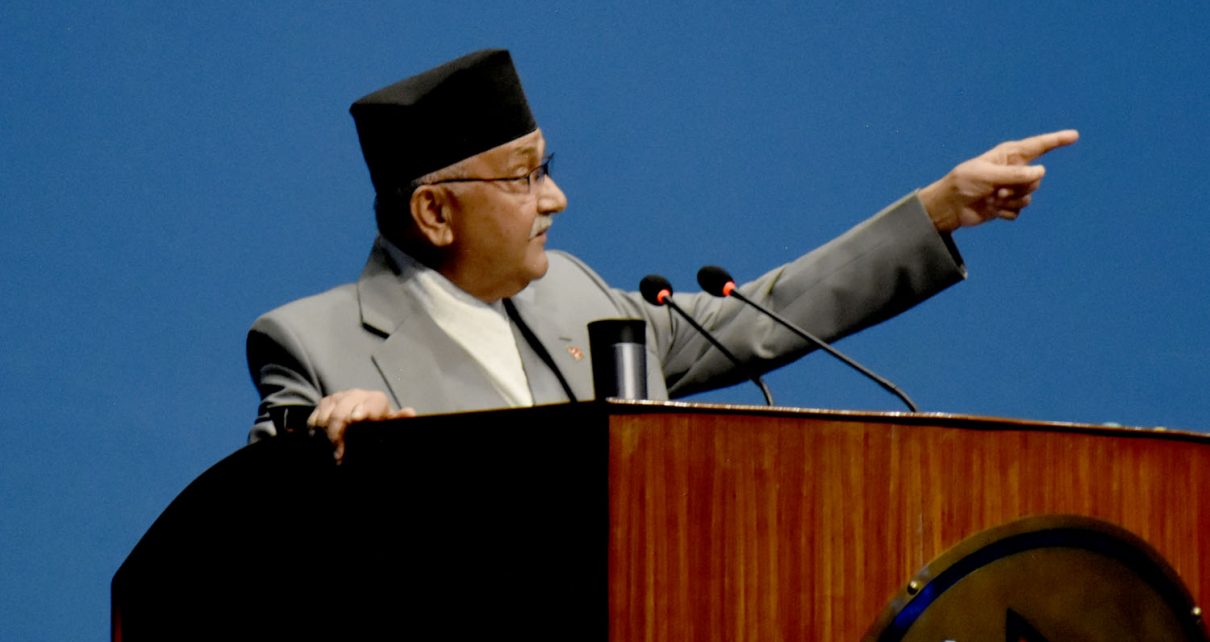
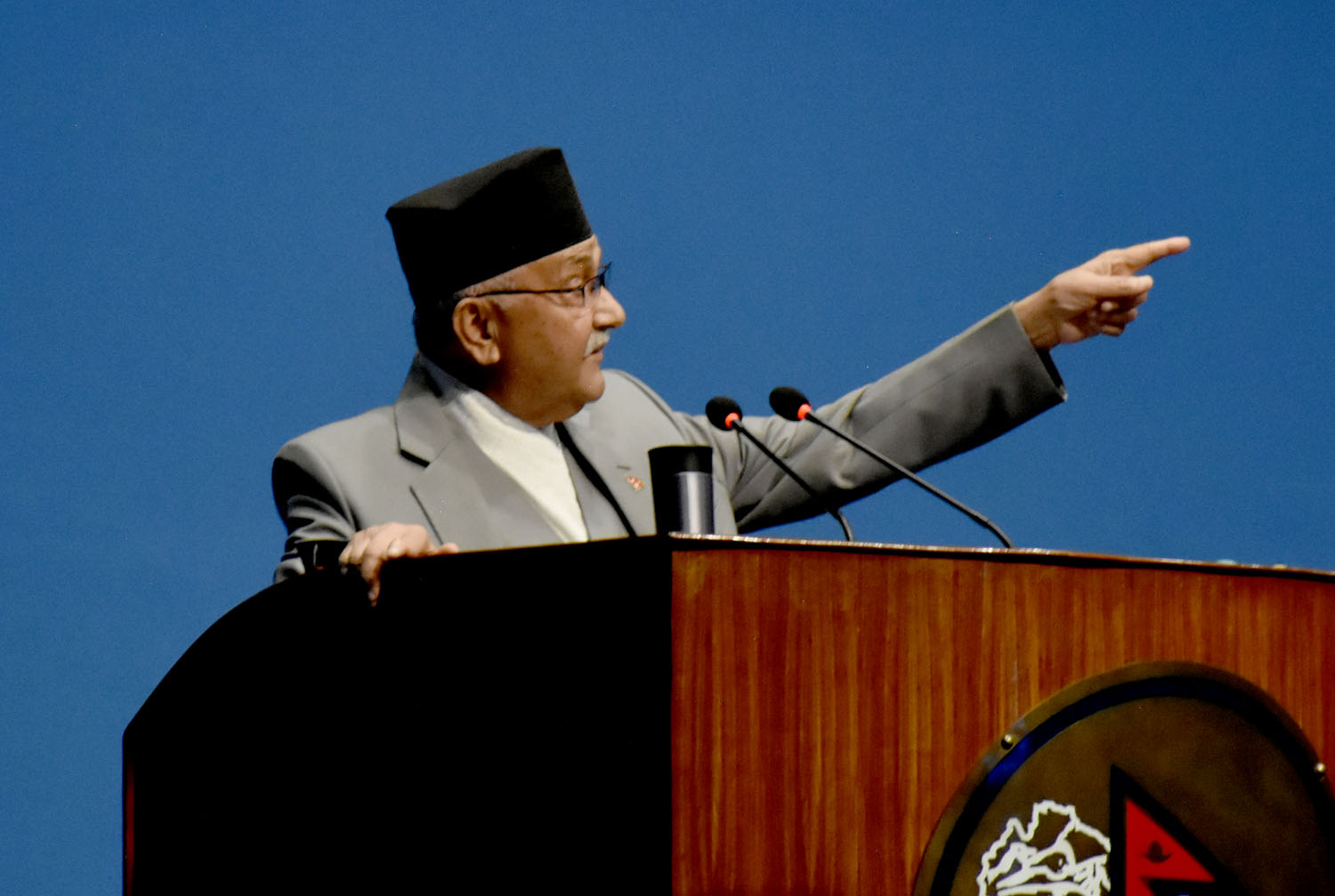
Dr. Geeta Kochhar Jaiswal. The politics of Nepal marches towards a major chaos when Prachanda, the Maoist leader in the Nepal Communist Party (NCP), finally withdraws support to PM Khadga Prasad Sharma Oli. Oli has announced to get the confidence of the House on May 10th. The turmoil has been brewing for months since the frictions became wide open between the two factions of the NCP – the UML led by Oli and the Maoist led by Prachanda. In its March 7, 2021 decision, the Supreme Court of Nepal scrapped the unity of NCP formed since 2018 and revived the two original parties UML and Maoist. The decision was a consequent development of the February 23 directive to reinstate the House of Representatives that was unconstitutionally dissolved by PM Oli on December 20, 2020.
Amidst the Covid-19 crisis, Nepal’s politics has been facing crisis of rule with almost all the parties being unhappy with the autocratic rule of PM Oli; along with inner-party factions and disgruntled citizens. Yet, the issue now is the future of political stability of Nepal. What are the options for Oli ? What if Oli loses the confidence motion ? Will Maoist, Nepali Congress (NC), and Janta Samajwadi Party (JSP) join hands to form the government? Or will Nepal move for fresh elections? Considering the cleavage in the recently united Madhesi Party, i.e., the JSP, there are speculations that Rajendra Mahato, Mahanta Thakur led older Rashtriya Janta Party Nepal (RJPN) will support Oli; while Baburam Bhattarai, Upendra Yadav led older Samajwadi Party (SP) will support Prachanda. Therefore, in some sense the JSP is a decisive force for the future of Nepali politics; though the resignation of some members of UML may churn the wheel for Oli, where possibilities of some 21 to 30 members withdrawing their support to Oli are high.
Oli : The Powerful Nationalist Leader or the Political Loser ?
With the developments in Nepal for the past few years, it is clear that the centre of entire political game in Nepal now revolves around Oli; though Prachanda has been shaking the stage to garner greater support. Seen as a nationalist leader among many, Oli has been taking decisions that have shocked and at times dismayed not only other political leaders, but have sent jitters to leaders across globe. From Nepali journalists to ordinary citizens, all have criticised his policies; yet have supported him on issues of larger national interest. This was markedly visible when Oli raised the issue of Kalapani with India, with a consequence of approving a new map of Nepal incorporating the disputed areas. He then proved himself as the saviour of Nepali land and a great nationalist leader working for national interest.
With a clear majority mandate, Oli came to the helm of Nepal as the President of newly united NCP. From the beginning of his tenure as the PM of Nepal, he has put forth the rhetoric of “Samriddh Nepal, Sukhi Nepali”. His visionary propositions was focused on development and graduating Nepal from a least developed country to a middle-income country with sustainable development by 2030. While there were various challenges of institutional weakness and low public expenditure, Nepal’s economy grew at an average rate of 6-8%; despite the fact that there were aftershocks to the economy badly hit by 2015 massive earthquake.
Besides internal challenges, Oli was faced with a herculean task to manage the two giant neighbours -India and China. His position was to reorient the neighbourly relations with the two powers from equi-distance to equi-proximity. However, considering that China was difficult to woo, Oli opted for the easy route of Nepali politicians, i.e., India bashing to win support from the Northern neighbour. The unity of NCP provided relative advantage to Oli to deal with the Communist Party of China (CCP); and hence, NCP worked rigorously to promote relations with CCP and trained its cadres with Chinese President Xi Jinping’s ideology. Yet, Oli could not win the greater trust of China, as was bestowed on Maoist leader Prachanda. Hence, Oli used diplomatic as well as strategic skills to engaged in frequent meetings with Chinese Ambassador to Nepal Ms. Hou Yanqi and succeeded in inviting Xi Jinping to Nepal, the first Chinese President’s visit after 23 years.
It was without doubt that the tilt to please the Northern neighbour was at the cost of displeasing the Southern neighbour, which Oli perceived as raising his status as a nationalist leader. With Chinese Ambassador meeting not just the Nepali political leaders, but also the Army Chief without proper protocols, it was clear that Oli’s policy of equi-proximity was to build closer relations with China to reap benefits for economic prosperity. One of the critical issues was to negotiate hard on Belt and Road (BRI) projects, so that not only the Tibet Railway line can get speedy connections to Nepal, but there can be projects that can connect Nepal to other countries without touching Indian land. In order to secure Chinese support, Oli went ahead to toe the Chinese line of “sovereignty” and took a drastic step to issue a new map of Nepal incorporating disputed areas of Kalapani, Lipulekh, and Limpiyadhura. Unfortunately, Oli failed to convince China that was looking for action on ground for the approval and progress in BRI projects from Nepal side. In that sense, Oli lost to Prachanda who is a more trusted friend of China.
Oli’s China love or greater proximity is also challenged by the rebalancing Nepal needs to make with US and other western powers in the wake of US-China trade war. Considering Nepal as the first destination for many Tibetan refugees and the attempts to sign an extradition treaty with China, US has been looking at Nepal with caution. It is in the interest of US to rope in Nepal in the Indo-Pacific grand strategy; while Nepal is joining the group of China-Pakistan nexus to manage relations in South Asia. MCC proposal of the US in which the Nepali Army will be supporting the western powers has already become a contentious issue among political parties of Nepal. The failure of Oli to get the majority approval of the House for MCC has also dented his image as a smart political leader balancing multiple voices to gain maximum in diplomatic engagements. Thus, leaving Oli high and dry to swim in rough weathers at home as well as abroad.
Vote of No-Confidence Against Oli and the Future of Nepal
Last year, almost the same period, Oli got President”s approval for two ordinances (Political Parties Act and Constitutional Council) without the consultation in the NCP or broader cabinet, to create rift in political parties, especially the Madhesi Parties. The move was seen as an intent of Oli to consolidate his power with giving no space to Prachanda to take over the seat of President of the Party and the PM of Nepal. Though the two ordinances were later withdrawn, but it exposed Oli’s interest to seek magnanimous power, which only resulted in the unity of JSP that is now seen as a decisive force for the continuity of Oli as the PM.
Oli has now accepted to face the House for the no-confidence vote on May 10 with 53 members (though four had already lost their position) of the Maoist faction led by Prachanda withdrawing from the alliance of NCP. Oli had made urgent calls and met former PM and Nepali Congress (NC) leader Sher Bahadur Deuba to gain support. Oli led UML holds 121 seats in the House of Representatives and it wants 63 members (though two are suspended) of NC to support in order to gain majority out of the total 275 members (currently 271 total with four Maoist losing seat). However, the greater challenge for Oli is the division within UML where Nepal-Khanal faction holds 30 seats who are not in line with Oli and may opt against him.
The other alternative that Oli had tried earlier as well is to split Madhesi party -JSP. JSP holds 34 seats; while two remain suspended. There are differences of opinion between the members of JSP with the former RJPN tilting towards Oli and negotiating the release of their member Resham Chaudhary; while the SP proposing to support Prachanda against Oli. Although there are differences among leaders of JSP, Ms. Sarita Giri, former Member of Parliament and representative of JSP, feels that the leaders of JSP might remain neutral and will go by the trend. There are greater chances of dissolution of the parliament with mid-term elections as Oli is unable to control and manage the parliament, she opines, adding that at personal level Oli and Deuba are collaborating.
With the haste in meeting leaders and gaining support, it seems that Oli will need to think of plan B as their own UML members may change tracks, in which case only NC support or the support of few members of JSP may not work. According to Mr. Prakash Pokhrel, political analyst and writer, history of communist party of Nepal shows that they have lost vote of trust at different points of time. He believes that the role of President Bidya Devi Bhandari is crucial as she is active in uniting the UML members, but if things will not work as Oli desires, then he may extend the date of no+Confidence vote or announce emergency. However, looking at the current scenario, it is highly unlikely that Oli will opt for declaring emergency, though his best bet is to dissolve the parliament and go for elections, which he tried few months back. To rely on the divided support of JSP is living in paradise, though Oli will use all power to lure the members of JSP. The future of Oli may look in turmoil to many, but his acts are much subtle yet vociferous. It is not only hard to unseat him with greater opposition now; but a turmoil in times of Covid-19 pandemics will be counter productive for the future of Nepal.

Dr. Geeta Kochhar, Assistant Professor, Jawaharlal Nehru University; China Fudan FDDI Ambassador in South Asia