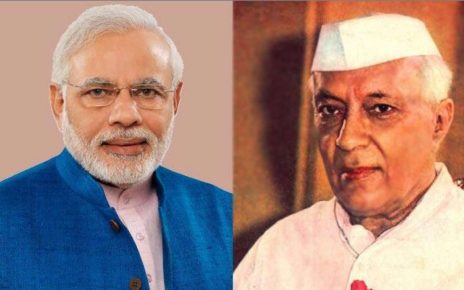
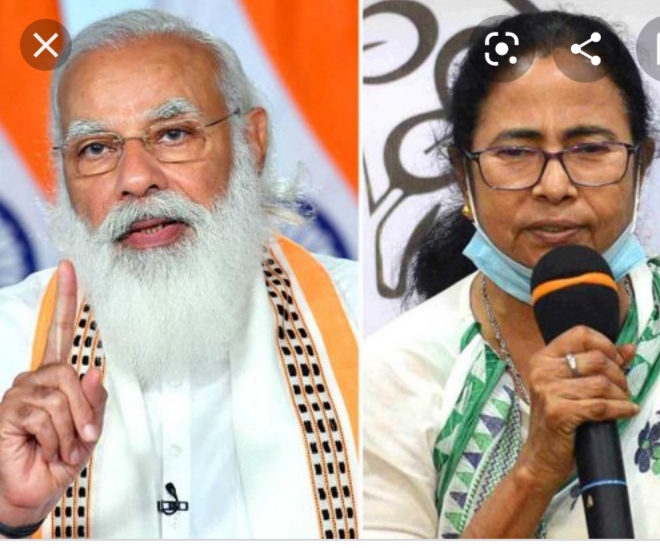
Notwithstanding the Goebbelsian propaganda afoot to malign Mamata and her cohorts by the BJP, the the fact is increasingly becoming apparent to the nation is this: The emergence of Mamata as the purported challenger to hitherto Modi’s exclusive domination in the polity, has driven BJP to the feast of frenzy. Significantly, thwarting of Modi’s Ashwamedha, along with throwing a subtle hint of her national ambition, Mamata has driven BJP to utter despair, for the carefully nurtured BJP’s gameplan of making the national battle perpetually arrayed between Modi and Rahul appears to have run its full course, as the new equation that is destined to emerge on the horizon is: Modi versus Mamata in 2024.
Vivekanand Jha, Ranchi. The popular joke went around the city of Kolkata, decades back when Jyoti Basu was presiding over the destiny of West Bengal: ‘ The very invocation of Mamata Banerjee’s name triggered the raising of strand of hair of Communist patriarch’. In fact, though it was a sarcasm invoked to portray the inordinate sense of apprehension of Jyoti Basu that Mamata’s name evoked. Mamata, in those days, was a rising star on the political firmament of West Bengal, whereas Jyoti Basu was an unquestioned leader of the Communist Party and West Bengal, who had been ruling the state with an iron hand. But notwithstanding Basu’s ubiquitous footprints visible across the political landscape of West Bengal, Mamata too, despite her unsophisticated social background, antithetical to Jyoti Basu’s sophisticated one, had already emerged as a force to be reckoned with in West Bengal politics. No wonder the Biplabi image of Mamata Banerjee had already gained currency by then. The journey of Mamata from the Street Fighter’ to that of a ‘ Biplabi’ had already begun with the power oligarchs fearing her like an invisible ghost everywhere.
The 2019 General Election was a watershed in West Bengal politics: The unexpected victory of BJP, winning 18 seats out of 42, surprised the political pundits. Significantly, the BJP too sensed blood: it came to believe in upending Mamata’s rule in West Bengal and, thereby, heralding the saffron flag in an otherwise secular state. Evidently the BJP, aided and abetted by RSS-RSS’ decades of its works in the interiors of West Bengal -had provided the wherewithal to BJP to dream its eventual conquest of an alien’s bastion. Thus leaving no chance, BJP devoted its fullest of energy towards accomplishing its mission West Bengal. Small wonder then conquest of West Bengal was the pre-requisite for Modi’s successful completion of its Ashwamedha. Further, taming the Royal Bengal tigress would send a positive message to the entire country that Modi phenomenon, irrespective of its intermittent setbacks, remains invincible. BJP, through its Mission Bengal, had sought to convey its message unequivocally: defeating the hitherto entrenched Mamata in her own bastion and strengthening the roots of totalitarianism in the polity-BJP’s agenda of Uniform Civil Code, NRC and other pet agendas depended upon its geographical conquest of the entire India.
2021 Assembly Election was an opportunity for BJP to accomplish its avowed objective of capturing West Bengal. BJP, brimming with confidence with brand Modi, undertook the mammoth task of decimating Mamata. Sensing an impending victory at the hustings, BJP deployed its formidable ammunition: Modi-Shah ballast. This fact could be guaged from the statistical figure of Narendra Modi conducting 12 rallies in 15 days whereas Amit Shah had conducted 62 rallies including the road shows. Shah, emboldened by the massive mobilisation of people, even enthusiastically went on projecting 200 seats for BJP. Such was the confidence of BJP leaders that, most of the Union Ministers, instead of concentrating on their works, commuted between Delhi and Kolkata for electioneering. Buoyed by the surging crowd, Prime Minister himself publicly patted his back for addressing such a mammoth gathering, putting to shreds his own prescription in multiple fora to strictly maintain distance to avoid contracting the contagion. No wonder West Bengal election witnessed the overwhelming flow of money and muscle power. Consequently, the violence unleashed across the landscape of West Bengal made the daily national news.
Regrettably, the constitutional office of Election Commission, throughout the election, played a partisan role, even prompting the Kolkata High Court to indict the office of Election Commission. Castigating the office of Election Commission, the court even went to the extent of invoking T. N. Sheshan’s role as the Chief Election commissioner, decades back. Significantly, during such humongous national crises, the office of Election Commission, which could have abolished the public meeting and introduced the virtual meetings to curtail the gathering of crowd. Had the election commission gone ahead with the virtual meetings, instead of physical ones, it would have been watershed in Indian politics, thereby bringing the serious curb in the deployment of black money in politics. Paradoxically, the Election Commission did exactly the opposite: It sided with the ruling dispensation at the centre. Evidently, despite putting its best, BJP bit the dust at the hustings: Trinamool won the landslide with 213 seats whereas BJP had to contend with just 77 seats, much below 200 seats that Amit Shah boasted, BJP would win. Mamata Banerjee returned with a big bang; Ashwamedha of Modi faltered at the altar of the blitzkrieg of the Biplabi’ Mamata firing from her wheel chair, yet puncturing the big ambition of Modi-Shah.
But then the real drama unfolded in the wake of massive defeat of BJP. In fact, BJP won convincingly only in Assam, losing in Kerala, Tamil Nadu and West Bengal. The abysmal defeat in the hands of Mamata, fuelled an unprecedented display of fury by the BJP leadership. The resultant violence that broke out across West Bengal, where reportedly BJP cadres were attacked, was amplified with an ulterior motto: to lend credence to the fact that law and order situation in West Bengal has completely broken down, thereby inviting the imposition of President’s rule under Article 356 of Indian Constitution. While BJP upped its ante, the office of governor-Dhankar, since the time he took over, he behaved like BJP spokesperson more than that of the constitutional head of the state-exerted an extra effort to aggravate the confusion further by alleging that law and order situation was in serious jeopardy.
The latest crisis brought about by the CBI arresting four Trinammol leaders against Narda cheat fund case. Significantly, the national media, much against the fact, faked the news that how the Chief Minister, along with her party workers, had gheraoed the Nizam Palace housing CBI’s office. The four Trinammol leaders, Hakim, Subrata Mukherjee, Sobhandev and Madan Mitra. Worse still, while the timing of the arrests itself was questionable, the politicians belonging to BJP camp like Subhendu Adhikari, Mukul Roy and Dastidar, are yet to be arrested, for the CBI hitherto has failed to obtain sanction from the Speaker of Lok Sabha. Whereas the Kolkata High Court had cancelled the bails of the leaders and remanded them in the judicial custody till 29th after overturning the bail order of the CBI court. But the matter of grave concern is the inclusion of Mamata Banerjee and Kalyan Bandopadhya for intimidating the CBI officers. Consequently, CBI is seeking the transfer of the case outside of West Bengal.
With the unfolding of the latest crises in West Bengal is the vindication of BJP’s getting increasingly jittery over the rise of Mamata phenomenon as a counterweight to that of Narendra Modi. Modi, carefully nurtured by the BJP strategists, as the invincible God, the bubble today stands punctured at the altar of Mamata’s landslide. No wonder panic stricken BJP, discomfited by the emergence of new Mamata’s phenomenon, appears to have run out of its wisdom, for its stratagem of carefully pitting Rahul with Modi, appears to be replaced by Mamata versus Modi. BJP managers, aware as they are of emerging equation of Biplabi Mamata to take on Modi, has chickened out into orchestrated propaganda of unsettling Mamata to the extent that she might be confined within West Bengal, or kept on tenterhooks so that she is ultimately frustrated to give up her national ambition. In hindsight, as Jyoti Basu’s hair would spontaneously raise hearing Mamata’s name, Modi too, notwithstanding his 56 inch, might too exhibit the similar panic at the invocation of her name. No wonder the imposition of President’s rule is only a tactics, for Modi can seldom risk storming Delhi by Biplabi Mamata. Evidently, 2024 is going to be a battle between Biplabi Mamata and strong man Modi. A titanic battle awaits the nation in 2024.