
By Prof. Dr. Birendra Prasad Mishra . During the last seven decades, India seems to have faced three categories of Nepalese establishment in Kathmandu. The first category of governments was of benign nature. They were neutral and to some extent favourable to it. The second type of governments were strategically hostile to it and continued anti-India activities without displeasing India, as Nepal was dependent on it for the supplies of essential goods and military hardware. And the government of third kind had been out and out hostile to it. These three types of establishments correspond with the three phases of political events and development that took place during this period.
Diplomacy has limited role to play, as it is an instrument to achieve the goal of foreign policy. Hence, the sole objective of a diplomat is to execute the decision of the country s/he represents through one’s ability of negotiation and dealing. To a great extent, bilateral relations between two countries are dependent on psychological, social, cultural, economic, and geographic conditions of the countries.
The Indian diplomacy in Nepal had been challenging and continues to be so with a greater degree. One of the reasons is the psychology of dependence on the one hand, and forgetting reciprocity, on the other. It expects some thing without paying any thing in return. Its one-sided approach appears to be a common psychology.
Rationale behind the Psychology:
This psychology has its reasons. First, the lack of bureaucracy at the early stage in Nepal was the main reason that made it rely on India for its support. Previously, there was no permanent administrative setup in the country till 1950, as it was governed by the whims of the highest authority of the Ranas. The immediate job of the new government, which took over in 1951, was to create a permanent service mechanism to deliver services to the people in the changed democratic dispensation. There was hardly any permanent staff, as every year there used be ‘Pajani’, (a summary dismissal of staff) in which some administrative staff had to be dismissed. Hence, it needed administrative and logistic support from India, which was the only neighbour to come to help in no time to meet its requirements. Sadly, it depended on India for political support as well, as it was not stable politically. Even for economic development, it had to lean on India primarily. India, which was itself in its formative stage, was experiencing difficulties in meeting its own developmental challenges with its limited resources. In fact, it was not in a position to meet all requirements of Nepal and naturally Nepal had to look beyond India. Its contact with the other nations enlarged its horizon to look beyond India politically and its exposures to the external world made it to interact and establish relations with the countries all over the world, which still continues.
India’s diplomacy has been facing constant dilemmas in Nepal on several fronts. First, its foreign policy confronts with contradictions. The post-independent India decided to have a foreign policy that recognized and respected the sovereignty, integrity and independence of Nepal, on the one hand and wanted to have common foreign and defence policies, on the other. Ironically, the British India, which did not face any serious external challenge from China due to conditions of its own and that of the world, tried to meet the Chinese challenges very shrewdly. The post-independent India’ s diplomacy in Nepal faced a new reality, at least psychologically, in the form of the forthcoming threat from China as it became the next-door neighbour by bringing Tibet under its control. The British succeeded in having greater control over Nepal only after 1816 when Sugauli treaty was ratified by Nepal. Its relations with Tibet were somewhat defined in course of time but its relation with China was not defined then properly. There was no clear cut line of demarcation of border between India and China as the British got the border line, known as McMahon line, drawn only on the map, which was drawn by Lieutenant-Colonel Sir Henry McMahon. It later created border disputes between India and China.
The second dilemma is related to its special relations with Nepal. If its international borders with Nepal are restricted, it cannot boast about having special relations with Nepal and if borders remain open, though it can claim to have special relations, it needs continuous vigilance at the borders to check that no criminal and terrorist enters its territories to create havoc inside the country warranting constant security alert.
Simultaneously, the Kathmandu elite is adamant to have the open border restricted, if not sealed for it holds open border dispensation responsible for the imaginary flux of Indian immigrants to Nepal to upset the demography of Nepal. It has been pressurizing India directly and indirectly to control the movement of the people from India. Politically, with the eradication of malaria from the Terai region and deforestation, the people of hills and mountains were encouraged to settle in Terai to outnumber the original Madhesi inhabitants. For this purpose, the government decided to rehabilitate people from Hills to Terai, though in the name of landless people, established special Rehabilitation Company. Ironically, powerful people acquired enough land in Terai. As a result, the far-east and far-west regions of the country acquired the dominance of hill origin people over the Tharus in the west and the Satars in the east. The demographic situation got changed in favour of the hill-origin people increasing their decisive say on the national politics, on the one hand and reducing, if not eliminating altogether, the influence of the original inhabitants, on the other.
Its third dilemma is related to its genuine concern of security on its northern borders. To have its northern border secured, it always considered seriously holding Nepal under its security umbrella. However, after 1950, the Nepal-India relations through the treaty of 1950, continued to maintain the formal traditional relations. However, in course of time, the Nepalese stand underwent drastic change, which is evident from the analysis made earlier. Hence, India has to accept it as a psedo-concern or has to live with it like a migraine, for the days to come. This contradiction may continue for some times implicitly and sometimes explicitly as well.
The fourth dilemma is the faulty perception of the Indian establishment, which always equated Kathmandu and its elite with Nepal. It always tried to please them at any cost neglecting others who really constitute Nepal. If it continues for those who are in power, it is well and good for them and if it deviates from its earlier track by shifting its attention to others, Kathmandu elite will oppose it as has been experienced recently while promulgating the new constitution. Hence, any change in perception will meet with all sorts of opposition and resistance from Kathmandu and will face it in the future too.
The fifth dilemma, which is a corollary of the fourth one, is connected with the inhabitants of Terai/Madhes region who aspired for equality with the hill-origin people. With the people’s movements in Nepal, Madhesis and other marginalized communities like Janajatis and Dalits started aspiring for equality with the ruling elite. They are struggling for it against their stiff resistance. It is obvious from the adoption of the new constitution by the Constituent Assembly half-heartedly leaving room for another struggle. India, if remains neutral, it will be welcomed by the elite and if it shows its sympathy to the Madhesis, it will invite opposition from Kathmandu and its ruling elite.
The sixth dilemma lies in its diplomatic endeavours in Nepal while dealing with its political players. In the Nepalese politics, there were three factors playing their decisive roles. First, it was Monarchy or its shadow (now), which was sovereign and had effective control over the Kathmandu elite and kept its people oppressed and voiceless. Second, the political parties, which came into being in early 1950s, were only after acquiring state power either by pleasing monarchy or opposing it. In their early days, before 1950’s armed revolution, all political activities were banned. Similar situation prevailed again after 15 December 1960, when the elected government was dismissed, constitution was suspended, and PM with his cabinet colleagues were arrested and all political activities were banned. It took almost three decades to end the partyless Panchayat system. Third, it is the people whose interests count decisively in a democratic regime. Nepal is a country with more than 120 castes and communities with their mother tongues. It is multicultural, multireligious, multiracial and multilingual. It is a challenging task to manage the plurality of the country. Sadly, neither the monarchy nor the political parties cared for the people. Significantly, there is no monarchy now. Previously, India had to deal with Monarchy, then it dealt with political parties and now it has to deal with the people. Since Nepal is not a monolithic nation, India has to deal with the people who are marginalized. The Kathmandu elite and those who are in power will not tolerate its minimized dominance. Hence, it is a Herculean task before India to have a balanced diplomacy in Nepal. Any hasty and immature diplomacy will prove to be problematic for India.
Role of China:
India is facing yet another dilemma, which has been resisting the influence of Indian diplomacy, the role of communist China, which emerged as a communist nation in 1949. China captured Tibet in 1959 and declared it later as its autonomous region, perhaps, only for namesake. India always remained defensive in the context of China. Since monarchy and communist regime had one similarity in respect of governance that both preferred centralized, regimented and authoritarian rule, China always stood by the Monarchy, where as India, at least, pretends to stand for its people and democracy. This is the basic difference between the two. China is, therefore, an important factor, which has been playing its role silently and strategically to seek expansion of its share of influence with all its might. In this connection, Lok Raj Baral writes, “China clout in Nepal seemed to have increased in recent years, while India’s role is somewhat declined despite its overarching relations with Nepal”( 1)Baral.2018.) This has actually pushed India to the corner. It is for India to decide whether it has to assert itself suitably or not. Only casual telephonic talks would hardly change the political course.
On the Horns of Dilemma:
India is now on the horns of a dilemma, as it is difficult for it to accept the reality as it is and also is not in a position to change it to suit it. It is high time for India to introspect, revise and devise its approaches and action in dealing with it. Nepal appears to be heading gradually towards becoming another Pakistan for India. It is partly due to India’s approach, partly due to Nepal’s internal necessity and partly because of China, which has been showing its economic might in Nepal. It seems that China has been supporting Pakistan against India in several ways and now it wishes to play Nepal against India. It has now found another friend in Nepal, which is not happy with India.
Choices before India:
There are three choices before the policy makers of India. First, try to neutralize the Chinese effect by positive steps. Second, adopt aggressive diplomacy to pressurize the government to listen to the Indian grievances. And lastly, wait and watch how China handles Nepal and how Nepal reciprocates.
India has to introspect over its own policies and performances in Nepal. The deficiency of India’s past performance in executing its earlier agreements is another challenge, which affects its effective diplomacy in Nepal. There are some misconceptions between them, as India could not execute the provisions of the agreements on the two major river projects, which were signed earlier. The confusion should be cleared as early as possible and the Nepalese claims should be addressed immediately. But the fact remains that the agreements were signed between two countries whereas the execution part was the subject of Indian states that marred the fulfillment of the agreements.
S.D. Muni’s elaboration in this regard is very relevant as he writes, “ The central dilemma of the Indo-Nepalese relations is the incompatible nature of the Indian and Nepalese states, due to their respective social characters. Over the years, marginal changes have taken place in the feudal character of the Nepali State as a very small but significant commercial bourgeoisie and middle class is emerging. But this emergence is still taking place under the protective umbrella of the feudal order.” (2) Muni, 1992, p-9) He writes significantly, “ Political changes in India have not much to do with the policy towards Nepal and consequently, India-Nepal relations. In a way, India’s Nepal policy has always been a matter of debate in the inner policy circles as also at the level of political competition. For instance, during the anti-Rana revolution of 1950-51, Nehru was confronted by two conflicting pressures. One, from the right of the centre, which wanted not to disturb the Ranas and have pragmatic alliance with them to protect India’s perceived security interests. The second pressure came from the Congress Socialists, i.e. those taking left of the centre, who asked for all out support for the democratic forces and carry the momentum of change generated in Nepal at that time to the extent of turning the kingdom into a Republic. These polarities in the Indian political culture have continued to reflect that Nepal-bias for all these years, wherever need for taking position has arisen. These polarities existed even in the Janta government (with its socialist members pushing the government towards greater identification with B.P. Koirala and his Nepal Congress and the traditionalist elements, like the B.J.P. and even Prime Minister Morarji Desai favouring a harmonious relationship with the king), which was otherwise committed to be soft and accommodating towards all the neighbours, including Nepal. This was to underline the Janta government’s contrast with Mrs Gandhi’s approach and style in dealing with India’s neighbours.” (3) Ibid,)
Significantly, in the last century, the world gradually turned into a global village and the countries, which fought two World Wars in Europe, joined hands together, although Britain is in the process of pulling out of it. Especially, in the 21st century, not only did these countries abolish their visa system for their citizens, they did also introduce a common currency. The Korean peninsula has started dreaming of unified Korea and lasting peace forgetting the war that divided the peninsula into North Korea and South Korea in mid-20th century. It is the prime duty of the leaders of these two countries to sit together and evolve a common interest strategy to avoid further gap between the two, otherwise, both the countries have to face ugly situations which , probably, they have not visualized. The diplomacy of one country will prove effective, only if, another responses positively.
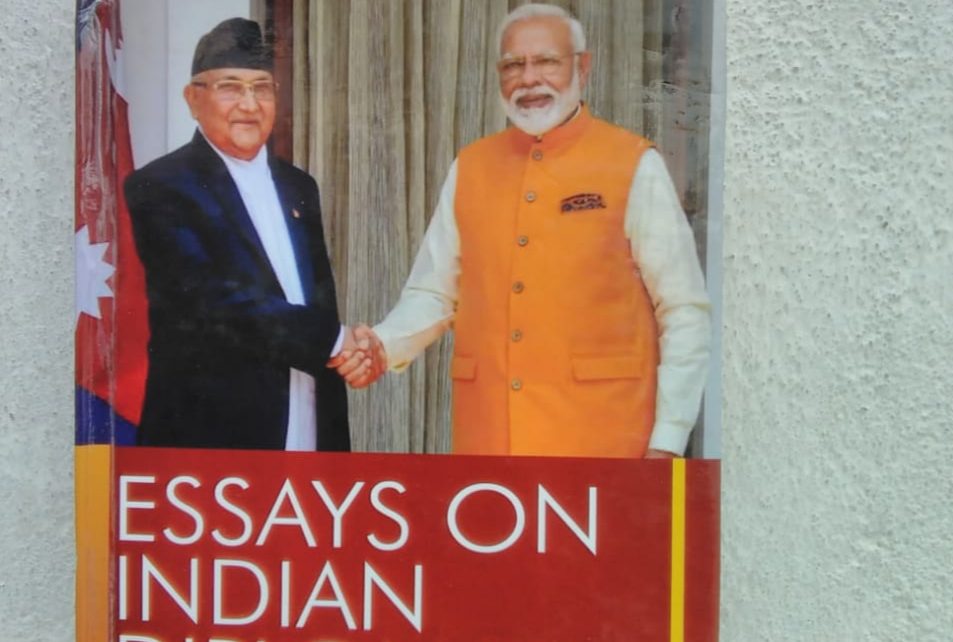
(The conclusions of the book ‘Essays on Indian Diplomatic Dilemma in Nepal’, pub. in 2019 by Adroit Publishers, New Delhi.) By Birendra Prasad Mishra, (mishra_bp@yahoo.com)
Reference:1.Baral, Lok Raj. 2018. Preface to Politics of Geo-Politics: Continuity and Change in India-Nepal Relations.2. Muni, S.D., 1992, India And Nepal,. 3.Ibid, pp.,9-10.