Vivekanand Jha, Ranchi. When the gladiatorial battle couched in the sophisticated tricks of diplomacy is masqueraded in terms of one upmanship between the two Asian giants seeking to leverage Nepal, it is the the time Modi’s ‘Neighbourhood First’ policy should express itself decisively to prevent Nepal from degenerating into another buffer state of China, after pulverising Pakistan.
India has finally woken up from its self -induced slumber. However,
the perception that is gaining currency, on both sides of the border, is this: By the time the realisation has dawned on India that the neighbouring Nepal deserves far more attention than what India thought it required, the situation is fast moving out of the latter’s influence. Worse still, when China has almost made Nepal its another home, New Delhi’s suddenly developing its cold feet, panic stricken in its reaction, India is scurrying for an immediate cover, reflecting its serious anxiety to have lost the political game in its diplomatic chessboard. Unfortunately, New Delhi, cannot shirk its own responsibility of being certainly lax, even if not negligent, in terms of affording space for the Chinese influence to infiltrate Nepal’s political corridor. The commonality of Hndu religion that had bound the nation together, since ages, ironically has ceased to matter it anymore, when Nepal s seeking a more closer relationship with China as a bulwark of its protection from any type of exploitation in the hands of India, exemplifies that how Nepali intelligentsia, especially the
Paharis, the so-called aboriginals, have come to loath any Indian stranglehold over their polity. In fact, the deep divide between the Paharis–the aboriginals, and Madheshi’s –the people of Terai region–was too stark to be ignored. The discontent was simmering between these groups for decades, and has finally assumed its monstrous proportion when the simmering tensions between both the groups became apparent when Nepal’s Constitution was unveiled during the presidency of Dr Ram BaranYadav,
It was in the month of September, 2015, I had visited NepaL, from the Madhubani side of the border, I straightway entered Rajbiraj, a part of Mithila, on the other side of the border. Staying in Rajbiraj for a few days, I visited Kathmandu, where I stayed as the guest of the then first Vice- President of Nepal, Shri Parmananda Jha. The underlying objective behind my visit to Nepal was to portray the two topmost people of the country from Maithil community–it was the the historic privilege of the Maithil community that, for the first time in the history of both India and Nepal, two Maithils had ascended to the highest constitutional positions of the country.–both the President as well as the Vice- President of the Republic of Nepal.
Significantly, I was a stranger to Shri Parmanand Jha, apart from managing to get some recommendation from one of the retired foreign service officers of Nepal in Rajbiraj. With that recommendation I was
allowed inside his chamber. Interestingly, Shr Jha, on coming to knowmy avowed mission to write a pioneer book on ‘The Living Legends of Mithila’ wherein I intended to figure him out, evinced an overwhelming interest in my work and consequently hosted me there in Kathmandu. It was also his grace that enabled me to have an august audience with the first President of Nepal, Dr Ram Baran Yadav at Sheetal Bhavan. In fact, it was my first experience of Paharis’ extreme bitterness towards Madheshis. In some of my subsequent meetings with elite Paharis, I could sense a deep revulsion in them when they deliberately feigned an ignorance about knowing who their president or vice-president was. Even, after being reminded about their names, they would express their apathy with a sense of resentment, unequivocally suggesting to me the deep ostensible divide that defined Nepal’s intelligentsia class. Later when I had gone to meet the President Dr Ram Baran Yadav, I had an excruciatingly difficult time in negotiating with his Royal army guard—neither they understood Hindi nor English, only Nepali—and I understood no Nepali. When taken inside for a meeting with the President, who, despite being a Madheshi, spoke to me exclusively in English. Dr Ram Baran Yadav had discussed with him about Indo- Nepal relations. In contrast, Shri Parmananda Jha, an intrepid vice- president, conversed with me freely in Maithili and, at times, in Hindi, without the least of equivocation or, any moral inhibition.
The Vice – President Shri Parmananda Jha was a crusader. He, in fact, stood for the entire Madhesh and Madheshis as few people ever had. Seeking to unify the entire Madheshis in a common unified whole, Shri Jha had taken the constitutional oath of the Vice- President in Hindi, causing an unprecedented turmoil across Nepal. No wonder in no time, the allegations were flying thick and thin levelling him as a ‘traitor’. Significantly, Nepal’s constitution decrees in favour of taking the oath of any constitutional office in any of the mother tongue, and Hindi was the eighth language incorporated in the Constitution. But then the ostensible aversion for Madhesh and the Madheshi’s language, propelled the massive unrest across Nepal, dubbing the vice- president as an Indian agent, for having taken an oath in an Indian language. In the midst of the escalating crisis, the petition was filed in the Supreme Court, seeking a direction to invalidate the post of a vice- president, because Parmamanda Jha had disgraced and undermined it by showing an open contempt for the national language of Nepal, while embracing the language of India. Justice Basnet, who was the Chief Justice then, was alleged to be opposed to Parmananda Jha, and therefore, the latter sought his recusal from the Bench of five judges constituted to hear the case.
Yet the Bench went ahead under Justice Basnet. The judgment delivered was already on the predicted lines: Parmananda Jha should take the oath in Nepali within a fortnight, or the post of the Vice- President shall remain in the suspended animation. Yet Parmananda refused to follow the verdict. Even his own party, Madhesh Janadhikar forum, waslosing its substantial strength because of the series of splits, and its leader Mahant Thakur and Rajendra Mahato, requesting Parmanada to fall in line, as the verdict came from the apex court, failed to
persuade the vice- president to change his stance. Parmananda, staunchy felt that he stood by the language of the majority of Madheshis, the language that bound the Madheshis as one people. Later, he undertook the tour across Madhesh region to explain his stand, and got a rousing reception from his own people. FInally, by way of compromise, it was agreed that Parmananda would take oath in Maithili as well as in Nepali. He decided to go ahead with it, as the support for his staunch stand on Hindi, began to lose steam, with the passage of time.
Hindi is the connecting language of all Madheshis. The Madheshis,
consisting of Maithils, Bhojpuris, Awadhais, Adivasi and others, even
though have their own mother tongue, but when it comes to a connecting link between them, Hindi plays a pivotal role. It was the strength of Hindi that Paharis dreaded and consequently did everything to emasculate it. They feared the mobilisation of Madheshis’ along this language, which they inordinately feared may continue to sustain India’s stranglehold over Nepal’s polity. No wonder while they did everything to defeat Paramanda’s strong resolve to stand by the aspiration of Madheshis as well as that of the long term strategic interest of India in Nepal, which, unfortunately though, the South Block, immersed as they remained in their own policy procrastination, resulted in Paharis’ first victory over that of not only the Madheshis, but strategically it was the victory of Nepal’s power oligarch that had long been aspiring to banish India’s influence in policy making corridors of power. Simultaneously, the power oligarchs who resented India’s influence in their internal affairs, profoundly aspired to invite China to play the pivotal role in not only balancing the Indian influence, but defining and shaping their economic and
political lifestyle. Ironically, the South Block was caught napping when the power oligarchs contemplated inviting China to replace India. It was not that China was the stranger to Nepal’s affairs; in fact, Nepal had begun hobnobbing with China, in the wake of Rajiv Gandhi’s ill- timed and ill- fated decision to teach the younger brother Nepal a bitter lesson when he had recklessly banned the movements of Indian goods to Nepal in the year 1989. The obnoxious decision taken by the Rajiv Gandhi government then to teach the errant Nepalese the lesson of their lifetime, ultimately was the trigger for Nepal’s realisation that, its exclusive dependence upon its big brother India was its strategic mistake. Small wonder then while Indian blokes in South Block gloated over its big brotherly status, little did it realise that in its statchen fruide, it has pushed Nepal in the eventual lap of its biggest rival in Asia, far more powerful than itself, China. Little did the foreign policy czars in the South Block anticipate that, because of their lopsided vision, they had put India’s long term strategic interest to perpetual jeopardy. Nepal, on the other hand had not only serendipitously hit upon their unexpected benefactor in China, but ingeniously hit upon an idea to play India against China. Not only
China had bailed out Nepal then but also held a hope for the future strategic relationship to insulate them from what they perceived as India’s big brotherly, tyrannical attitude.
Notwithstanding, the Hmalayan blunder of Rajiv Gandhi in 1989, India
had another golden chance in 2015 when Narendra Modi had already
started shaping India’s foreig policy. He knew that China was no longer a peripheral player and consequently standing solidly by Pramanada Jha, could have strengthened the Madheshis against the new elites in the power corridors whose love for China and the corresponding visceral hatred for India, was an open secret.
Incidentally, the way Parmanada was harassed by the Paharis’ apparatchiks, and India not showing any inclination to solidly endorse him, was the sufficient indication of the the things to unfold: The weakening of Hindi not only was the consequential factor in emasculating the Madheshis, but it held the imminent expulsion of Indian influence in the power citadel. Unfortunately, the Madheshis
too stood divided as the subsequent unveiling of the constitution openly vindicated: While Madhesh area was strategically fragmented to break its intrinsic solidarity, the president, ostensibly exhibiting his unswerving loyalty to his country, condescending inimical to the interests of the Madheshis, purportedly accepted the discriminatory constitution with reverential salutations. Whereas if the president had been forthcoming with his own criticisms of the constitution, which was apparently discriminatory towards the Madheshis’ long term strategic interest, perhaps the world would have taken cognizance of such disparities and partialities. No wonder the president’s silent acquiescence to the adoption of the constitution, validated the claim of the Paharis that the constitution was equitable and, therefore, the barrage of criticisms directed against the constitution by the Madhesh’ leaders were simply motivated by their narrow, partisan interest. Had India staunchly backed Parmanada Jha, on his stand on Hindi, India’s strategic interest in Nepal, would not have been prejudiced as it stands today.
The banishment of royalty from Nepal and the consequential arrival of Communists in Nepal, on the one hand was the bonanza for China, it
held the prospect of dread for India, because Communists are known to
have their extra -territorial loyalty to Russia and China. Prachanda,
soon ascending the power, visited Beijing, instead of New Delhi. It
was, in fact, the first instance of the things to come in the future.
Later, K.P. Oli Sharma had mastered the art of playing China against
India. K.P.Oli, the incumbent Prime Minister of Nepal, has a visceral
hatred for Hindi. Such has been the magnitude of his contempt for
Hindi that, during the last visit of Narendra Modi to Janakpur,
K.P.Oli had warned his minister Jitendra Prasad Sonal, a leader from
Madhesh to skip Hindi during anchoring and, instead, choose some other regional language. However, Jitendra Prasad Sonal had defied the warning of K.P.Oli and went on speaking Hindi at the stage. The subsequent steps have so irrevocably established the fact that Nepal today stands deviated from its moorings: while the mandarin has become ubiquitous across Nepal, Hindi has been withdrawn from the schools and colleges. There is a palpable hatred for Hindi in the establishment, among the elites who preside over the destiny of Nepal today. The rapid Chinese infiltration in the power corridors has marginalised Hindi and the overall aspiration and the clout of Madheshis. Hence in this backdrop, the overall worries and anxiety of the diplomats at the South Block, too has accentuated to the unconscionable level that exhibits the flurry of tours undertaken by the highest officials of India.
In the meanwhile, the increasing clout of the Chinese ambassador, Hou Yanqi who has almost taken control of K.P.Oli , is apparent to one and all. Notwithstanding the speculations galore, the truth cannot be denied that how Hou Yanqi had been dictating the policy in Nepal, and has been exerting all her efforts to keep the detractors and dissidents of Oli in check. For instance, the power struggle going on within the Nepal, between Prachanda and Oli, where Oli has the unequivocal support of Hou Yanqi, In fact, despite the Nepal Communist Party standing a divided house and Prachanda’s strong opposition to K.P.Oli, thus far was adequately dealt with by Hou Yanqi, yet how long she will be able to deal with it, is a million dollar’s question? Besides, the recent tour of General Manoj Mukund Navrane to Nepal when he met K.P. Oli. Prior to Navrane’s visit, the IB chief, Samant Kumar Goel too met Oli, And, if the reports are to be believed, Vijay Gokhale too, the foreign secretary of India, is about to undertake a visit to Nepal. To counter this flurry of visits from Indian side, China’s Defence Minister Wei Fenghe too is likely to visit Nepal in the immediate future. The situation today is very delicate: with China, already entrenched in the corridors of power, it is well nigh impossible for India to destabilise it now. Worse still, India has been dogged by certain apparent shortcomings: The ambassador Vnay Mohan Qwatra, a virtually new appointee, has been dogged by the pandemic Covid, resulting in his meetings with only few influential people. Added to this is the bedeviling shortcoming of a fixed tenure of 3 years for the staff in the Indian mission; the staff takes almost a year to settle down and, as they begin to work, the time of their departure comes. Even the DIC and the PIC is new, thus inhibiting the functioning of the embassy. Whereas the Chinese ambassador is going great guns, India is inhibited by the cripping shortcomings as explained above. India is in a desperate situation today so far as its overall depleting clout in Nepal is concerned. In hindsight, India had lost an important opportunity already when not standing solidly by Parmananda Jha, who had given a clarion call for the rehabilitation of Hindi, by taking an oath in Hindi for the high constitutional office of the Vice- President, Hindi is India’s soul, and if the soul suffers the
ignominy, the nation’s downfall is more than assured. Modi government’s ‘Neighbourhood First Policy’ is in shambles today. Importantly, after Pakistan, Nepal too suffers the bright chance of getting pulverised into another buffer state of China, which India has to stop by fair or foul means. No wonder then, India’s primary interest lies in ensuring that Hindi is restored; it gets the primacy of its place. The weakening of Madhesh is the crushing blow to India, it is this realisation which should have dawned on the mandarins in the South Block long back. Yet, India has to fight back. It cannot let Oli destroy Hindi and the strategic interest of Madheshis. India should recall that the weakening of Tamils in Srilanka, ultimately resulted in the emasculation of India’s strategic interest there. Thus, India’s mandarins in the South Block, should mull this issue meticulously. India has already jeopardised its own interest by neglecting the interest of Madhesh, even though India had strongly taken up this issue during the unveiling of the constitution. However, it softened its own stand when it felt that it would irritate the Paharis. This approach has to go. The mandarins in South Block should keep this factor in mind, if the long term interest of India is to be sustained, Hindi is to be restored to its pristine glory. This should be the immediate goal of the Modi government and his ‘Neighbourhood First’ Policy. Worse still, the recent infiltration of Chinese in Terai region is also a grave cause of concern for the policymakers in the South Block
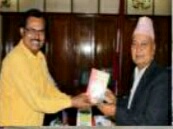
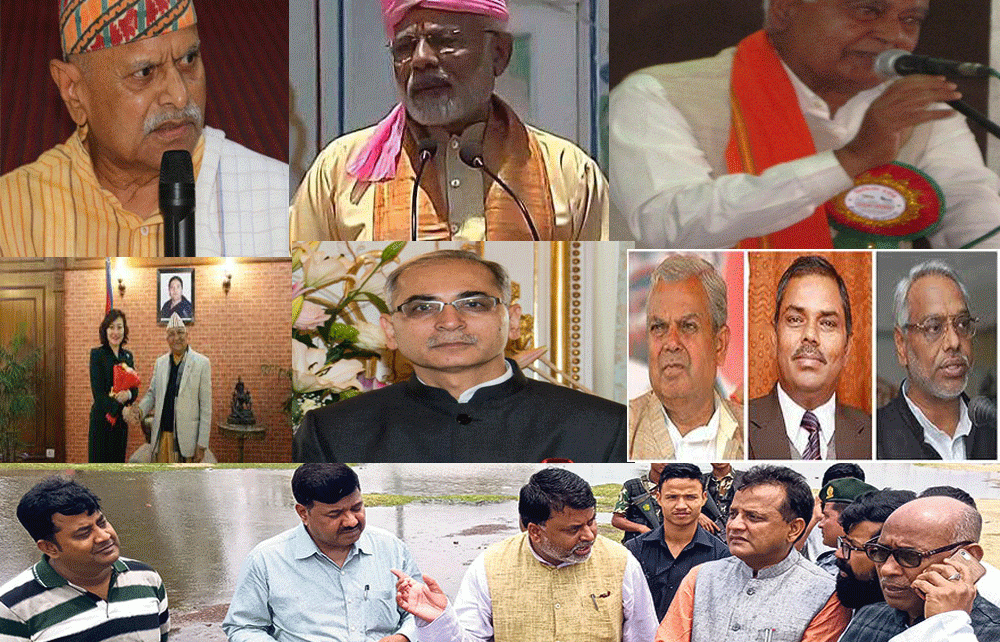
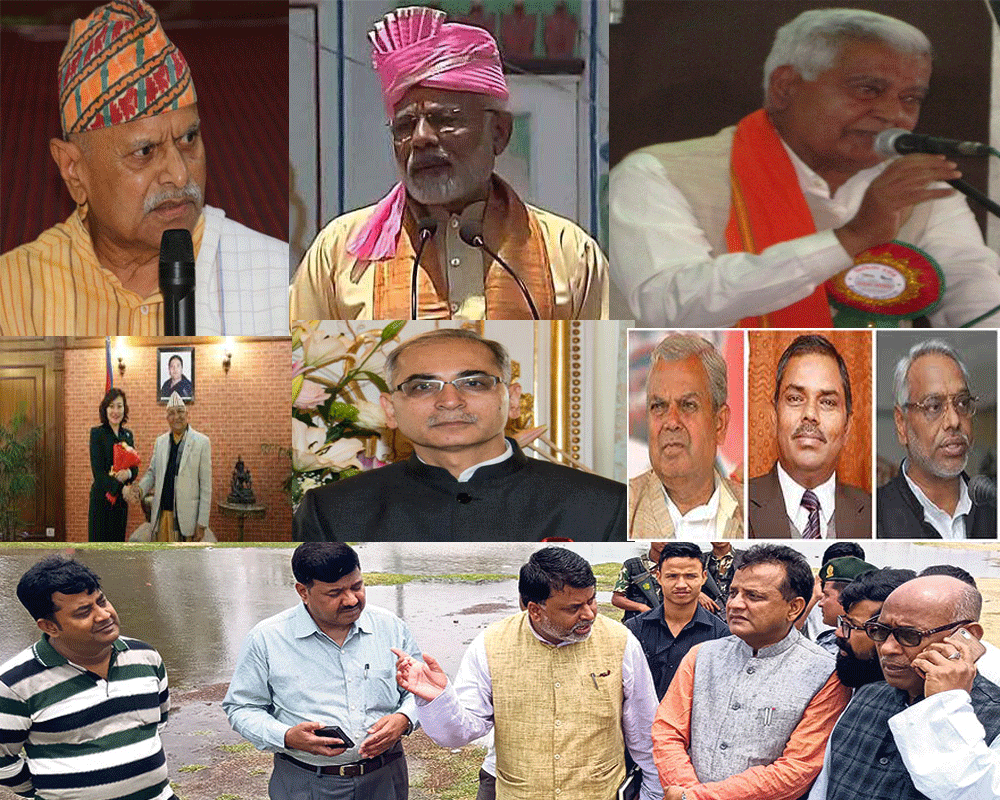
Vivekanand Jha to the President and the Vice President of Nepal in the
month of September, 2015
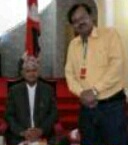
Vivekanand Jha is an author of ‘Yes, I am Bihari’ , The Living Legends
of Mithila, ‘Delhi Beckons: RaGa for NaMo. He is an author and a
Public Intellectual. ‘