Birendra Prasad Mishra, Retd.Prof. of Philosophy, The Bhagavad Gita, which is a collection of 700 verses, is a part of the Bhishmaparva of the Mahabharata. Almost all Indian scholars subscribe to the view that it is a part of the Bhismaparva, some Western scholars do have some reservations on it. In this short article, an effort has been made to prove that being the theistic theme of the great epic Mahabharata, it has been inserted into it later.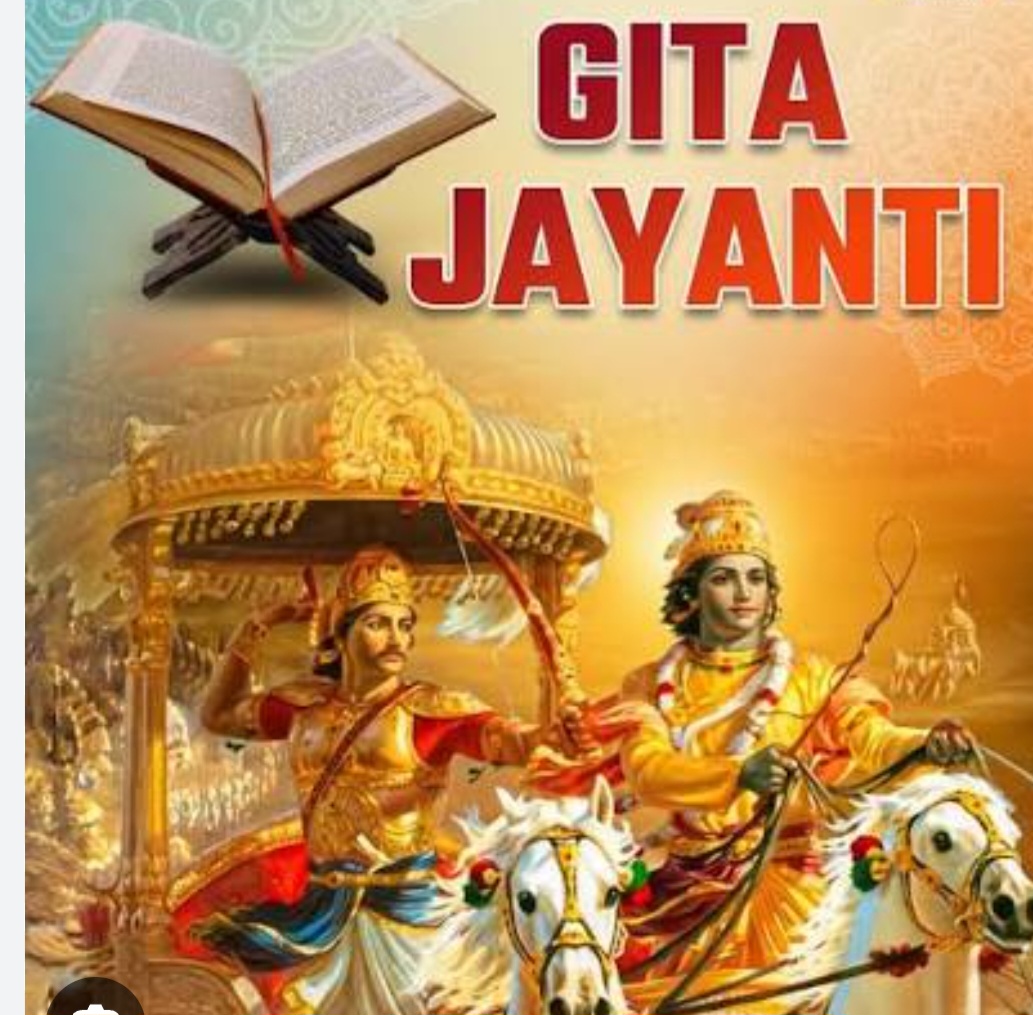
The Gita mainly presents the conversation between Arjuna and Krishna on the battlefield of Kurukshetra, where Arjuna decides not to fight, and Krishna tries to convince him to fight with his physical, metaphysical and social arguments and lastly with showing his acosmic form, in whose mouth everybody is entering, horrified him. This state of his mind confirms his faith further in Krishna’s divinity as Paramatma, the supreme being.
The Purpose of the Gita: Promotion of Religion and Philosophy
Before the conversation between Arjuna and Krishna comes to an end, Krishna, in verses 18.67–71, defends his philosophical and religious( spiritual) teachings that he has taught to Arjuna so far. In these verses, his final objective becomes clear, as he tells Arjuna that those who do not perform penance with knowledge, or who do not have devotion to Krishna, should not even desire to listen to this knowledge. And those who have a faultfinding attitude should not be given this knowledge either (18.67).
He tells further that the person who teaches this secret knowledge to his devotees will undoubtedly become devoted to him and will attain him. The one who shares this teaching with others will become his dearest devotee, and he will bestow upon him his highest love. He adds that whoever studies this spiritual dialogue will be performing a kind of wisdom-based worship to him. The one who listens to this teaching with faith and without a critical mind will be freed from sin and will attain the highest realms reserved for the virtuous. Though, at the end of the dialogue (18.63), Arjuna says, “Karishye vachanam tava,” which means, “I will follow your advice”. Though he assures Krishna to fight, he does not pick up his bow and arrows and stands up immediately to fight.
The suggestions of Krishna to Arjuna raise some serious questions: When the war was about to start, why did he feel the necessity of making such declarations? Why does he say that whoever listens to or studies this teaching would receive proper results or liberation? From the contexts, it appears that the Gita was inserted later into the Mahabharata, so that a particular religion (Dharma) and philosophy promoted by him could be spread and communicated through an appropriate context of the great epic.
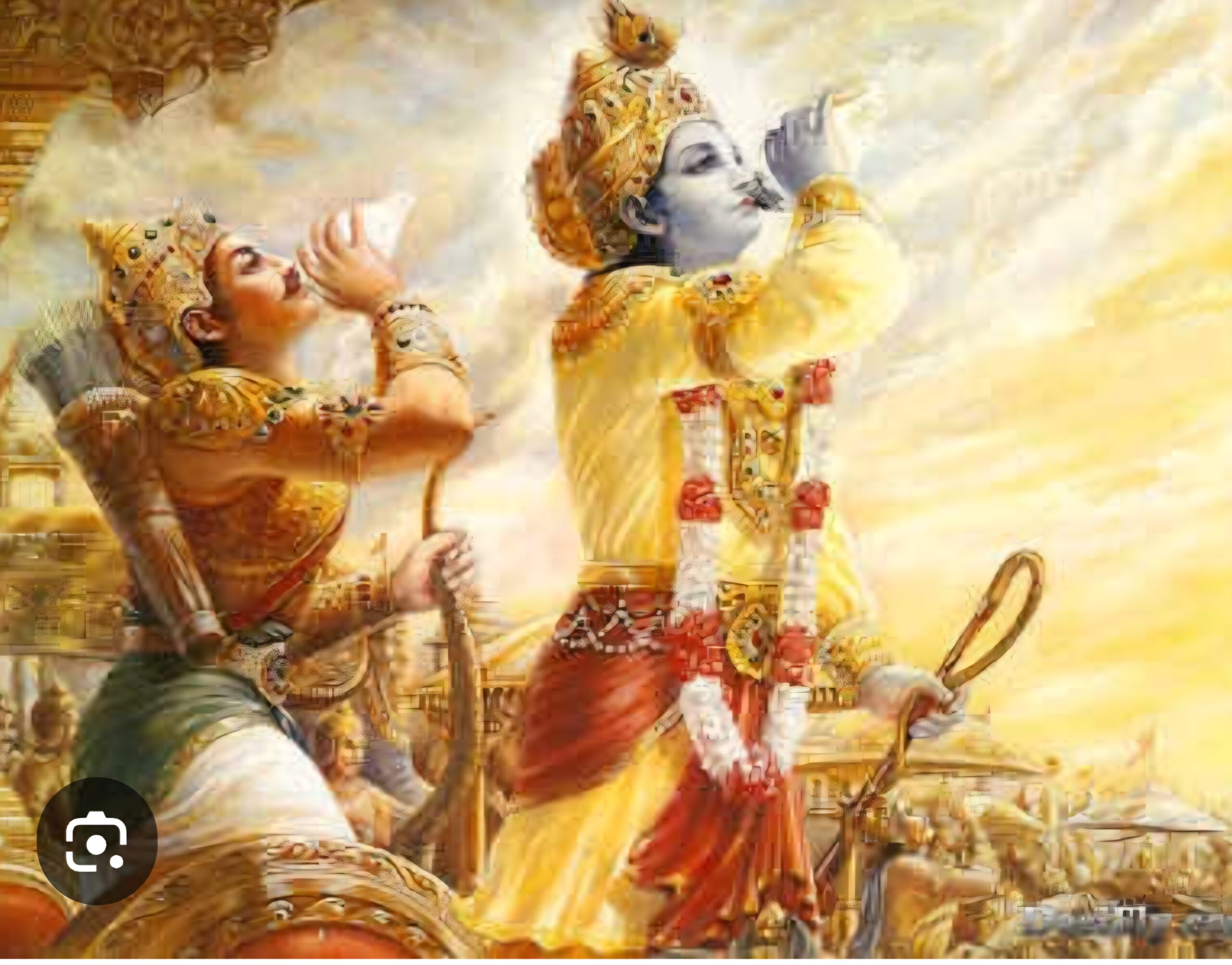
. The Gita begins with fully armed Arjuna to fight being brought into the middle of the battlefield by his charioteer Krishna as per his command. It changes the mind of Arjuna who refuses to fight after seeing all his kinsmen, elders, teachers, and relatives ready to kill or be killed. His mind and heart at once plunges into grief and sadness for them and the feeling of renunciation overpowers him. It makes him to sit as he is unable to stand with his bow.
Arjuna contemplates about two things– the purpose and the end of the battle. As every war is fought with a purpose, and always involves casualties on both sides and ens with one side wining and the other side getting defeated. Correspondingly, two natural questions arise in Arjuna’s mind: First, is the purpose of this war. Is it truly just and beneficial for him? And second is its result. He wonders what benefit will come from this battle, if the people for whom this war is being fought are no longer alive?. Since who will die and who will live further is uncertain, what meaning does this war provide? How can he raise his arms against his respected elders, those who raised him, who taught him the art of warfare? Realizing his circumstantial inability, Arjuna feels it would be better to live by begging rather than killing them in the battle.
Similar Mindsets of Arjuna and Yudhishthira
Significantly, a similar mental state of detachment is observed in Yudhishthira in the Shantiparva after the battle is over and he becomes king. The very reasons for which Arjuna refuses to fight before the war are later echoed by King Yudhishthira, who after his victory, laments for those who lost their lives in the war and expresses his wishes to renounce the kingdom and retreat to the forest. The early chapters of the Shantiparva describe it in detail.
The Arjuna’s mental turmoil before the war, and the Yudhishthira’s sorrow after the war, both appear entirely natural and similar.Arjuna’s agony has arisen out of thinking of relatives,and respectables, where as Yudhishthira’s sorrow is caused by the death of both friends, relatives and foes, though some are respectable in the war. The same mental condition is reflected in both the Gita and the Shantiparva. It appears that Yudhishthira is unaware of the discourse between Arjuna and Krishna that takes place before the war begins in which Arjuna refuses to fight. He fights the battle after Krishna’s long persuasion, as described in the Gita. If the Gita is a part of the Bhishmaparva, then why is it not mentioned by Arjuna when Yudhishthira discloses his mind to his brothrers and Arjuna exclusively?. This is a subject that deserves elaboration.
In the first chapter of the Shantiparva, we find a description of Yudhishthira residing for one month on the banks of the Ganges after secret ritual water-offering to all those who die in the war. During this time, sages like Dwaipayana Vyasa, Narada, Maharshi Devala, Devasthana, Kanva and others come to meet him. Honoured according to the occasion, they gather around the grief-stricken Yudhishthira, reassuring him and sitting beside him.
Narada is the first to ask Yudhishthira: “O King! You have conquered the entire earth through your physical strength, by the grace of Lord Krishna, and through the power of dharma. Thus, the whole world has been freed from war. Are you now prepared and happy to follow the duties of a Kshatriya? All your enemies have been vanquished, and you are keeping your dear ones happy, are you not? Having attained the blessings of kingship, you are not troubled by grief, are you?” (Shan.1.10-12)
In response to these questions, Yudhishthira says: “By Lord Krishna’s grace, the blessings of the Brahmins, and the valour of Bhima and Arjuna, I have indeed conquered the entire earth. But in my heart remains constantly the overwhelming sorrow—that out of greed, I caused the massive killing of my own kinsmen (1.13). I am deeply grieved by the death of my sons, but what pains me most is the death of Karna-my eldest brother, whose true identity was kept hidden from me by my mother Kunti.(1.18)
Later, in the seventh chapter of the Parva, Yudhishthira expresses his state of mind to Arjuna in these words: “Arjuna, had we gone to the city of Dwaraka, the home of the Vrishnis and Andhakas, and begged for our livelihood, we would not be suffering this misery after destroying our entire clan. Our enemies’ goals have been fulfilled. All those for whom we did all this are now gone. After killing our own relatives, what fruits of dharma can we possibly obtain? It is a shame upon the customs, strength, courage, and pride of the Kshatriyas, which have led us to this dreadful situation. Out of greed and attachment for royal pleasures, and relying on vanity and arrogance, we have fallen into this misfortune.(3-6)
Yudhishthira says, “When we saw that all our kinsmen who longed for victory over the earth had been slain, we realized that even if we were offered dominion over all three worlds, we would not be content. For the sake of this petty earth, we killed kings who were invincible, and now, bereft of our loved ones, we live a meaningless life. Just as dogs greedy for flesh meet ruin, we too, who were greedy for kingdom, have met ruin.”(8-10)
He states that these relatives of ours who were killed—we should not have sacrificed them, even if we had been offered the whole earth, heaps of gold, all the cows and horses in the world (11-17). The laps of mothers have been emptied. Those who were slain have neither enjoyed this earth, nor have they been able to repay their debts to the gods and ancestors in the afterlife—for they did not even receive the proper funeral rites (18).”
Yudhishthira attributes the entire destruction to the sons of Dhritarashtra, for they conspired to deceive the Pandavas, harboured hatred toward them, yet outwardly pretended to be polite and humble. Blinded by his attachment to his son, Dhritarashtra endorsed Duryodhana’s desires and never considered the counsel of Bhishma or Vidura. Duryodhana, in the end, left his aged parents immersed in the fire of grief.
Yudhishthira says, “We killed great warriors and plunged our land into the depths of ruin. Though our wrath was calmed by destroying our enemies, this sorrow continues to haunt me constantly” (7.36). Therefore, he tells Arjuna that he wishes to bid farewell to everyone and retreat to the forest. His reasoning is that sins committed can be destroyed through confession, virtuous deeds, repentance, and charity (7.36). Likewise, by becoming detached from worldly life, undertaking pilgrimages, studying scriptures, and practising chanting (japa), one can also rid oneself of sin.
He also refers to the Shruti, which commands that a renunciant (tyagi purusha) commits no sin and is free from the bondage of birth and death (7.38). Yudhishthira states that he committed sins due to his desire for possession, which inevitably results in the cycle of birth and death. Finally, he tells Arjuna that he should rule this secure and peaceful kingdom because Yudhishthira himself has no further need for kingship or worldly pleasures (7.42). Arjuna, however, encourages Yudhishthira to rule the kingdom as per royal duties while describing the importance of wealth and requests him to perform yajna, sacrifice.( chap-8) .
Thus, the liberation (moksha) that Krishna promised to Arjuna in the Gita becomes Yudhishthira’s ultimate goal as well. Therefore, the attainment of liberation appears to be the highest objective of both the Gita and the Mahabharata.
If we analyze the different episodes of the Shantiparva, we find that the essence of the Mahabharata has been summarised in the Gita. In other words, the Gita is the conclusion of the Mahabharata, and particularly of the Shantiparva. It contains ideas and discussions that appear again in the dialogues between sages like Vashishtha and Yajnavalkya, or Janaka, and in the Naradiya Upakhyana(discourse), including philosophical topics such as Prakriti and Purusha, the perishable (kshara) and imperishable (akshara), and the nature of Lord Narayana..
Despite the fact that the Gita’s main objective remains to inspire Arjuna to fight, its deeper and ultimate aim is to articulate and propagate Krishna’s religious, philosophical and moral worldview. One of Arjuna’s key questions is: can anything truly beneficial (shreyas) come out of the battle? The word “shreyas” occurs in the Gita about a dozen times. It is explained variously as “welfare,” “good,” “noble means,” “most beneficial,” “leading toward liberation,” and “auspicious,”etc.
Philosophically, Arjuna’s detachment from the war is considered as a pursuit of the nivritti marga—the path of renunciation, in which one gives up actions and attains liberation through knowledge. When the soul (jivatma) acquires knowledge of the Supreme Self (paramatma), liberation follows. In this way, the Gita reflects the essence of Sankhya philosophy, a dualistic philosophy that accepts two ultimate principles: Purusha (spirit) and Prakriti (matter). Purusha is fully conscious but inactive, whereas Prakriti is unconscious yet dynamic, composed of three fundamental qualities: sattva (purity), rajas (passion), and tamas (inertia). When Purusha realizes that all of creation is the result of evolving Prakriti, it becomes free. It is Prakriti that grants this knowledge through its activity, thereby liberating Purusha.
However, Sankhya accepts many Purushas, each being both the agent (karta) and the enjoyer (bhokta). This multiplicity weakens its logical coherence. The Gita’s affirmation of the existence of one Supreme Purusha (God or Parameshvara), and aligning with the three gunas of Prakriti, transform Sankhya into a theistic doctrine, as realization of God or liberation is the supreme goal.of the Gita. It frequently employs terms associated with Sankhya Philosophy: Sankhya –7times, Sattvika –15times, Tamasa –4times, Prakriti –28times, Guna –32 times,Purusha – 19 times, and Yoga- 13 times.
The Gita does not advocate escaping from action (karma), but rather emphasizes performing action. Krishna prevents Arjuna from turning away from the war by stressing the importance of karma, as he states that action must be done—but without desire or attachment. This is called nishkama karma, meaning action performed without selfish motives or personal desires. Since Arjuna, who worries about victory and defeat in the ensuing war and is reluctant to fight, Krishna convinces him not to avoid action but to perform it by remaining detached from success and failure. Krishna repeatedly inspires him to act like a true karma yogi. A detached performer . Detached action or nishkama karma is termed as yoga because it requires the mind to be resolutely focused and steady. Krishna advises Arjuna to combine the path of devotion (bhakti) and meditation (dhyana) with karma, dedicating all actions to him (the Supreme God) to become a selfless actor. In this way, the Gita becomes theistic glorifying the path of devotion.
The Gita seems to advocate the theistic Vedanta as well by recognizing the diversity of creation based on the qualities (gunas) of Nature (prakriti) and harmonizes unity and multiplicity. Vedanta explains multiplicity arising from one supreme principle through the concept of maya (ignorance, which has been a challenge for different Vedantic schools.
Conclusion
It is said that whatever is found in the Mahabharata can be found anywhere, and whatever is not found in the Mahabharata can be found nowhere. From the historical perspective, the Mahabharata is a compilation of historical events. From the ethical viewpoint, it depicts the conflict between right and wrong, where the right ultimately triumphs over the wrong. From social and cultural perspectives, it is the heritage of the oldest ideal customs and traditions. Politically, it advocates limited monarchy. Philosophically, it is a work that establishes Krishna as God, the Supreme Being and supreme soul (Purushottama).
The essence of all these elements that are scattered in the Mahabharata is summarized in the Shantiparva, which seems to be included in the Gita, the poetic composition written in sweet rhythms as a summary. Therefore, it would be appropriate to say that the religion and philosophy of the Gita are the essence of the Mahabharata, which the author included in the Bhishmaparva before the Shantiparva to make it more contextual.
This assertion can be also be proved with this simple argument: Had Arjuna not got his chariot in the middle of the battlefield to see well-armed warriors, who were bound to be there, he could not have been perplexed and decided not to fight after seeing them. Thus the episode of Gita-dialogue was needed by Krishna to propagate his philosophy and religion through the Gita and not for convincing Arjuna to fight.
Lastly , I quote BG Tilak, who writes, “ The four names Narayaniya, Satavat,Ekantika, and Bhagavata are synonymous; and this chapter explains the devotional energetic path preached by Rishi Narayana or the Blessed Lord to Narada in the Shantipava.( Shan. 334.351). The underlying principle of this Bhagavata religion is, that by worshiping Vasudeva insolitude, and by carrying on one’s duties in the world according to one’s religion, one attains Release;. and that I have already shown in the previous chapters that it has been maintained in the Bhagavadgita, that the Karma-Yoga is superior to the Path of Renunciation.(Ibid. p.723).
However, it is not possible to support the later part of his saying, as Krishna has already prioritized his worship, as he asks Arjuna to relinquish all his duties and surrender to him alone for Release.( Gita.18.66)This proves that the aim of the Gita and of the Great epic was to give stress on wordshipping Krishna, who is the Supre Being, ParmeshwaraProfessor Birendra Prasad Mishra Ph.D.
Tribhuvan University, Kathmandu, Nepal
https://tribhuvan-university.edu.np/