Today is Dr. Harka Gurung Memorial Day. Himalini remembers him.
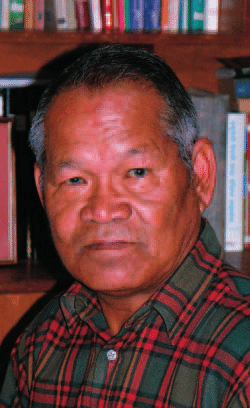
The evening news of September 23 about the missing helicopter carrying 24 people gripped me with a cramp like pain. When they were found dead two days later – after the crash site was located – my heart went aching. I have heard of many accidents, but this one just ripped me apart. It was a national tragedy and more so because of Dr. Harka Bahadur Gurung.
I knew him from my university days. Not that Harka Dai taught me, but as a friend of my brother, he used to visit our place often when we were living together in aj joint family. It was around 1970 when he was a member of the National Planning Commission. I remember having dinner with him quite a number of times at our place. My first impression was that he was a blend of naivete and sophistication transfixed into roughness and excellence. Interestingly, this is precisely what I found him throughout.
As the fourth son of a First World War veteran, Thula was born in 1939 in a small village called Taranche in Lamjung district in central Nepal. He grew up with Mother Nature, watching the mighty Marshyangdi River always in haste on one side and wondering what lay beyond the snow-capped summit of Manaslu and Himalchuli on the other. Thula’s oozing energy drove him to village adventures to be nature’s wild. However, his purposeful adventure began, as a child of nine, when he ran away from his home to follow a group of pensioners travelling to faraway Kathmandu, a good one week walk to cover over 130 kilometers from his home. What propelled him was his longing to go to school as the whole of Lamjung district then had none. He was a determined lad who found “Kathmandu was a discovery, and a new world had opened before him.” In a span of 17 years, this naive and rustic Thula from Taranche became a sophisticated Dr. Harka Bahadur Gurung in 1965 with a Ph.D. in Geography from Edinburgh University at the age of 26.
His ‘real world’ journey began when he left academics and joined the government in 1968 at the age of 29. For the next 10 years, he continued to be a member of the National Planning Commission, its Vice-Chairman and, finally, a state minister, which abruptly ended on November 26, 1978. He had to resign after being implicated in a legal case known as the carpet scandal. For an honest man, it was unbearable. True to his nature and unlike his other colleague, he even resigned as nominated member of the Rastriya Panchayat, the highest legislative body of king’s partyless system, and bade goodbye to King Birendra. This brought him into consultancy works with national and international organisations for 15 years before becoming the director of the Kuala Lumpur-based Asian and Pacific Development Centre in 1993 for four years. After that, he remained with New ERA.
Harka Gurung had the ‘feel’ of this country. When I use this term, I need to be careful in terms of how it is being understood, as words often tend to be deceptive the way literary theorists argue. Perhaps, every Nepali – foreigners for that matter even more – can talk about our poverty. And, high-priced foreign consultants working to alleviate our poverty can even write volumes about it. But not everybody can have the feel of it. To explicate further, all of us know that it pains when we get our fingers burnt. Unless one’s fingers are burnt, he does not get the feel of pain.
So this brings us to the dichotomous relationship between knowing and feeling. To be able to feel, say poverty, one must be exposed to its various dimensions. This is precisely where I found Harka Dai very tall. He got the ‘feel’ not just because he was a geographer, an academician, a planner, a state minister, an international consultant, a photographer, an artist, a sportsman, or because he was born in a village. Rather, it is because of his ability to interrelate the various dimensions of the Nepalese society, which is so diverse, so heterogeneous for a country of our size, amidst homogeneity when it comes to making a nation. I consider this as his forte. And, in this process, he came up with the concept of development axis and growth centre dividing Nepal into five development regions and shared his ‘feel’ or what he used to say “my version of Nepal with us by way of writing about a dozen books and an equal number of monographs.
From a planner, I saw him as a minister of state for Industry in Butwal. I vividly remember him in my office of the dairy industry along with his brother-in-law Lieutenant Colonel Pancha Bahadur Gurung who was in command of the battalion at the Ramnagar Barrack at Butwal. The next time, when I was involved in the campaign for multiparty democracy in the national referendum that brought me to Kathmandu, I met him often in his office at Malla Travels & Tours where he had started working as an advisor after leaving the government. My brother and I also visited him in his rented house somewhere in Baneswor. That was the difficult period of his life as he was fighting his legal battle. For a person of impeccable honesty, the way Harka Gurung was, I was not surprised that he was implicated in the carpet scandal. We all know that Nepal’s history is also of Bhimsen Thapa and Bhim Malla, and for that matter even my father’s. Honest people do suffer here while the corrupt are eulogised and even raised to the seventh heaven.
Then came the time meeting him in his scantily furnished New ERA office. The last time I had met him was on August 18, 2006, a Friday. It was at a programme to mark the release of Void, a compilation of my poems originally written in English. A day earlier when I telephoned him, before I could speak anything, he said, “Bhai, I’ve received your card. I can come only for 50 minutes because I have invited members of the parliament belonging to the ethnic community at the Hyatt Regency at 5 p.m.”
Here I remember the concluding line of Pearl S. Buck’s The Good Earth: Out of the land he came and into it he went. This is the story of Harka Dai who came from Lamjung’s Taranche set amidst mountains and rivers in the west and went into the mountain of Taplejung’s Ghunsa in the east. In 2001, in the death of a hero, Babu Chhiri, whom I never knew but was so saddened, I had expressed thus: “It is not tranquil, it is painful. Beneath lies the void. This void can never be filled because Babu is no more. He left making the mountains lonely and breathless.” But Harka Dai was intimately known to me. What words do I have to express my grief? None. All I can say is let the worthy son of this land, the way Harka Dai was, always inspire us to safeguard the sensibility of this country that is so dear to us. The article was first published in The Rising Nepal dated October 6, 2006.