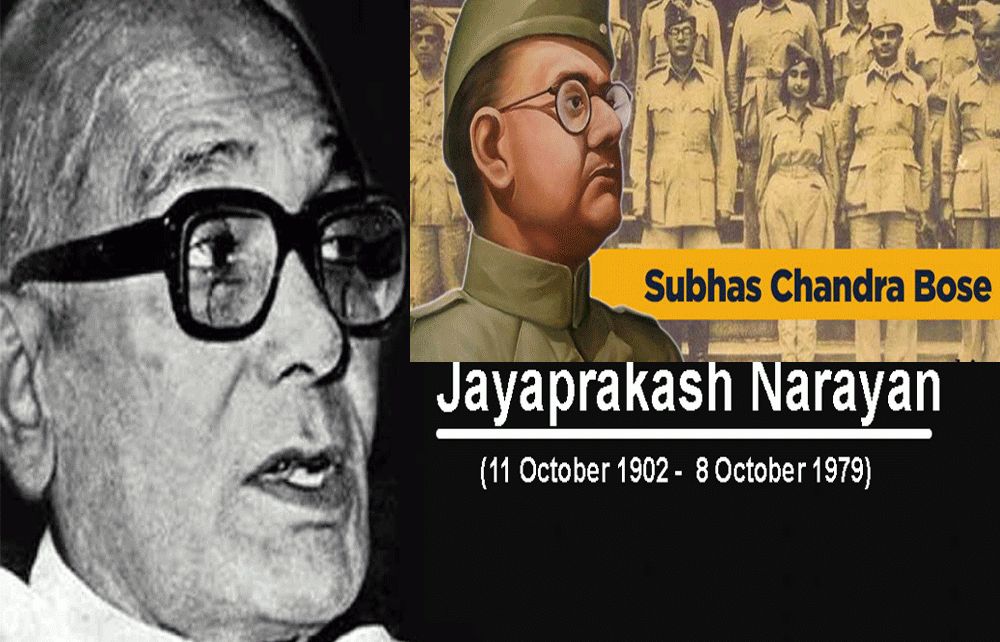
When the legacies of the icons of Gandhi-Nehru family were foisted upon the nation as the summum bonum of the republic, the priceless legacies of the most deserving leaders was mischievously buried in the sands.
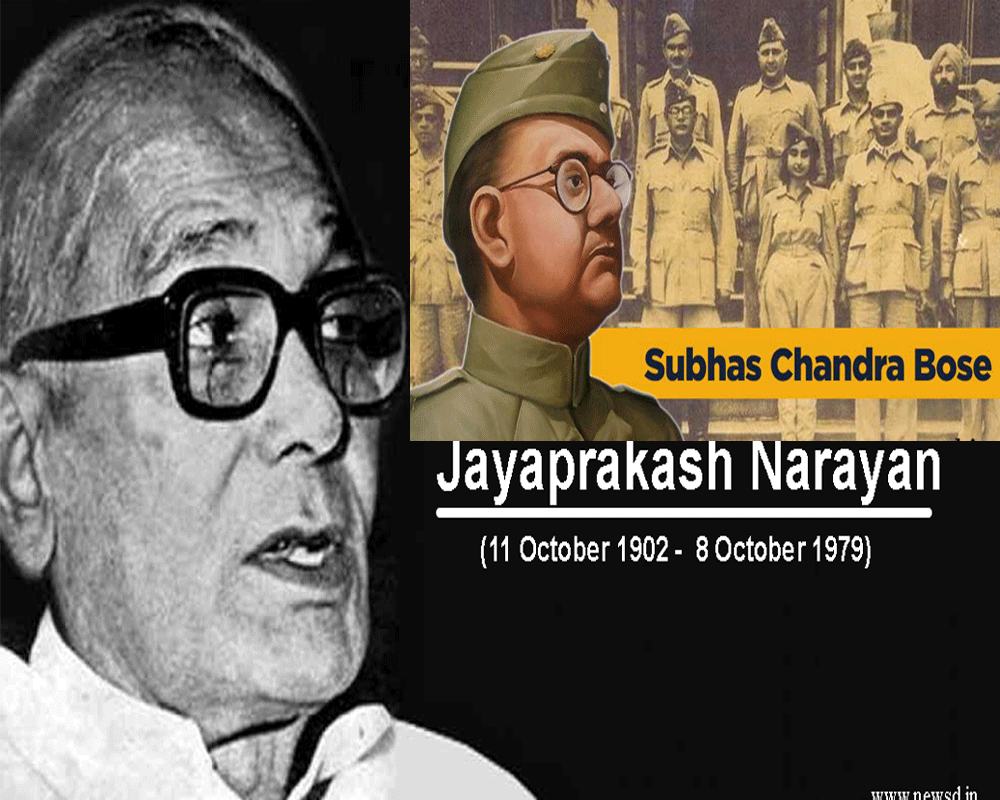
Vivekanand Jha,Ranchi. 11th of October had passed by, yet there was hardly any buzz around it. In fact, the nation hardly took a cognizance of the historical significance of the day that was the witness to one of the greatest world figures to have been born and consecrated Bharat Varsha. 11th October, in fact, is the birth anniversary of Loknayak Jayaprakash Narayan. Worse still, such has been the degree of magnitude of the sheer insensitivity of the governments, since decades, that this auspicious day was blatantly glossed over, in fact, allowed to pass off as any normal day, no significant effort was made to educate the nation, the current generation and even posterity, as to who this phenomenon was, who dared to lock horns with the dark lengthening shadow of fascism that had engulfed the nation in its demonic tentacles. In fact, Jayaprakash Narayan was the one who gave India her second freedom from the clutches of the fascist rulers. Indubitably, had Jayaprakash not been there, India, in all probability, would have been a different country today, matching shoulder with its neighbours like Pakistan, Myanmar, China and other countries ruled by the fascists and dictators.
It was the thumping victory of Indira Gandhi, in the wake of the liberation of Bangladesh, which, while it was the celebration for the nation, which was self-manifest in form of an overwhelming majority that Congress Party, under Indira Gandhi, had secured- winning 351 seats in the Lok Sabha. While nation was immersed in celebrating this new triumph, Jayaprakash Narayan was the only exception who could dare to foresee the ominous foreboding that Indira Gandhi’s overwhelming triumph held for the future of the nation. No wonder what followed, virtually shook the national conscience, it upended the hitherto institutionalised values that Pundit Jawaharlal, Indira’s father, despite his glaring omissions and commissions, had taken such humongous pain to institutionalise. No wonder, Indira Gandhi, in no time, in the wake of Allahabad High Court verdict, which had disqualified her electoral victory from Rai Bareily, sought to subvert, in order to ensconce herself more firmly in the power citadel. Putting the institutional values of Parliamentary democracy to shreds, Indira Gandhi did everything to pulverise judiciary, a constitutional watchdog, so as to make it subservient to her individual whims and fancy. The famous Keshavanand Bharti case where Supreme Court, albeit for the first time, had constituted thirteen judges bench to hear the vital argument whether the basic structure of Indian Constitution was amenable to changes. Consequently, when it became obvious to the fascist ruler then that, despite exercising ‘Carrot and Stick’ policy, which is a crucial tool in the hands of dictators, of every age and era, Indira Gandhi failed drastically to doctor the apex court’s verdict the way she wanted, she was finally left with little option but to suspend Indian constitution and seize power from the backdoor.
It was against the backdrop of the overwhelming challenge to stop the march of the fascists towards attaining their ulterior objective, there arose the leader of the nation, Jayaprakash Narayan, already a septugenarian, physically frail, yet mentally agile, to challenge Indira’s excesses. In fact, Students Movements were built to challenge the frenzied moves of the dictators whose whilsicalities resulted in the blowing into smithereens the time tested values of Indian democracy. 18th of March, a historic day in the calender of the nation when Jayaprakash Narayan had given a clarion call to encircle Bihar Vidhan Sabha when tens of thousands of people had joined him. The police had lathicharged, resulted in the severe injury to Nana Deshmukh, the senior Bharatiya Jan Sangh leader, even Jayaprakash was attacked on his head, the brunt of injury was borne by his bodyguard. Thus, Indira Gandhi imposed Emergency upon the nation, suspending the constitution of India. Jayaprakash and all senior opposition leaders like Atal Bihari Vajpayee, Chandra Shekhar, Lal Krishna Advani, Charan Singh and others were arrested. However, Indira Gandhi, finally had to beat the hasty retreat, defeated by the irrevocable resolve of Jayaprakash, had to withdraw the proclamation of Emergency, whereupon democracy was reinstated.
But then such a great leader who gave India her second freedom, was forgotten in no time. Even, the movie made on him by the director-producer Prakash Jha, by the name Loknayak, was simply a damp squib, the Congress Party, yet again on power, censured it to make Jayalrakash appear as an apologist. Worse still, his Centenary celebration, falling in the year 2002, despite Atal Bihari Vajpayee being in power, was soft-pedaled, allowed to pass off silently. Because none was interested to foster the priceless legacy of India’s greatest leader in the post -independence phase. Regrettably, the children are taught about the glory of fascist Indira, and the mythical bravery of Narendra Modi in his childhood days when he had fought with a crocodile, there is no trace of Jayaprakash in the syllabus. RSS too is least interested in preserving or fostering his glorious legacy since his towering stature eclipses all of Sangh’s stalwart leaders. Nation, unfortunately though, has been extremely unkind to India’s greatest figure since post-independence phase.
Netajee Subhas Chandra Bose, unequivocally, India’s greatest freedom fighter, too, never got his due by his own progenies. Significantly, even the decades gone by, none of the Prime Ministers ever bothered to de-classify the files pertaining to the mysterious disappearance of Subhas Chandra Bose. Even, Narendra Modijee had promised the nation, especially to the family members of Netajee Subhas Chandra Bose, that, soon ascending the highest political position of the land, he will do the needful, yet the situation stands where it was. Landing at Singapore, straight from Tokyo, the immortal leader was welcomed with the song that was never sung for anyone else, when Jhansi brigade, the first women brigade in Asia, had given him a rousing welcome by singing this immortal song: ‘ Subhasjee, Subhasjee, ae shanay Hind aa gayay, hai naaz jisko Hind par, wo naaze Hind aa gayay’. Ironically, this ungrateful nation, had given the legacy of an immortal freedom fighter a most undesirable decent burial. Worse still, the traitorous Communist party, always in thrall of its extra constitutional loyalty, for decades continued to call him ‘ burjua’ unless of course, the patriarch Jyoti Basu had the good sense to seek a public apology for the same. In hindsight, what comes out as the most painful fact is this: while the legacies of Gandhi-Nehru family, far inconsequential than that of Netajee Subhas Chandra Bose and Loknayak Jayaprakash Narayan, were foisted upon this nation by the Congress Party ruled by the dynasty, the priceless legacies of these great leaders were mischievously buried in sands.