China is doing all this work to strengthen its strength and to put
pressure on India, of which Nepal is also becoming a part, although thegovernment has always been saying that Nepal will not allow its soil to beused for anti-India activities. The unseen truth is that it is just happening.It has been Chinese policy to show its supremacy by giving loans andthen creating situations to coerce the other party to come to its knees,
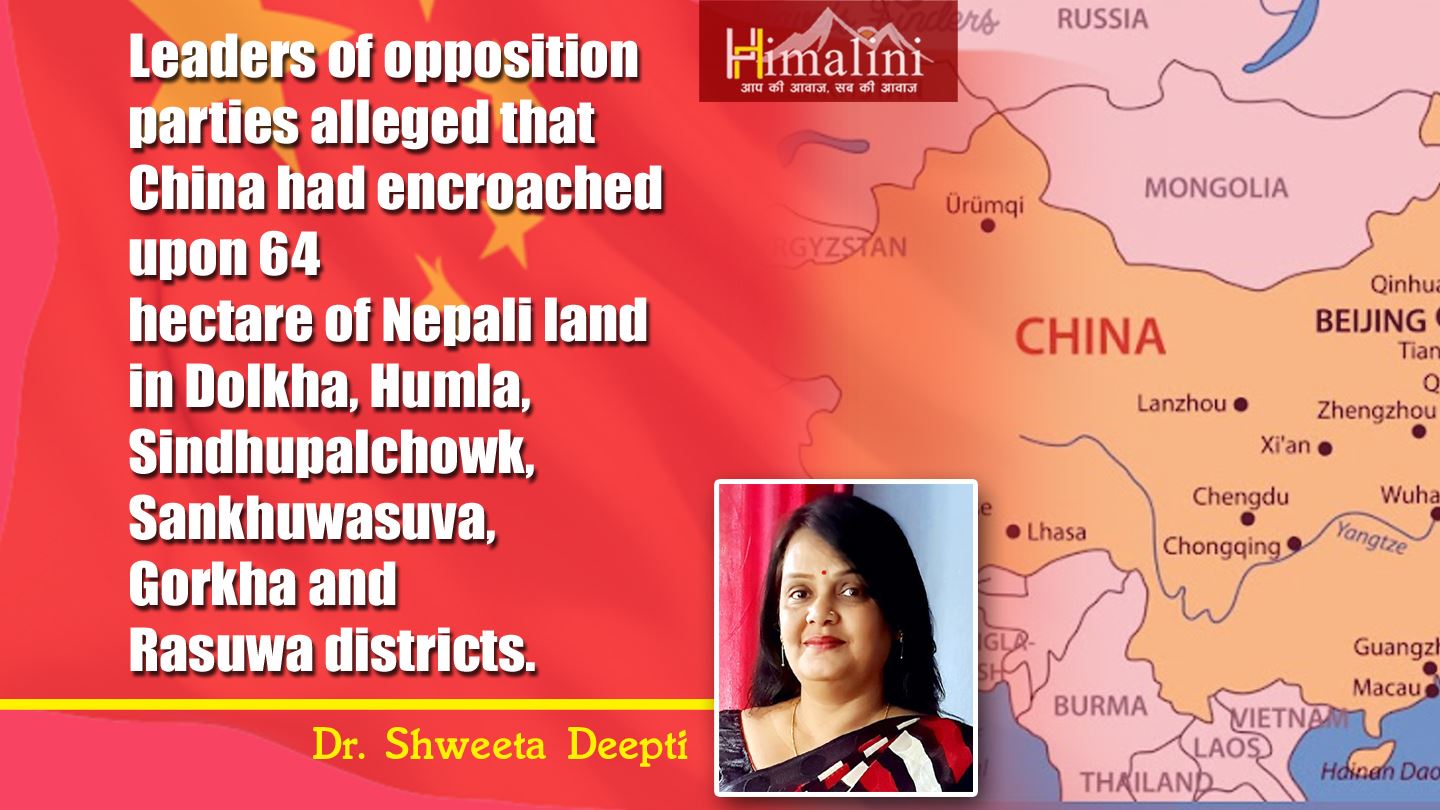
Dr.Shweta Deepti, (Editor of Himalini) Kathmandu.
Nepal-China border dispute is once again a hot topic in politcal
corridors of Nepal. It is difficult to say how long will it last this time. Because,
it is all a part of politics, where, although committees on various issues are
constituted but their reports are either delayed or related files are lost.
Current Deuba regime has announced the constitution of a high-level
committee to investigate Chinese encroachment on Nepal’s land. This
committee will submit a report on all the disputes related to border with
China. ( It is now submitted but not Disclosed ) Last year, when China was engaged in a violent stand-off with India in
Galwan, the issue of Chinese encroachment of Nepal’s land in Humla
surfaced during that time. That time also, a committee was constituted but
the members of the committee were not allowed to reach disputed area and
they had to return from half of the way. The then Prime Minister Mr. KP Sharma
Oli had then categorically rejected allegations of land encroachment by
China saying there was no dispute with China on border issue. Even the
report of the committee was not made public. That time, China asserted that
it had not constructed any building on Nepal’s land and the construction
took place only in Burang County of Tibet Autonomous Region. Chinese state media Global Times then wrote that there were faults in
border determination. Nepal’s survey officers were not properly trained
and are non-professional. China had published a map depicting Pillar No.
11 & 12 through its mouthpiece Global Times.
The Nepal Govt has been at odds with China over border issue since
2005. Due to this dispute, Nepal had also called off talks related to border
issue in 2012. Issue of Humla is not new. China has undertaken many of
such mischievous activities on bordering areas of Nepal and has constructed
permanent structures and roads on Nepal’s land. News of China’s enclosing
of Rui Village of Gorkha district of Nepal also surfaced which caused much
uproar. The opposition party Nepali Congress then moved a resolution in the
lower house of Nepal’s parliament urging Oli Government to take back the
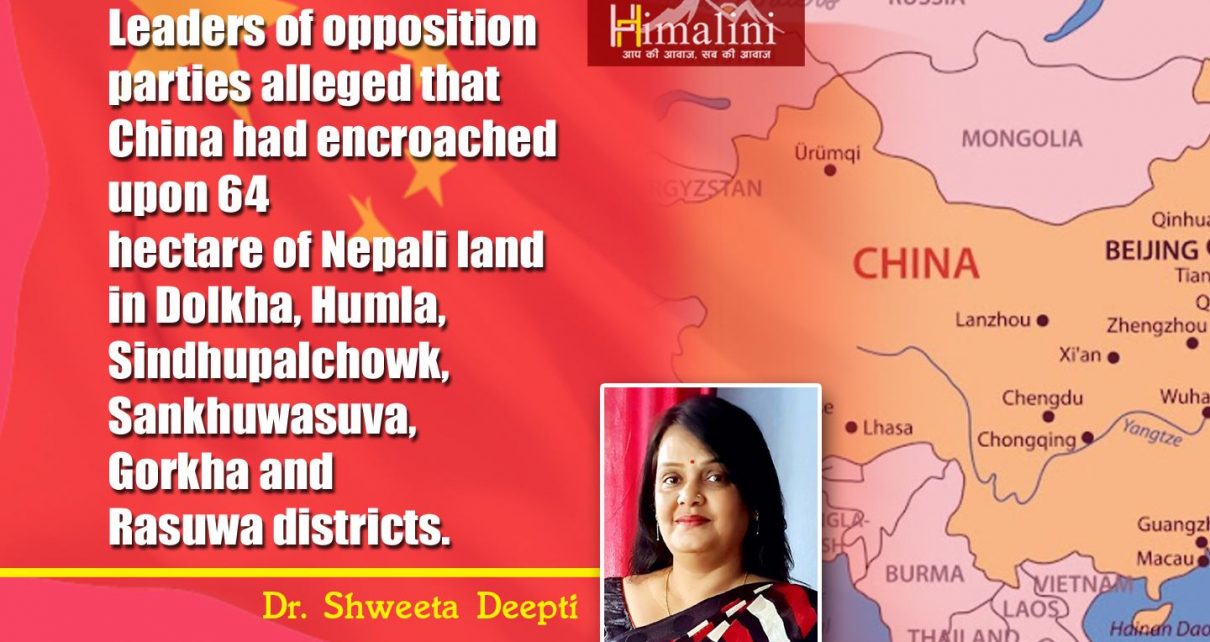
encroached land from China. Leaders of opposition parties alleged that
China had encroached upon 64 hectare of Nepali land in Dolkha, Humla,
Sindhupalchowk, Sankhuwasuva, Gorkha and Rasuwa districts. Around 18
pillars are missing and many are pushed into Nepali territory along the
1414.88 km-long border between Nepal and China. However, at that time
the then Foreign Minister of Nepal Pradeep Gyawali had plainly denied
encroachment by China on any territory of Nepal and said that Nepal had no
dispute with China regarding the border.
It is already known that border determination between Nepal and China took
place in 1960 with the mutual consent of both sides. After this a border
agreement was reached between the two sides in 1961 and pillars were
installed on the border. Many changes took place since then but the
borderline remained unchanged. Latter 76 permanent pillars
were also installed on the border of both the countries. With emerging
developments China is trying to change the status quo.
Recently, during the last government, a report was prepared by Survey
Department of Agriculture Ministry which showed 10 bordering places out
of 11 had been encroached by China. Nepal government then
suspected China of encamping its military post there in times to come. An
ANI news report showed that China was stepping up its road network in
Tibet region causing many rivers and their tributaries to change their course
towards Nepal which has resulted in curtailed border. It was feared that
if this situation continued, a large part of Nepali territory would be added in
Tibet. According to survey report, the construction work by China near
border has changed the course of Bagder and Karnali rivers, due to which
10 hectares land in Humla district of Nepal has been encroached upon by
China. Similary, China has encroached 06 hectares of land in Rasuwa
district. In Sankhuwasabha district also, China has encroached 9 hectares
land due to change in the course of river, and it claims additional 11 hectares
land as part of Tibet region.
According to sources, China has resorted to encroachments in Lapcha
and Limi areas of Humla. This area is of very strategic importance which is
near the way to Kailash Mansarovar. Ten years ago, when a road was
constructed there, China built a structure. When Nepal objected to it, China
dubbed this building as veterinary hospital saying this was significantly
useful for both the nations. Lapcha-Limi is a faraway region of the country
and lacks effective administration. Taking advantage of this, China
constructed buildings and it has now openly made clear that the land does
not belong to Nepal. According to sources, for months China has been
constructing roads in Tibet under its jurisdiction. This has caused some
rivers flowing in Nepal to change their course. This situation has created a
favorable environment for China to encroach upon Nepali land.
China claims that the land on which the river flows in its territory,
belongs to it. If this situation continued, hundreds of hectares Nepali land
will be lost. Because China’s has already reached to Nepal’s mountains, plains and rivers.
China ambition to become superpower of the world
The world is familiar with the expansionist policy of China. It has been
China’s policy to extend loans in the name of cooperation and development
and gradually exerting its strong influence over the borrowing country. It is
due to this policy that China is supporting the notorious Taliban which is
considered synonym of the terror in the world and in this China has a
support of a nation which has already ceded its territories to China reeling
under its loans. China has all praised the Taliban and said that they have
changed now but the Taliban have started to showing their true colors.
China’s history shows that it has always resorted to expansionist policy
by means of power and weapons irrespective of any regime – monarchy,
republic and communist – it followed. Many ancient dynasties of China
extended the borders of the country to Korea, Vietnam, Mangolia and Central
Asia. This expansionist policy of China got even more aggressive when the
Communist regime was established in the leadership of Mao Tse Tung in
1949. Mao said, ‘power grows out from the barrels of a gun’. Mao assured his
countrymen that People’s Liberation Army would certainly recover the
territories that were part of ancient China. After this China started to expand
its boundaries by resorting to any means whatsoever. Not only China claims
the territories of its 14 neighbors but also lays a claim on the US-owned
Hawaii Island situated 8000 Kms away. According to Chinese, Chinese
sailors had discovered America well before Columbus did. Rock paintings of
New Maxico state of the US attest to this. This is not all, china asserts that
its sailors had settled in Australia centuries before the European could
discover it. As many as 23 countries all over the world are troubled by
sinister designs of China as it considers war integral to its expansionist
policy.
China has got the most neighbors in the world and it shares border
with 14 countries. Geography has endowed it greatly but the growing hunger
for land is getting it in conflict with each of its neighbors. Not only India but
22 other countries of the world are piqued by this.
A look at those countries of the world which are becoming victims of
China’s expansionist policy:
Afghanistan: China claims the Badakhshan province of Afghanistan.
Despite the 1963 treaty, it has encroached upon the province.
Bhutan: China claims the territory of Cherpik Gompa, Dho, Dangmar, Gesur
Doklam, Sichulang, Dramna and Ha districts of Bhutan as its own. China
has also infiltrated Bhutan.
Brunei: China claims the Spratly Island of Brunei in the South China Sea.
Myanmar: China says that Burma was under China under the rule of the
Yuan Dynasty (1271–1368). China also has a border dispute with Myanmar.
Cambodia: According to China, Cambodia was part of China during the Ming
dynasty (1368–1644). That is why China has been claiming its large land.
India: China has been infiltrating Sikkim, Arunachal Pradesh and Ladakh.
After the 1962 war, China occupied 38,000 square kilometrs land of India.
Indonesia: China has been claiming Indonesia’s Natuna Islands in the
South China Sea.
Japan: China also claims the Senkaku island of Japan in the East China
Sea as its own.
Kazakhstan: China claims that Kazakhstan was part of it during the time of
Chinese Emperor Kublai Khan (1260–1294). China has been claiming a large
part of Kazakhstan.
Kyngystan: China also considers Kyngystan to be part of ancient China. It
alleges that in the 19th century Russia took its hegemony over it.
Laos: According to China, Laos was also part of it during the Yuan
Dynasty (1271–1368), So it has also a claim on the land of this country.
Malaysia: There are several islands in the Spratly Islands region in the South
China Sea. Different islands here are occupied by Malaysia, Vietnam, China,
Taiwan and the Philippines. China considers the island occupied by Malaysia
as its own.
Mongolia: China has also been claiming the land of Mongolia on the basis
of the Yuan dynasty (1271–1368) empire.
Nepal: Between 1788–1792 there was a war between China and Nepal. In
this war, China occupied many areas of Nepal.
North Korea: China has been claiming North Korea’s Baekdu Mountains
and Jiangdao on the basis of the Yuan Dynasty (1271–1368) empire.
Pakistan: Gilgit Baltistan of Pakistan Occupied by Kashmir and Shijiang
province of China meet each other. China laid its claim in this area. To
jeopardize India’s security, Pakistan gave land to China to build the
Karakoram road in the Shaksgam valley.
Philippines: China claims the Scarborough Shoal and Spratly Island of the
Philippines in the South China Sea as its own.
Russia: China has recently claimed that the city of Vladivostok in Russia
was part of China in 1820. It has been claiming thousands of square
kilometers of land in Russia in the past as well.
Singapore: China also has a dispute with Singapore over some part of the
South China Sea.
Taiwan: According to the One China Theory, China considers Taiwan as its
part. When communist rule was established in China in 1949, the then
Chinese ruler Chang Kaishek formed his government-in-exile in Taiwan.
Taiwan considers itself an independent country and China has been
rejecting the claim.
Tajikistan: China has also been claiming Tajikistan on the basis of the rule
of the Ching dynasty (1644–1912).
Vietnam: According to China, Vietnam was under China during the Ming
Dynasty (1368–1644). Apart from this, China also considers its right over
the Paracel Island of Vietnam.
South Korea: South Korea has rights over many islands in the East China
Sea. But China considers it its own.
Not only this, China has forced many countries under its debt policy to
make them surrender to it. China had invested Rs 36,480 crore in Sri
Lanka’s Hambantota port, airport, coal power plant, road construction. In
2016, this debt increased to Rs 45,600 crore. Sri Lanka could not repay this
debt and due to this it had to lease the Hambantota port to China for 99
years, that is, many generations of Sri Lanka have become financially slaves
of China.
The situation in Pakistan is somewhat similar. Growing proximity of
Pakistan to China to play hostile to India, has given rise to its plight. China
has invested Rs 4.56 lakh crore in Pakistan’s CPEC project. A large amount
of it is in the form of debt with interest rate of 7%. China wants to build a
naval base near Gwadar Port of Pakistan. China considers Pakistan as its
most important partner.
Many important projects of China are going on here. But among these, the
China-Pakistan Economic Corridor is the most important and biggest
investment project. It is expected to involve an investment of more than $62
billion. CPEC is in the heart of Balochistan. But the citizens there consider
this project to be a repressive policy of the government and China. Pakistan
is also reeling under the huge debt of China. Troubled by rising debt,
Pakistan always looks to international institutions for debt.
China had tied up with Bangladesh in the BRI project. China has invested
Rs 2.89 lakh crore in Bangladesh and now Bangladesh has also come to
know about China’s intention.
Maldives leased 16 islands to Chinese companies in 2016. Now China is
doing construction work on these islands. So that the Indian Ocean, Arabian
Sea and Bay of Bengal can keep an eye on international trade and India.
Obviously, China is doing all this work to strengthen its strength and to put
pressure on India, of which Nepal is also becoming a part, although the
government has always been saying that Nepal will not allow its soil to be
used for anti-India activities. The unseen truth is that it is just happening.
It has been Chinese policy to show its supremacy by giving loans and
then creating situations to coerce the other party to come to its knees, on
one hand, and creating disputes with all its neighbours on the other hand
the instance of which is before us. Despite this, if a country gives China an
opportunity to hold its hand, then it will definitely capture the whole body,
the ground reality shows this.
In such circumstances, if the Deuba government has taken any
initiative, it should certainly be appreciated. But the fear of the Nepali people
persists whether our government will really be able to put pressure on China
or this announcement too will be reduced to mere formality. We can certainly
expect our government not to keep the country hostage in the name of
development and create an environment to present its side strongly with
regard to the border dispute whether it is with India or with China. People
expect that Nepal will stand firm before China.
(The article was first published in the September issue of Himalini in Hindi. Here is the translation from Hindi. : Publisher )