
From the Supreme Court to the Prime Minister’s Office, a widening investigation raises serious questions about political influence, judicial independence and police autonomy.

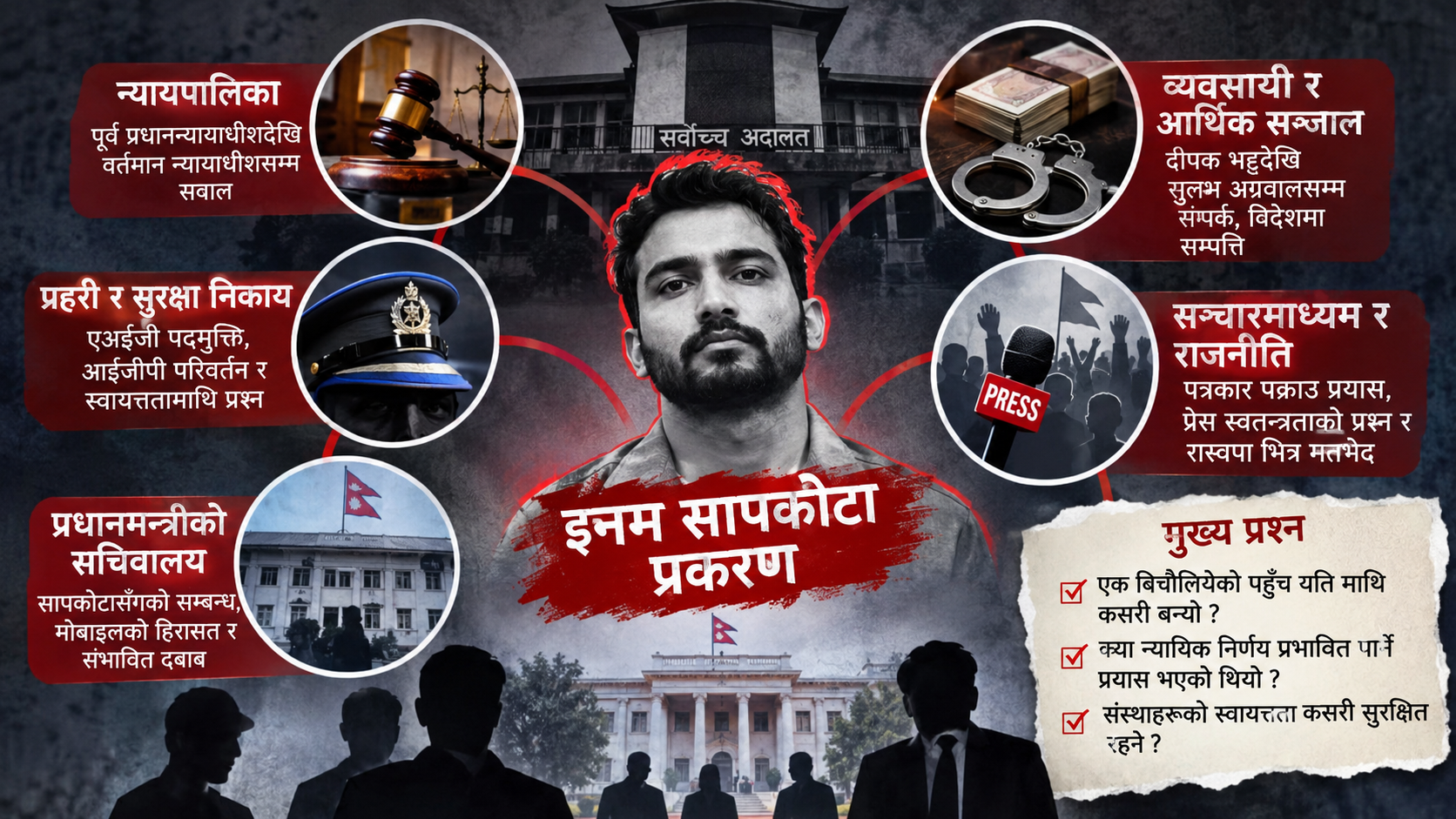
HIMALINI DESK, KATHMANDU, 5 November.nNepal’s political and institutional establishment is facing mounting scrutiny following the arrest of Inam Sapkota, a 31-year-old alleged power broker whose reported connections have reached the judiciary, police leadership, political circles and business community.
What began as an investigation into one individual has developed into a major controversy involving former and serving judges, senior security officials, the Prime Minister’s Secretariat and media freedom.
Here are five major developments that have shaken Nepal’s power structure.
1. Judiciary Under Scrutiny
The controversy intensified after former Chief Justice Cholendra Shumsher Rana was taken from his residence to a police office late at night on September 27. Police later said he had been taken into protective custody and released him the following day.
Investigators reportedly discovered repeated communications between Rana and Sapkota. Subsequently, WhatsApp exchanges between Sapkota and sitting Supreme Court Justice Hari Prasad Phuyal also became public.
Phuyal acknowledged meeting Sapkota along with four other judges but denied any financial dealings or attempts to influence judicial decisions. Chief Justice Manoj Kumar Sharma has also denied having any connection with Sapkota.
The developments have triggered demands for an impartial investigation and raised discussions about judicial accountability.
2. Police Leadership Shake-up
Armed Police Force AIG Banshiraj Dahal was dismissed following an investigation into his alleged communications with Sapkota and concerns over the handling of sensitive security information.
The controversy also engulfed Nepal Police Chief Dan Bahadur Karki. On November 4, the government removed him as Inspector General of Police (IGP), appointing Manoj KC as his successor.
Karki was subsequently assigned as the Prime Minister’s special security adviser. On November 5, he approached the Supreme Court challenging the government’s decision.
The development has raised questions about police independence and possible political interference in senior appointments.
3. Questions Surrounding the Prime Minister’s Office
Sapkota reportedly had access to individuals close to Prime Minister Balendra Shah despite holding no formal government position.
The Prime Minister’s chief adviser, Kumar Byanjankar, has alleged that Sapkota used the Prime Minister’s name and the Secretariat’s influence to advance various interests.
Questions also emerged after reports that the Prime Minister’s adviser held Sapkota’s mobile phone for two days following his arrest, raising concerns about the handling and preservation of potential digital evidence.
4. Business and Financial Connections
Investigators are examining Sapkota’s alleged role in attempts to secure relief for detained businessman Deepak Bhatt. Businessman Sulabh Agrawal and several political figures have also appeared in reports about his contact network.
Preliminary reports have raised questions about possible overseas assets and financial dealings involving Singapore and Dubai. These allegations remain subject to investigation.
5. Media Freedom and Political Fallout
The publication of alleged WhatsApp exchanges involving Sapkota and Justice Phuyal triggered attempts to detain journalists associated with reporting on the matter.
The ruling political establishment has also faced internal disagreements over whether judges linked to the controversy should face impeachment proceedings.
A Test for Nepal’s Institutions
The Sapkota investigation has become much more than a criminal case. It is testing the independence of Nepal’s judiciary, the professionalism of its security agencies, the accountability of political leadership and the protection of press freedom.
The central question remains: How could an individual without an official position reportedly establish such extensive access to the country’s most powerful institutions?
An independent, transparent and evidence-based investigation will be essential to establish the facts. Contact or communication alone does not establish criminal wrongdoing, and every individual is entitled to due process.
For Nepal, this is ultimately a test of institutional credibility and the rule of law.